• Skip to primary navigation
  • Skip to main content
  • Skip to primary sidebar
  • Skip to footer
Trending:
  • Kashmir
  • Elections
Friday, June 12, 2026

Daily Times

Your right to know

  • HOME
  • Latest
  • Iran-Israel war
  • Gilgit Baltistan Election
  • Pakistan
    • Balochistan
    • Gilgit Baltistan
    • Khyber Pakhtunkhwa
    • Punjab
    • Sindh
  • World
  • Editorials & Opinions
    • Editorials
    • Op-Eds
    • Commentary / Insight
    • Perspectives
    • Cartoons
    • Letters to the Editor
    • Featured
    • Blogs
      • Pakistan
      • World
      • Lifestyle
      • Culture
      • Sports
  • Business
  • Sports
  • E-PAPER
    • Lahore
    • Islamabad
    • Karachi

Agencies

Dinosaurs saw shorter days and longer years, says fossil shell study

Published on: March 15, 2020 10:59 PM

Time isn’t as constant as we might think. The Earth’s rotation is changing, which affects how many hours are in a day and how many days in a year. Now palaeontologists have managed to precisely measure how long days and years were back in the age of the dinosaurs – and it’s all thanks to a humble mollusk fossil.

Our everyday experience of time sounds simple enough: A day is one full rotation of the Earth on its axis, while a year is one full lap of the Sun. But those things don’t always take the same amount of time – astronomical factors are messing them up.

Although it sometimes feels like days pass faster as we get older and busier, it’s well documented that days are actually getting longer – though not by much. In fact, today will be roughly 1.8 milliseconds longer than this same day 100 years ago. That’s because the Moon is moving away from Earth at a rate of about 3.8 cm (1.5 in) per year, and the changing tidal forces are slowing down the speed of the Earth’s rotation. And a slower rotation, of course, means a longer day.

Previous studies have shown that about 1.4 billion years ago, a day lasted just 18 hours. That’s because the Moon was closer, making the Earth spin faster.

On the new study, the team was able to precisely measure the length of a day much later – about 70 million years ago. This was right at the height of the dinosaurs’ reign, 5 million years before the cataclysm that wiped out roughly three quarters of life on Earth.

Specifically, the team determined that at that time, a day was only 23.5 hours long. And because each day was half an hour shorter, more days could fit into one year – there were 372 days in a year back then, making it one week “longer” than we’re used to.

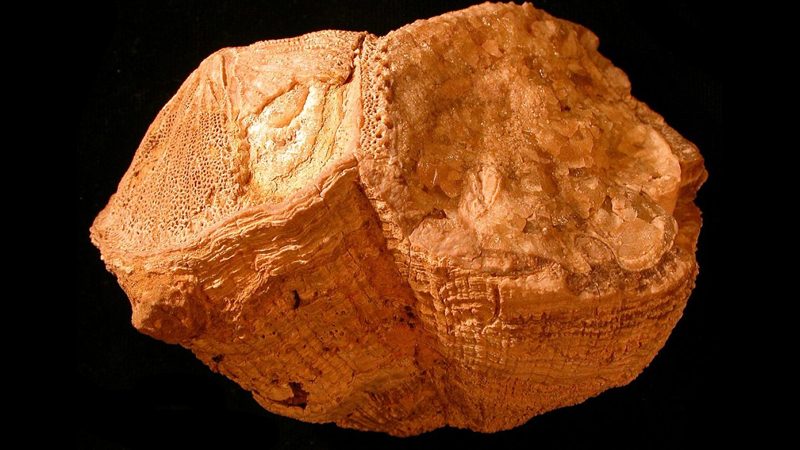
So how did the scientists figure this out? By studying a fast-growing, ancient mollusk. Torreites sanchezi is an extinct species of bivalve, a clam-like creature that lived in the oceans right up until that history-changing asteroid struck.

These things grew extremely quickly, adding several new calcite layers to their shells per day. Scientists can study these growth rings to get clues about the environment the mollusk at each stage. It’s similar to trees or layers of rock in the ground, but instead of years or millennia, the changes occur over mere hours.

“We have about four to five datapoints per day, and this is something that you almost never get in geological history,” says Niels de Winter, lead author of the study. “We can basically look at a day 70 million years ago. It’s pretty amazing.” The team focused the study on one particular specimen, which appeared to live for about nine years in a shallow tropical seabed. They used a laser to take tiny samples of the shell, and analyzed the trace elements found inside. This told them about the temperature and chemistry of the water that the bivalve lived in, and how that changed over time.

The analysis showed that the composition of the shell changed layer by layer, and it grew faster during daylight hours than at night. The researchers were able to see groups of layers that repeated in clear patterns, which indicated changing seasons. By carefully counting these layers, the team determined that there were 372 days in each yearly cycle.

They also discovered some more details about the kind of world these creatures lived in. For example, the oceans reached temperatures of up to 40 °C (104 °F) in summer and 30 °C (86 °F) in winter. That’s obviously much warmer than they are now, but it’s even warmer than previously thought for the time. The research was published in the journal Paleoceanography and Paleoclimatology.

Filed Under: Infotainment

Submit a Comment


Primary Sidebar


Latest News

Gulf of Oman oil tanker strike

Three Indians Killed After US Strike on Oil Tanker

Saudi archaeological discoveries.

Saudi Arabia Uncovers Ancient Discoveries Including Umar Inscription

US-Iran Peace Agreement

Trump Halts Planned Iran Strikes, Signals Deal Is Near

US-Iran Nuclear Agreement

Netanyahu Backs Trump’s Position on Proposed Iran Agreement

PTI Internal Dispute

Ali Amin Gandapur Criticizes PTI Statement as ‘Dictatorship’

Pakistan

PTI Internal Dispute

Ali Amin Gandapur Criticizes PTI Statement as ‘Dictatorship’

Karachi Power Outage

Karachi Residents Struggle as Power Outages Continue in Extreme Heat

Hangor-Class Submarine

First China-Built Hangor-Class Submarine Arrives in Karachi

Agriculture grows 2.89% despite floods

PM Shehbaz approves Pakistan Railways reform roadmap

More Posts from this Category

Business

Khyber pakhtunkhwa budget projected at Rs2.3tr for fiscal year

IMF agrees to drop solar panel tax hike

Pakistan budget 2026-27 unveiled with fiscal targets

Pakistan gold prices drop by over Rs9,000 per tola

Oil prices surge as US-Iran tensions threaten supplies

More Posts from this Category

World

Gulf of Oman oil tanker strike

Three Indians Killed After US Strike on Oil Tanker

Saudi archaeological discoveries.

Saudi Arabia Uncovers Ancient Discoveries Including Umar Inscription

US-Iran Peace Agreement

Trump Halts Planned Iran Strikes, Signals Deal Is Near

More Posts from this Category


Footer

Home
Lead Stories
Latest News
Editor’s Picks

Culture
Life & Style
Featured
Videos

Editorials
OP-EDS
Commentary
Advertise

Cartoons
Letters
Blogs
Privacy Policy

Contact
Company’s Financials
Investor Information
Terms & Conditions

Facebook
Twitter
Instagram
Youtube

© 2026 Daily Times. All rights reserved.

Manage Consent
To provide the best experiences, we use technologies like cookies to store and/or access device information. Consenting to these technologies will allow us to process data such as browsing behavior or unique IDs on this site. Not consenting or withdrawing consent, may adversely affect certain features and functions.
Functional Always active
The technical storage or access is strictly necessary for the legitimate purpose of enabling the use of a specific service explicitly requested by the subscriber or user, or for the sole purpose of carrying out the transmission of a communication over an electronic communications network.
Preferences
The technical storage or access is necessary for the legitimate purpose of storing preferences that are not requested by the subscriber or user.
Statistics
The technical storage or access that is used exclusively for statistical purposes. The technical storage or access that is used exclusively for anonymous statistical purposes. Without a subpoena, voluntary compliance on the part of your Internet Service Provider, or additional records from a third party, information stored or retrieved for this purpose alone cannot usually be used to identify you.
Marketing
The technical storage or access is required to create user profiles to send advertising, or to track the user on a website or across several websites for similar marketing purposes.
  • Manage options
  • Manage services
  • Manage {vendor_count} vendors
  • Read more about these purposes
View preferences
  • {title}
  • {title}
  • {title}
We use cookies to ensure that we give you the best experience on our website. If you continue to use this site we will assume that you are happy with it.