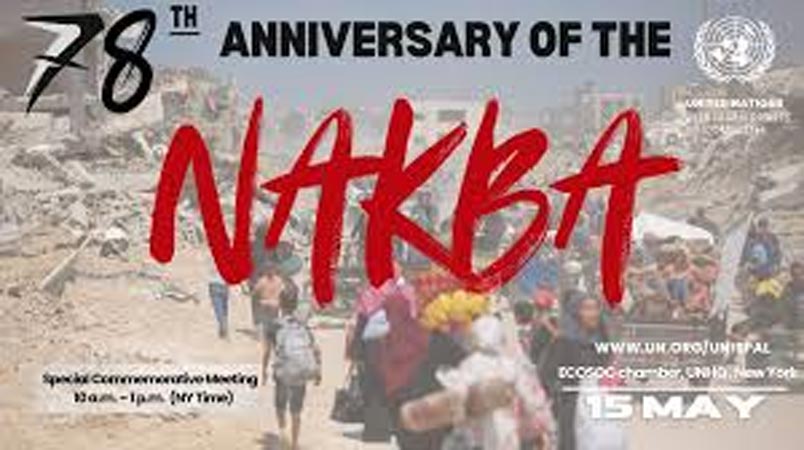
 Pakistan has reaffirmed its “unwavering” solidarity with the Palestinian people and their just struggle for self-determination at a special meeting marking the seventy-eighth anniversary of the Nakba – an Arabic word meaning “catastrophe” – held at UN Headquarters in New York.
(Nakba refers to the mass displacement and dispossession of Palestinians during the 1948 Arab-Israeli war. It involved the ethnic cleansing of about 750,000 to 800,000 Palestinians, the destruction of hundreds of villages, and the loss of their homeland.)
“Support for Palestine is etched in Pakistan’s own independence struggle,” Ambassador Asim Iftikhar Ahmad, permanent representative of Pakistan to the UN, told the meeting organized by the United Nations Palestinian Rights Committee, which heard testimonies from bereaved families and friends of victims – those killed during the events of 78 years ago, as well as in the ongoing conflict – including the mother of Hind Rajab, a five-year-old girl from Gaza, who has become a symbol of innocent lives lost amidst the Israeli war on the enclave.
“Tragically, for the Palestinians, the Nakba is not a closed chapter of history,” the Pakistani envoy said, adding, ” It is a continuing reality marked by occupation, displacement, dispossession and denial of rights.”
Deploring that the UN General Assembly resolution 194, which affirmed the right of return of Palestinian refugees, remains unfulfilled, Ambassador Asim Ahmad said millions of Palestinians continue to live in exile, with the temporary refugee camps having become symbols of prolonged statelessness and collective suffering.
“Today, as we commemorate the Nakba, we are also witnessing its most devastating contemporary manifestation in Gaza,” he said, pointing out that the enclave for two years endured devastating Israeli attacks with over, 70, 000 Palestinians killed, majority of them women and children.
“The overwhelming majority of Gaza’s population has been forcibly displaced multiple times, with nowhere safe to turn”, the Pakistani envoy said..
“The heart-wrenching killing of innocent children, including Hind Rajab, has come to symbolize the unbearable human cost of this tragedy.” At the same time, in the occupied West Bank, including East Jerusalem, illegal settlement expansion, settler violence, forced displacement, arbitrary restrictions and collective punishment continue unabated, he told the event.
The condemnable storming of the Al Aqsa Mosque by Israeli extremists is the most recent manifestation of the policy, where illegality and nefarious objectives are evident to alter the demographic and geographic character of the occupied Palestinian territory and to make Palestinian existence on their own land increasingly untenable.
UNRWA – created to hold the space for refugees’ return, remains indispensable for millions of Palestinian refugees, the Pakistani envoy said urging the international community to ensure its continued political and financial support.
“On this solemn anniversary, remembrance alone is not enough; The Nakba must not be allowed to continue into another generation. It must end through justice, accountability, and vacation of occupation.
“The only viable path to a just and durable peace is the realization of the legitimate rights of the Palestinian people, through the establishment of an independent, sovereign, and contiguous Palestinian State on the basis of the pre-1967 borders, with Al-Quds Al-Sharif as its capital,” Ambassador Asim Ahmad added.
The General Assembly President, Annalena Baerbock, urged Member States to recommit to the New York Declaration – the outcome of a high-level international conference on the peaceful settlement of the question of Palestine and the implementation of the two-State solution held in 2025.
She also urged Member States to “not lose sight of what’s going on right now in Gaza”, where the humanitarian situation remains catastrophic, access limited, and demand high, and where close to 800 Palestinians, including many children, have been killed since the announcement of the so-called ceasefire in October 2025.
The UN Assistant Secretary-General for the Middle East, Europe, the Americas, Asia and the Pacific at the UN Department of Political and Peacebuilding Affairs, Khaled Khiari, described the Nakba as “the world’s longest-standing protracted refugee crisis” – one that remains painfully unresolved. “Remembering the Nakba imposes responsibilities – not only of remembrance, but of action,” he said.
The path forward, he noted, is well-known and rooted in international law, relevant United Nations resolutions, and the collective commitments of the international community.
These include ending unlawful practices, protecting civilians, supporting Palestinian governance and institution-building, and reviving a credible political process towards a negotiated two-State solution, with Israel and Palestine living side by side in peace and security. If implemented comprehensively, the 20-point United States plan to end the Gaza conflict – endorsed by UN Security Council resolution 2803 (2025) – could offer a pathway towards addressing these longstanding issues, Khiari said.
The President of Palestine, Mahmoud Abbas – in remarks delivered by Riyad Mansour, Permanent Observer of Palestine – recalled that around 950,000 people were “forcibly and coercively expelled” from their homes, transformed into refugees amid efforts to “steal, falsify and erase their history and heritage”. The events are also characterized by widespread violence, including massacres and the destruction of “more than 531 towns and villages” that were once vibrant communities.
President Abbas underscored the central role of the Palestine Liberation Organization, which has “led the Palestinian struggle in all its forms; popular, political, legal and diplomatic”, helping to preserve national identity and achieve milestones, such as recognition of Palestine as a UN non-member observer State.
He further emphasized recent diplomatic developments, welcoming “President Trump’s plan for a ceasefire” and resolution 2803 (2025), alongside the growing international recognition of Palestine – now by 160 States. These developments, he noted, represent meaningful steps towards implementing the two-State solution and realizing “an independent and sovereign Palestinian State with East Jerusalem as its capital”.
Importance of National Unity; One State, One Government, One Law, One Weapon
Looking ahead, the Palestinian leader stressed the importance of reconstruction and national unity, reaffirming a vision of “one State, one Government, one law and one weapon” and calling for a complete Israeli withdrawal from Gaza. He described Gaza as an integral part of Palestine and emphasized the urgent need for rebuilding after “death, destruction, displacement and devastation”.
At the same time, he criticized Israel’s non-compliance with international law, noting that the UN has adopted “more than a thousand resolutions affirming the inalienable rights of the Palestinian people”, including resolutions 181 and 194, which he said Israel continues to disregard.
President Abbas affirmed that Palestinians “have the right to live in their homeland in freedom and dignity” and called on the international community to uphold these rights. He concluded by urging global recognition of the Nakba, warning that “nothing deepens tragedies more than denying them” and framing acknowledgment as essential to achieving justice and lasting peace.