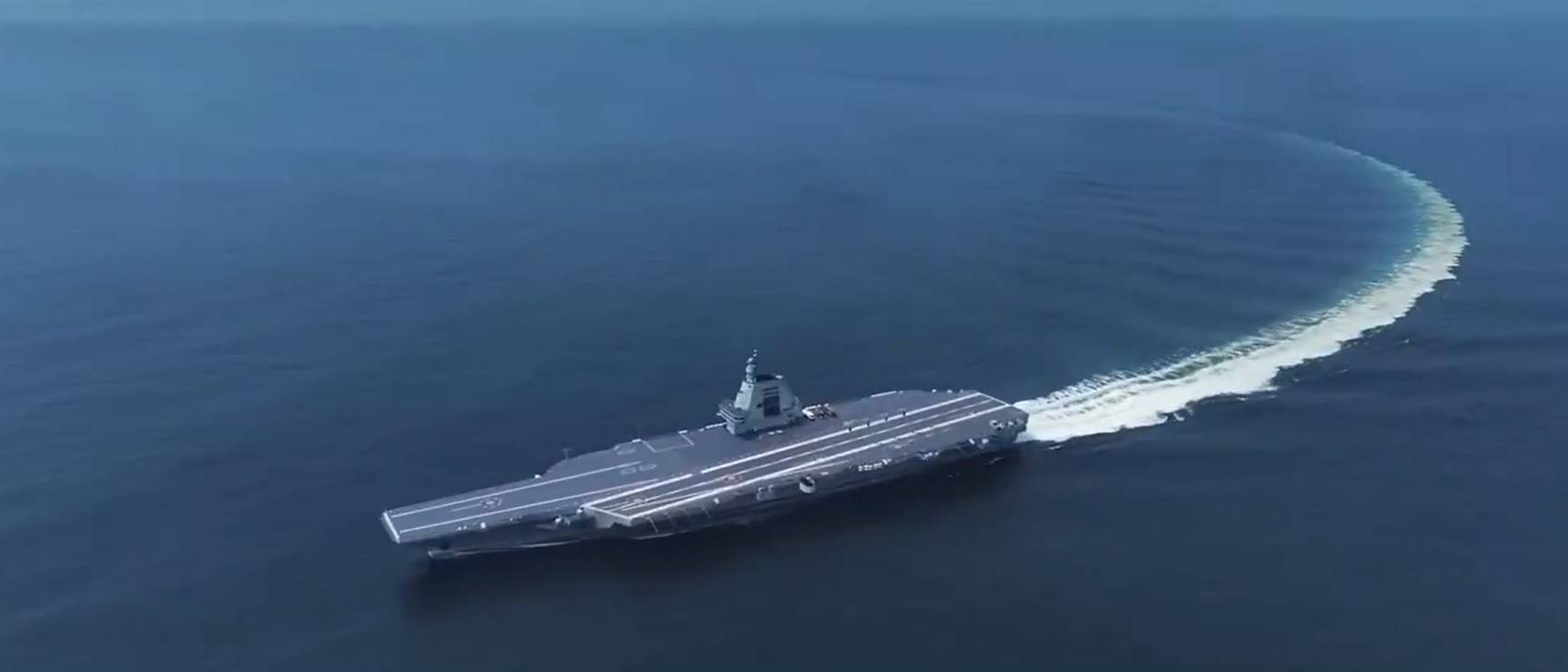
China has officially commissioned its third and most advanced aircraft carrier, Fujian, marking a major step in President Xi Jinping’s campaign to modernise the nation’s military and expand maritime influence. The commissioning ceremony took place at a naval port in Hainan province on Wednesday, with President Xi and top Communist Party officials in attendance. The event highlighted Beijing’s growing ambition to strengthen its naval power and challenge the U.S. and regional rivals across the Pacific and South China Sea.
Read more : Pakistan, China reaffirm resolve to deepen all-weather partnership
The Fujian joins China’s two existing aircraft carriers, the Liaoning and the Shandong, both of which have been pivotal in extending the country’s naval capabilities. Unlike its predecessors, the Fujian is equipped with an electromagnetic aircraft launch system (EMALS), a cutting-edge technology that allows jets to take off with heavier payloads and more fuel. This system, previously exclusive to the U.S. Navy’s USS Gerald R. Ford, demonstrates China’s significant leap in carrier technology and operational sophistication.
More than 2,000 personnel from the navy and construction units attended the handover ceremony, described by state media as “grand and enthusiastic.” Following the formal commissioning, President Xi boarded the carrier to review its systems and sign the ship’s logbook. He was also briefed on the vessel’s electromagnetic catapult system and flight operations, underscoring his personal involvement in the project’s development. Officials noted that Xi had personally approved the adoption of the EMALS system for the carrier’s design.
Read more : China unveils 2035 climate goals ahead of COP30
The Fujian has already completed multiple sea trials and gained international attention for sailing through the Taiwan Strait in September for “scientific research and training missions.” The transit, which brought the vessel close to disputed islands in the East China Sea, was widely viewed as a strategic message to Taiwan, Japan, and other regional powers. Analysts said the move demonstrated China’s growing confidence in deploying advanced naval assets in contested waters.
Equipped to launch fifth-generation J-35 stealth fighters, the Fujian represents a new level of power projection for the Chinese navy. Defence experts believe its addition will enhance Beijing’s capacity to conduct long-range operations, safeguard trade routes, and assert dominance in the Indo-Pacific region. As China continues pouring billions into defence modernisation, the carrier’s commissioning signals the country’s readiness to compete head-to-head with U.S. maritime forces in the years ahead.