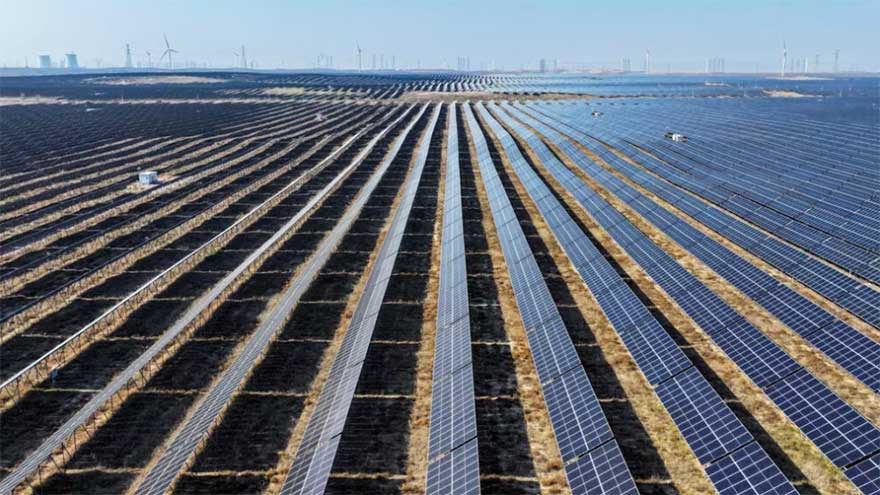
BANGKOK – China, the world’s largest emitter of greenhouse gases, is also leading the global shift toward clean energy by installing more renewable power and putting more electric vehicles on its roads than any other country. Ahead of the COP30 climate talks in Brazil, Beijing has outlined its latest climate commitments aimed at balancing growth with sustainability.
According to UN data, China emitted over 15.6 gigatons of carbon dioxide equivalent in 2024, accounting for more than 30 percent of global emissions. Although its per capita and historical emissions remain below those of the United States, they are rising rapidly. Coal still provides nearly 60 percent of China’s electricity, though new renewable projects are meeting much of the additional demand.
China also dominates the electric vehicle (EV) sector, producing over 70 percent of the world’s EVs. Nearly half of all new cars sold in China in 2024 were either electric or plug-in hybrids, according to the International Energy Agency (IEA).
Read More: Pakistan Climate Change and COP29
In September, Beijing announced its first numerical emissions reduction targets, pledging to cut greenhouse gases by 7–10 percent by 2035. Analysts suggest China may “underpromise but overachieve,” as it has done in past renewable energy commitments. The country aims to peak emissions by 2030 and achieve net-zero by 2060, though some experts believe emissions may already have plateaued.
China’s official climate roadmap, confirmed this week, outlines plans to increase solar and wind power capacity sixfold from 2020 levels — reaching 3,600 gigawatts (GW) by 2035. With current capacity at 1,482 GW, this would require annual installations of about 200 GW, a pace China already surpassed in 2024.
President Xi Jinping has also pledged to raise the share of non-fossil fuels in total energy consumption to over 30 percent by 2035 — a target experts say could easily be exceeded, with forecasts predicting 36 percent within a decade.
Read More: Climate Investment and Pakistan’s Road Map to Resilience
China’s emissions trading scheme (ETS), currently covering the power sector, will soon expand to heavy industries such as cement, steel, and aluminum, with plans to include additional sectors.
Beijing also committed to raising forest cover to 24 billion cubic metres by 2035, up from 20 billion today, in an effort to enhance carbon absorption.
UN climate chief Simon Stiell welcomed China’s updated roadmap as “a significant moment in our collective climate effort”, praising the country’s potential to drive global progress toward sustainability.