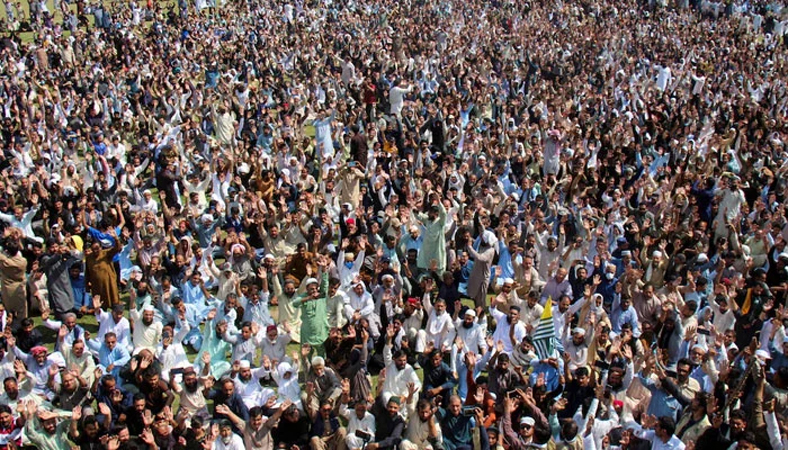
 The Azad Jammu and Kashmir (AJK) government on Friday formally banned Jammu Kashmir Joint Awami Action Committee (JAAC), declaring it a proscribed organisation under the Anti-Terrorism Act (ATA).
The AJK government’s Home Department also issued a notification and put JAAC in the First Schedule.
“Jammu Kashmir Joint Awami Action Committee (JK-JAAC), also known by names Joint Awami Action Committee (JAAC) and Awami Action Committee (AAC), is engaged in terrorism, acting in a manner prejudicial to the peace and security of the State, involved in creating anarchy in the State by intimidating the public, promoting hatred, and creating a sense of insecurity in society and the public at large,” the notification stated.
It further read that in exercise of powers conferred under Section 12 of the Azad Jammu and Kashmir Anti-Terrorism Act, 2014, the AJK president has accorded approval to list JK-JAAC, also known as Joint Awami Action Committee (JAAC) and Awami Action Committee (AAC), in the First Schedule of ATA 2014 as a proscribed organisation for the purposes of the said Act.
The development came days after JAAC announced a protest call for June 9. The JAAC has previously organised large-scale protests over economic issues and political rights, some of which turned violent and resulted in fatalities during clashes with law enforcement in May 2024 and September 2025.
Its latest protest campaign focuses on a demand to abolish the 12 seats in the Azad Jammu and Kashmir Legislative Assembly reserved for refugees from Indian Illegally Occupied Jammu and Kashmir (IIOJK) who migrated to Pakistan after 1947.
The AJK earlier in the day issued a travel advisory urging tourists and other visitors to avoid travelling to the region between June 5 and June 20 amid the planned protest of JAAC on June 9.
In its advisory, the AJK government advised travellers to postpone non-essential visits during the period. It also asked tourists currently visiting AJK for leisure or other purposes to leave the region by Saturday evening.
Meanwhile, the All Parties Conference (APC) held at the Prime Minister’s Secretariat in Muzaffarabad this week rejected the demand for the abolition of 12 seats reserved for refugees residing in Pakistan in the Legislative Assembly and made it clear that constitutional reforms are the exclusive prerogative and mandate of elected representatives of the people.
Pakistan’s Defence Khawaja Muhammad Asif has said that demands to abolish the 12 seats in the Kashmir Assembly reserved for Kashmiri voters residing in Pakistan are tantamount to an attempt to undermine and disrupt the electoral process.
This demand, made ahead of the upcoming elections, is tantamount to sabotaging the electoral process, the defence minister wrote on his social media platform X.
He said that in Sialkot city and tehsil, there is one seat in the Azad Kashmir Assembly and two seats in the National Assembly, while the remaining Kashmir Assembly constituencies are spread across Pakistan.
The defence minister went on to say that in October 1947, these migrants settled in Sialkot city and tehsil after sacrificing over 200,000 lives. “The modesty of hundreds of thousands of women was outraged, and thousands of daughters were abducted. How can these migrants be deprived of their rightful representation?” he questioned.
Meanwhile, the schedule for general elections in AJK has been announced on Friday according to that polling will be held on July 27.
Chief Election Commissioner Justice (R) Ghulam Mustafa Mughal, accompanied by Election Commission Member Syed Nazir-ul-Hasan Gilani and Secretary Election Commission Raja Shakeel Khan, announced the election schedule during a press conference. He stated that elections for 45 directly elected seats of Legislative Assembly will be held on July 27, 2026.
To ensure a free, fair, and transparent electoral process, personnel from the Pakistan Army, Rangers, Police, and other paramilitary forces will be deployed. The Chief Election Commissioner further announced a ban on new appointments, transfers, and the initiation of new development projects.
Meanwhile, the 41st meeting of the Azad Jammu and Kashmir Cabinet was held on Friday with Prime Minister Faisal Mumtaz Rathore in the chair.
Regarding regularization of ad hoc, temporary and contract employees serving against regular budgeted posts, the meeting decided to introduce legislation in the state legislature. Moreover, the cabinet approved the regularisation of 878 Grade-I Beldars in permanent basis and the upgradation of District Food Controller (DFC) posts to Grade-17 with effect from July 1.
Amendments were also approved to the Schools Education Package, including the readjustment of posts, upgradation of educational institutions, and changes in staffing patterns in certain schools. The cabinet approved the transfer of the powers of the Chairman Environmental Tribunal and the Chairman Appellate Tribunal MDA to District and Sessions Judges.
The cabinet approved amendments to the Criminal Law Act 2024 aimed at strengthening measures against cybercrime, as well as the Agriculture Pesticides Act to curb the use of substandard pesticides and agricultural chemicals.
To support the development of these key sectors, a comprehensive five-year Agriculture, Livestock and Irrigation Roadmap (2026-2031) was also approved.