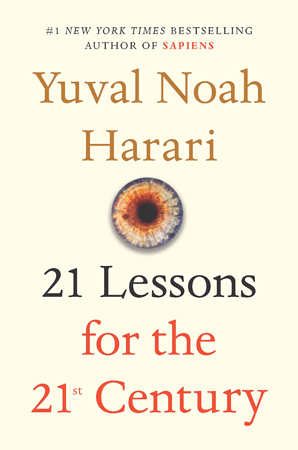
 Yuval Noah Harari became popular after writing two exceptional books, Homo Deus and Sapiens, about the human species’ history and future.
His latest book, “21 Lessons for the Twenty-First Century,” focuses on the current, with Twenty-One brief examines covering the most important problems we are facing nowadays, such as employment, equality, globalization, politics, justice, post-truth, and education. Most of Harari’s notable issues, such as the rise of AI and data, the fiction of systems influencing our social systems, and the downfall of democracy, are addressed in this book.
These issues had already been raised and debated in his previous books, as well as in several subsequent lectures and journals. However, framing these questions as either a retrospective or a prognosis made the risks, they pose appear theoretical and hypothetical.
Harari’s analyses in this book are grounded in the present. The gravity of the situation – for example, drastic shifts in social systems, where the greatest risk to the majority of humans is becoming “irrelevant”; the end of democracy; the transformation of racism into culturalism – will be an easy target for a doom and gloom scenario. Harari manages in offering us a steady, objective outlook on the ramifications of what we’re seeing around nowadays without succumbing to excessive optimism. It can be frightening, but his first piece of advice is just not to succumb to fear. The chapter on terrorism, for example, is a great essay on how fear is not a decision-making system. Harari does not ignore the danger of terrorism but also gives convincing counter-arguments to the fear that terrorism tends to instil.
Harari’s analysis in this book are grounded in the present. The gravity of the situation — for example, drastic shifts in social systems, where the greatest risk to the majority of humans is becoming ‘irrelevant’; the end of democracy; the transformation of racism into culturalism — will be an easy target for a doom and gloom scenario
Following the example of “Homo Deus,” there are many references to AI and statistics in the book. Harari confidently believes that imagination can be a function of artificial intelligence. Until now, imagination has been considered to be an intrinsically human trait; however, there are already pieces of evidence of AI systems that are more imaginative and vastly more intelligent than humans in any way. Harari also tells us about the prejudices that AI systems can embed, and the recent discussion about ethics in AI is a strong example of how current this issue is.
The enormous advances in computer analysis and networking have culminated in the chilling demise of government in favour of “digital imperialism.” Harari argues that as the nature of societal, economic, and political problems grew rapidly throughout the last century, democracy – a decentralised system – was much greater to centralised institutions. Currently, though, we are seeing the opposite: centralised, AI-powered institutions are more effective in ruling complex societies such as countries, giving rise to modern modes of governance that he refers to as “digital dictatorial regimes.” Furthermore, segregation implies not only an accumulation of capital in the control of a few but also access to culture.
The final portion of the book, on the other hand, lifts us out of what may otherwise be a grim picture. Education is defined as a cornerstone that allows humans to form technology rather than being shaped by it. The last chapter is a small gift to remind us that reflection and our ability to reflect are leading lights in these difficult times. The final chapters become unexpectedly very intimate, as Harari reveals his way of reasoning and dealing with all of the topics that have been so rationally debated previously. We may or may not adopt his methods, but it is surely reassuring to know that we are all accountable for our future.
21 Lessons for the 21st Century is a book written by bestseller Israeli author Yuval Noah Harari and published in August 2018 by Spiegel & Grau in the US and by Jonathan Cape in the UK and dedicated to his husband, Itzik.
Having dealt with the distant past in Sapiens: A Brief History of Humankind and with the distant future in Homo Deus: A Brief History of Tomorrow, Harari turns in 21 Lessons his attention to the present. In a loose collection of essays, many based on articles previously published, he attempts to untangle the technological, political, social, and existential quandaries that humankind faces.
The book itself consists of five parts which are each made up of four or five essays.
The writer is an engineer and can be reached at [email protected]