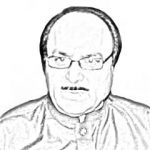
The 75 minutes video interview with The Wire by Special Assistant to Prime Minister (SAPM) on National Security first after 5 August 2019 is a welcome sign, towards starting an engagement between New Delhi and Islamabad. It was interesting to see Dr Moeed Yousaf lock horns with one of the formidable journalists of India.
I am sure that SAPM would have had in the back of his mind the question that he had asked the Foreign Minister Khawaja Asif during his first public engagement at USIP on5 October 2017. Dr Moeed asked the Foreign Minister that, “Differential of power and resources between India and Pakistan is growing every single day in your opponent’s favour. My calculation tells me that in 15 years’ time the power differential will be such that your opponent will not need to speak to you”. How did he overcome the construct of his scare for Foreign Minister 3 years back merits interest? The scare construct was wrong.
India has no exit ramp in Kashmir. It has no choice but to yield to Kashmiris and talk to Pakistan. The question remains how to box India. Out of the five conditions set for the resumption of a dialogue 4 are related to Kashmir. The content of his responses on Kashmir, has revealed that there is an urgent need to know more about Kashmir. Otherwise the crafty fox would trick the crow and make him drop the piece of cheese from its mouth, for her to eat.
Indian lie and fooling the world on the reason of sending more troops to Kashmir before its action of 5 August 2019, needed to be explained in the context of 2 UN Human Rights Reports
Karan Thaper’s show is watched widely and with interest. It was a golden opportunity to expose India as a rogue State as one which had sinned against the UN Charter, UN Resolutions, People of Jammu and Kashmir, Pakistan, all bilateral agreements and in view of a UN compliance test had “committed a very grave offence” against three parties.
It is legally and politically incorrect and serves Indian narrative if we say that Kashmiris are a third party and should be included in the dialogue. It wrongs the jurisprudence of Kashmir case. India and Pakistan are two parties as a consequence of the Kashmiri’s right to self-determination. If we take out the title of the people of Kashmir to self-determination, there is no consequence and India and Pakistan disappear as parties to this dispute. Kashmiris are the principal party.
Only a Kashmiri citizen and a Kashmiri scholar would have helped SAPM on this point. It has been argued at the 773rd meeting of UN Security Council held on 20 January 1957 that “pending the holding of a plebiscite, neither India nor Pakistan can claim sovereignty over the State of Jammu and Kashmir.” Article 257 of the Constitution of Pakistan confirms this wisdom.
The demandto “Release all political prisoners in Kashmir”, should have been handled in a more convincing manner. It needed an understanding of Kashmir case. It was an ideal opportunity to tell the audience in India and in Pakistan and across the world that Government of India has continued to ignore the obligation under UN Security Council Resolution of 21 April 1948 to ensure “That the Government of State releases all political prisoners”. The history of taking prisoners is 72 year old and Government of India has also been taking Kashmiris as political prisoners. It makes India a rogue State.
Indian lie and fooling the world on the reason of sending more troops to Kashmir before its action of 5 August 2019, needed to be explained in the context of 2 UN Human Rights Reports, 4 restraints accepted at the time of “accession” and 3 restraints accepted under UN Security Council Resolution of 21 April 1948. Indian army accepted a discipline on 27 October 1947 and another discipline on their behaviour, number and location on 21 April 1948.
A reference could have been made as a caution on UN Charter Obligations and in particular qualifications for re-election as a non-permanent member at SC. The best and prevailing reference on the rogueness of Indian army is contained in Resolution L.21 brought against Indiaat the UN Sub Commission for Human Rights by British Expert Mme Palley in August 1997. It was a golden opportunity. Karan Thaper should have been confronted with this out pour.
Reference to Dr. Farooq Abdullah that Kashmiris hate India, should have been dovetailed with National Conference Government’s REPORT on State-India relationship. It has been adopted by both houses of Jammu and Kashmir Assembly. The report published in July 2000 has challenged the vires of Indian control and has pointed out that the relationship was limited to only 3 subjects. The report has made a finding that Jammu and Kashmir has never signed any instrument of merger with the Indian union.
In addition we should highlight the caution made in UN Resolution of 30 March 1951, pointing out that Jammu and Kashmir Government was elected from only a part of the State and as such could not take any decision, that would prejudice the principle of self-determination ascertained through a UN supervise plebiscite.
Highlighting the domicile law and making a demand to rescind it, had provided an opportunity to tell the Indian audience, that Indian citizens required an Entry Permit (a visa) to enter the State until the requirement was rescinded on 31 March 1959 by the Prime Minister of Kashmir at the request of Mr. Nehru the Prime Minister of India. Jammu and Kashmir was fractured into three administrations and the Prime Minister of Jammu and Kashmir had no authority to rescind the requirement of entry permit. Nehru was refused entry by Kashmir Government and arrested on 20 June 1946. We need to aggravate our contest and aggregate it with enough evidence.
Dr. Moeed Yousaf expressed himself with dignity and confidence. He should have sharpened his tools on Kashmir and should have sat through many rounds of discussions with Kashmiri experts and scholars. Kashmiri hand needed in the construct of an argument on Kashmir should not be ignored.Otherwise we will wrong the Kashmir case.
The author is President of London based Jammu and Kashmir Council for Human Rights – NGO in Special Consultative Status with the United Nations