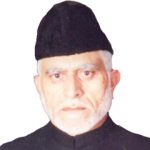
Current Prime Minister (PM) of Azad Jammu and Kashmir (AJK) Raja Farooq Haider Khan, recently stirred up a debate related to directives issued by Pakistan PM Shahid Khaqan Abbasi on February 15, ordering that the AJK and Gilgit-Baltistan (GB) councils be disbanded. These councils are designed to act as substitutes to Parliament and the federal government in the absence of a constitutional link with Pakistan.
When India was being divided in 1947, AJK declared itself as an independent representative government of the whole state on October 24.GB entrusted itself to Pakistan on the first of November. AJK’s independence was not recognised by Pakistan or India; however both territories fell outside Pakistan’s constitutional jurisdiction. However, it was still practically governed by Pakistan under different legal instruments, beginning with the Karachi agreement of April 1949.GB continued to be vexed under the Frontier Crimes Regulations (FCR), while AJK got its first ever dignified constitution in 1970, complete with all legislative and executive powers other than defence, foreign affairs, communication and the responsibilities of the UN Commission on India and Pakistan. Other federal powers were exercised by the government of Pakistan without any formal legal arrangement. GB also received a ‘symbolic’ legal framework in 1994.
In 1971, the cabinet division of the Pakistan government issued a notification declaring that AJK shall be treated like a province. AJK’s 1970 constitution was soon interpolated through a consensus of all political parties. This created a new legislative and executive authority named the AJK Council. This happened under the guise of the Azad Jammu and Kashmir Interim Constitution Act 1974. The council consists of six members elected by the AJK Assembly and five members of Pakistan’s parliament, nominated by the Pakistan PM — who is also the council’s chairman.
The PM and President of AJK are members of the council by virtue of their office only. All executive powers of the council are vested in its chairman — the PM of Pakistan. They are exercised directly or through a minister of the council secretariat or a joint secretary of the council. It is treated as a province — short of being provided actual provincial rights. Council members are not answerable to anyone whatsoever. Elected members have no say in matters related to the executive.
The purpose of creating the council was to establish an indirect liaison to fill the politico-constitutional gap in the relationship between AJK and the government of Pakistan. Gradually however, it received financial autonomy, power to appoint judges of the superior court. Today, it is an Arabian Camel.
A similar system was introduced to GB in 2009. However, GB is still portrayed as a province. Today, the council’s hegemonic and colonial style operations have resulted in brewing resentment against Pakistan itself. Besides this, all the policies and decisions made by federal institutions apply to these areas, which have no representation in Pakistan’s electoral system. The only influence these areas have in the federal government is through nationalist parties, federal bureaucracy and certain agencies which operate in the territory. This breeds further alienation.
AJK must have a pro active role in relation to the Kashmir issue at the international level and also because it is a part of the Pakistani state
Taking this into account, the scrapping of the council is more than welcome. However, this will not be a complete solution, unless the governance vacuum is filled with consensus of all stakeholders, empowering AJK and GB at the local and federal level. AJK and GB must be consulted in formation of policy and decision making, because this is a matter of constitutional right. AJK must have a pro active role in relation to the Kashmir issue at the international level and also because it is a part of the Pakistani state.
However, the system followed thus far has not delivered dividends at home or abroad. The strategy must change; the goal of integrating these territories into the country must not be abandoned in favour of a substitute ‘Azadi’. To achieve this goal, matters of a federal nature on the council list can be added in the list. Instead of nominating the PM of Pakistan and members of parliament for the councils, the Assemblies of the two regions can be empowered under the constitution to nominate members for Parliament. This is what was done by the IHK Assembly for the Parliament of India from 1947 to 1967. They can become a part of the policy and decision making process and a parliamentary Kashmir committee can be headed by any of them. Assets and liabilities should be shared by AJK and the Pakistan government. A flock of non state subject employees of council should go to the ministry of Kashmir affairs. This will fill the vacuum and address the alienation issue. The Government of India Act 1935 had also reserved three seats in the council of states and four in the federal legislature for the state of Jammu and Kashmir, even though the state was sovereign and not a part of British India.
While scrapping the Council, the most sensitive positions of the superior judiciary and the like cannot be left to the tribal decisions of the AJK government alone. It can neither be left up to the dictatorial orders of the Council and the Pakistan government. These powers have to be counter balanced by associated bar councils, leaders of the opposition and representatives from AJK and the Pakistan.
The writer is a former Chief Justice, AJK
Published in Daily Times, February 27th 2018.