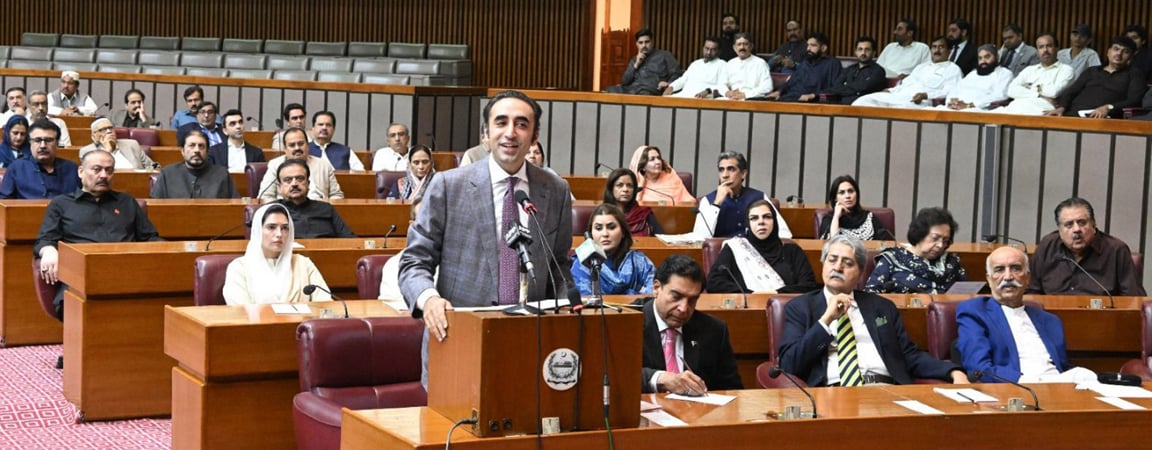
 PPP Chairperson Bilawal Bhutto-Zardari said on Thursday that the federal government had promised that allocations for provinces under the 7th National Finance Commission (NFC) award would be “protected”, and that the Centre would not request any further “help or sacrifice” following the recent decision to freeze development allocations for the provinces.
Bilawal joined the budget debate a day after he held a meeting with Prime Minister Shehbaz Sharif, who is reported to have convinced the head of his coalition partner PPP to attend the budget session in the NA.
“The provinces’ NFC award and financial resources have been kept protected; no damage will be caused to them,” Bilawal declared while addressing the NA, which was debating the proposed federal budget for the next fiscal year (FY27).
“Besides this decision, the provincial governments will not be required to make any sacrifices,” he added.
The government has decided to freeze development allocations for the provinces for three years to generate more than Rs900 billion in additional resources for the Centre’s strategic needs.
Referring to this decision, Bilawal said that the Centre and provinces had decided to jointly bear the burden of “extraordinary needs pertaining to defence and national security”.
He affirmed that “we came up with such a constitutional and democratic solution which meets the national security needs and also minimises complaints from the provinces”.
The PPP chairman emphasised that the decision was not taken unconstitutionally but rather under Article 164 of the Constitution.
“This is not just a financial or administrative [success], but the success of Pakistan’s politics. It is proof that when national interest is at stake, then democratic institutions, political parties, and all parts of the federation can make decisions together,” Bilawal said.
He underscored the significance of the consensus reached on the development allocations at a time when “the India-Israel nexus wants to harm Pakistan in every way, [such as] terrorism and our issues with Afghanistan”.
Bilawal also welcomed the opposition PTI for “keeping aside its politics”, noting that the decision was made not just by the parties in the ruling coalition but also by the PTI-ruled Khyber Pakhtunkhwa.
“If PTI and our opposition allies adopted similar politics, where there could be political differences […] but we work together like this in national interest, then there is no issue that we cannot face,” he remarked.
However, during his speech, Bilawal termed such temporary moves as “non-sustainable solutions”.
Speaking about the ongoing tense situation in Azad Jammu and Kashmir (AJK), Bilawal said the protesters “cannot damage Pakistan or the Kashmir cause, nor would they be allowed to”.
The PPP head asserted that action was necessary if the state or the people of Pakistan were targeted.
He urged the individuals protesting in the region to “separate themselves from those who were adopting extremist politics and taking the law into their hands”.
Bilawal reiterated that if the violent protesters surrendered, then the possible revocation of the ban on the Joint Awami Action Committee (JAAC) could be reviewed with consultations from other stakeholders.
“These issues should be solved in the AJK parliament instead of on the streets,” he emphasised.
On the “controversial” demand of the JAAC to abolish the 12 seats in the region’s legislative assembly reserved for refugees from Indian-occupied Jammu and Kashmir, Bilawal said the JAAC itself had not contested elections either.
He acknowledged that it was not objectionable if a region wanted to make decisions about its future itself.