

LAHORE: There was a grim silence in the hall as Mehmood Hayat Khan, the father of missing peace activist Raza Mehmood Khan, walked to the stage.
As he started speaking in a dejected, yet firm, tone, at a citizens’ seminar at South Asia Media Centre on Saturday, many among the listeners were reminded of the patience of Iqbal Khan, father of Mashal Khan who was lynched in April last year by his fellow students at Abdul Wali Khan University in Mardan over unfounded blasphemy allegations.
“I don’t know whether I’m lucky or unlucky”, he said, “My son is missing. And we don’t know anything about his whereabouts. But I’m lucky to have all of you by my side here today and I feel proud to have fathered a son who felt the pain of those who were not even related to him. That is the only reason why he has been abducted. I thank you all for coming here today and raising voice for his return.”
Earlier, the gathering including scholars, activists and students was told by Human Rights Commission of Pakistan (HRCP) secretary general IA Rehman that the number of reported cases of disappearances had reached 1498 people. These included dissident Sindhi nationalists, protesting students and civil society members from Balochistan, people linked to outlawed outfits from Khyber Pakhtunkhwa, political workers from Karachi, Punjab and many other parts of Pakistan.
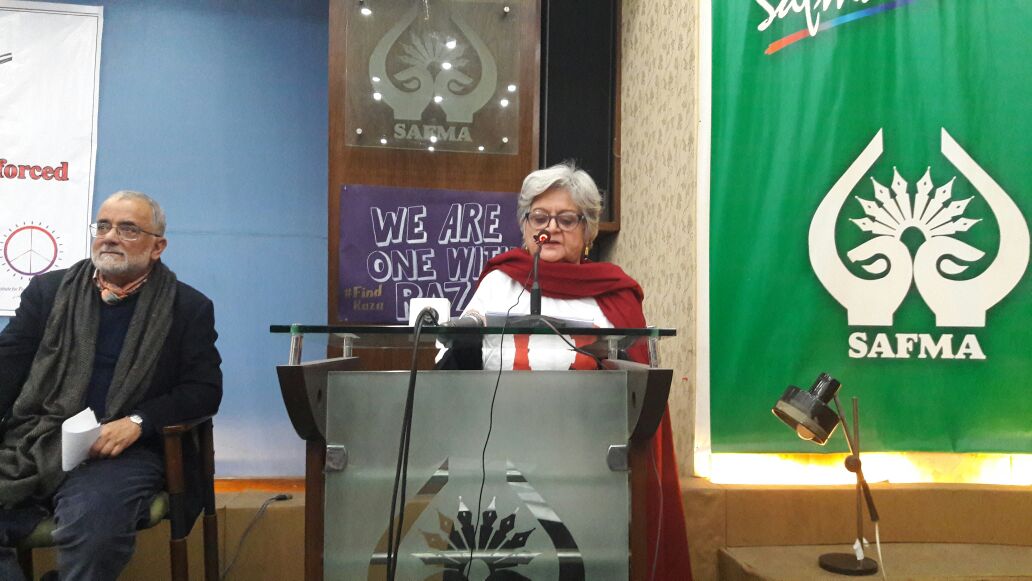
Some speakers at Human Rights in the Era of Enforced Disappearances were outraged at the situation prevailing in the country. Others were able to maintain their soberness somehow. But none seemed happy with the state of affairs.
Imtiaz Alam, senior journalist, was livid as he reminded state institutions that the people living in the jurisdiction were not their property, instead they were the other party in a social contract which formed the very basis of the state’s existence. “We have given up some of our rights for the protection of another set of rights under this social contract. We are not asking for freedom from the state. All we are demanding is legal slavery. This state can’t give us even that?” he asked.
Activist and lawyer Hina Jilani’s words echoed same anger as she warned against the commission of rights violations. “We are this close from international accountability,” she said, raising her right hand with the index finger and the thumb remaining apart only by about half an inch. “The way you are running this state cannot continue. Today, you’ve been put on a watch list for religious freedom violations. What next? And stop assuming that we’ll fall quiet. No matter how many mouths you shut; many will still remain open to ask for their civil rights”.
On requests regarding legal position on the issue, Jillani said, “Law is least relevant here. They are not picking up people lawfully. And if you insist, there is no law in Pakistan that would justify enforced disappearances.”
Irfan Mufti was similarly blunt. “I see only three reasons behind what is happening. Firstly, the state is afraid of what people like Raza Khan, Ahmad Waqass Goraya and Salman Haider are doing. It fears the narrative these people are trying to build. Secondly, there is no respect for law or institutions in this country. And thirdly, the state is doing everything with impunity and it isn’t even bothered by its international isolation that is at an all-time high right now,” he said.
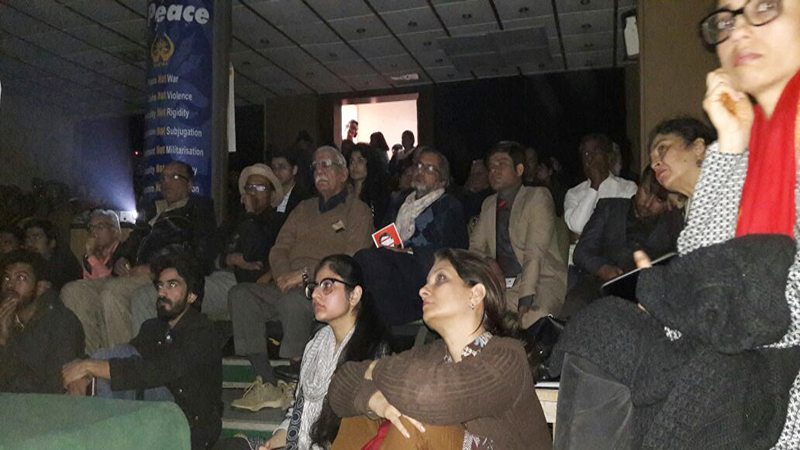
Senior columnist and editor of Pakistan’s most popular Urdu news website Humsub.com.pk, Wajahat Masood, kept his talk precise. He left listeners with a question that remained the most frustrating aspect of the discussion about impunity with which personnel of executive agencies were going about disappearances: “Who are we asking all these questions from? I’ve read the blog published on BBC Urdu by Salman Haider today. He says he was beaten up with brutality while being schooled on issues like poetry, liberalism and the 18th amendment. If even these issues are a problem, who are we talking to?” Masood asked.
Advocate Salman Akram Raja, Professor Dr Mehdi Hasan, and journalist and author Ahmed Rashid criticised the government for inaction.
Yet the most pertinent of issues were raised by senior academic Dr Muhammad Waseem. “Why are they always in plain clothes? When the state system was first formed around 200 years ago, the idea was to provide the people with equality under the law that governed the functioning of the administration. These laws brought the legitimacy that empowered an ordinary traffic warden to stop and fine even the richest of the men living in the country. The uniform that the warden wears gives him the authority and legitimacy in the eyes of the commoners that allows him to act on behalf of the state. These people come in plain clothes to pick up the dissenters because while the uniform gives them the legitimacy, plain clothes provide them with impunity,” he said.
The professor stressed that students must be taught about social and collective causes instead of just equipping them with the knowledge to make individual careers. He said that the education in the country had focused the ideological perspective only but the need of the hour was to give students the understanding of the legal perspective as well.
Earlier, the organisers showed a presentation highlighting facts and numbers of enforced disappearances. The highest number of disappearances were from Khyber Pakhtunkhwa, according to the statistics shared by HRCP, but there is no part of the country where enforced disappearances were not common today.
Published in Daily Times, January 7th 2018.