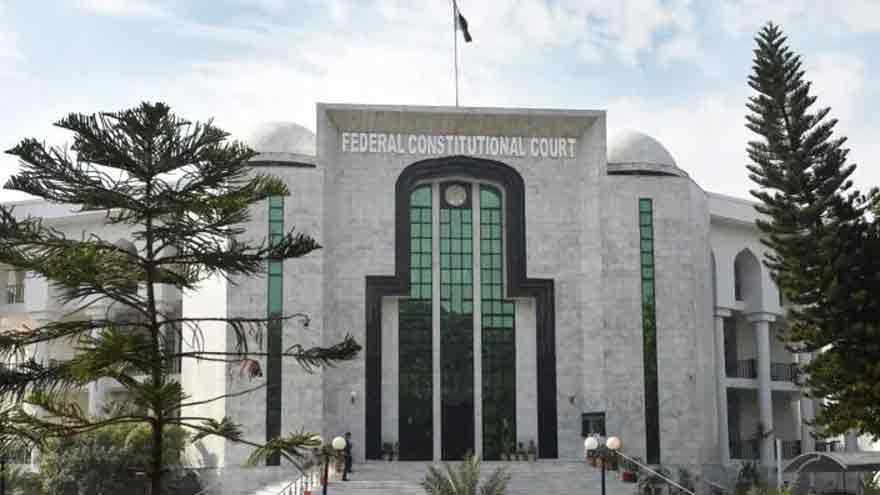
The Federal Constitutional Court (FCC) has ruled that it lacks authority to hear appeals against final decisions of the Supreme Court, reinforcing limits on judicial review under the Constitution. Chief Justice Aminuddin Khan clarified that the 27th Amendment does not empower the FCC to reopen or oversee Supreme Court rulings, emphasizing the importance of finality in the legal system.
In a written verdict, Chief Justice Khan stated that endless litigation is not permissible under the law and that every legal dispute must eventually reach a definitive conclusion. He stressed that final Supreme Court decisions cannot be challenged under the pretext of corrective review or re-evaluation of prior judgments.
Read more : Supreme court questions Islamic validity of quota system
The court also addressed the scope of Article 184(3), noting that it applies to matters of public importance rather than private disputes. Land compensation cases, while legally significant, are classified as private matters and do not fall within the extraordinary powers of the FCC, according to the verdict.
The case involved a land compensation dispute between the petitioner and the Multan Development Authority, where a three-member Supreme Court bench had initially ruled in favor of the petitioner in 2015. This decision was later overturned by a two-member bench in 2022, prompting the petitioner to seek review from the FCC.
Read more : Supreme court approves rules 2025 amendments
Chief Justice Khan further explained that under Article 188, the right to review is limited, and once the Supreme Court denies a review petition, the matter is considered conclusively closed. The ruling underscored the judiciary’s commitment to ensuring legal finality and preventing repeated challenges to settled cases.
The FCC’s decision reinforces that private grievances cannot be escalated under extraordinary judicial powers, maintaining the distinction between individual disputes and matters of public interest. Legal experts believe this verdict will streamline litigation and reduce unnecessary appeals, strengthening the judicial system.