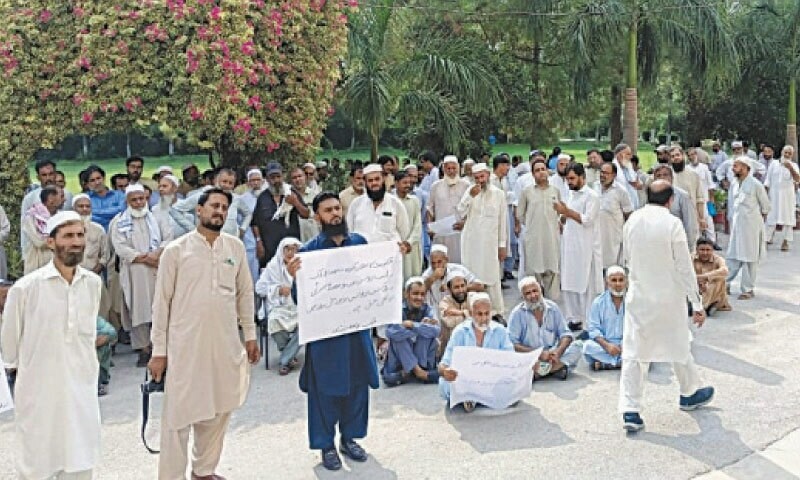
PESHAWAR: Teaching and non-teaching employees of the University of Peshawar (UoP) have demanded that the institution be placed under federal administrative and financial control, alleging that the provincial government has failed to manage its affairs. The demand was issued during a protest on Friday over the non-payment of December salaries and pensions.
Read More: KP government releases much needed funds for UoP
The joint action committee (JAC), comprising representatives of teachers, administrative officers, Class-III and Class-IV staff and sanitation workers, convened a general body meeting at the university’s administration block. Chaired by Puta president Dr Zakirullah, the meeting voiced concern over recurring payment delays and warned of escalating protests.
A resolution unanimously adopted by the JAC criticised the provincial government for what it termed poor management and neglect of the province’s oldest public university. It claimed that shifting UoP back to federal control would serve the interests of students and the wider public, while warning of boycotts of academic and administrative duties if payments were not released promptly.
Speaking to Dawn, Dr Zakirullah described the situation as “a joke” for staff who have gone unpaid, arguing that continued uncertainty has left employees and their families distressed. He called for amendments to the KP Universities Act, 2012 to facilitate a federal takeover and noted that the university had not paid pension commutation to employees retiring in 2024.
A senior university official said the institution had been burdened by a growing fiscal deficit, now estimated at Rs1.5 billion. He said UoP required Rs5.5bn for the current fiscal year but could only generate roughly Rs4bn from federal grants, fees and other sources, with the gap widening annually.
Read More: Shafiullah successfully completes PhD
The official added that Higher Education Commission grants had declined in recent years while expenditure, especially on salaries, continued to rise. He questioned how research and quality standards could be maintained when routine salary and pension obligations remained unmet.