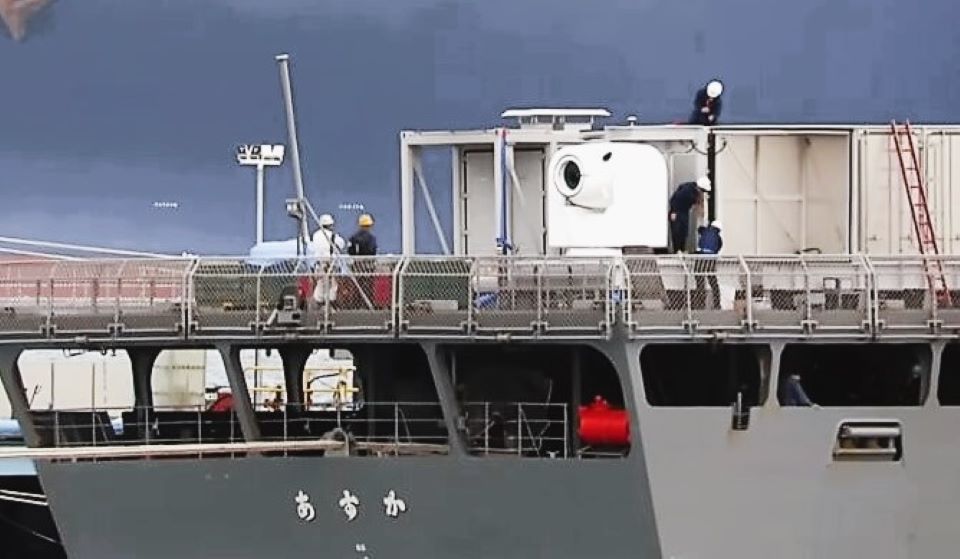
Japan has successfully tested a 100-kilowatt laser weapon system as tensions rise with China over the Taiwan issue. The high-powered system, capable of cutting through metal and intercepting drones mid-flight, combines ten 10-kilowatt lasers into a single beam, delivering sufficient energy to neutralize airborne and metallic threats.
Read More: The Global Hypersonic Weapons Race and South Asia
The weapon is part of Japan’s broader effort to modernize its military amid regional security concerns. Installed on the 6,200-ton JS Asuka test ship, the laser system will undergo further maritime trials starting in February next year. Officials emphasized that the system can engage targets without relying on traditional ammunition, offering a strategic advantage against emerging aerial threats.
‼️🇯🇵🇺🇸💥🇨🇳Japan has sent a clear message. It will not back down in the face of Chinese pressure.
Instead of restraint, Tokyo is accelerating its push to strengthen national defense.
After deploying missiles on Yonaguni Island, only 110 kilometers from Taiwan, Japan is now… pic.twitter.com/fK3fJKaNv3
— Defense Intelligence (@DI313_) December 19, 2025
Development of the laser weapon began in 2019 by Kawasaki Heavy Industries, and the first prototype was delivered to Japan’s Acquisition, Technology and Logistics Agency (ATLA) in February 2023. The technology reflects the growing importance of counter-drone capabilities, a trend highlighted by recent conflicts such as the Russia-Ukraine war.
Several countries, including the United States, Russia, China, Germany, and Australia, have also been developing similar systems to address the rising role of drones and other lightweight airborne threats in modern warfare. Experts say laser weapons offer a cost-effective and precise means of defense, especially in contested maritime and aerial environments.
This development comes amid escalating regional tensions, following statements from Japanese Prime Minister Sanae Takaichi suggesting that the Self-Defense Forces (SDF) could be deployed if China takes military action against Taiwan. Analysts say the introduction of laser-based weaponry signals Japan’s intent to strengthen its defensive posture and deter potential aggression in the Indo-Pacific region.
Read More: The AFSA report: chief of mission guidelines
With these tests, Japan joins a select group of nations actively advancing directed-energy weapons, underscoring the increasing role of high-tech systems in future warfare and regional security strategies.