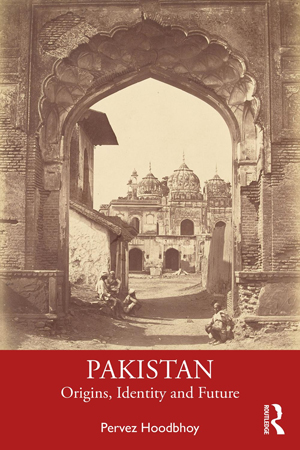
 Pervez Hoodbhoy is nuclear physicist and a prominent activist whose concerned with freedom of speech and education is dominant. Divided into five parts, his book Pakistan: Origins, Identity and Future offer a critical exploration of Pakistan’s history and the trajectory it is currently taking. It serves as a significant contribution to understanding the nuances of Pakistan’s past and present. It engages readers in critical thinking, offering a thought-provoking perspective on the country’s history, identity and the challenges it faces in the contemporary world. The book gives a radical insight of Pakistani history from the beginning of Muslim invasion in subcontinent, where Hoodbhoy in his conventional satirical style has criticised every major figure in making of Pakistan and has given critical view on Muslim period in subcontinent. Providing the scenario of Two Nation Theory which never existed before 1857, he writes, for Hindus and Muslims had seen periods of cooperation, spread of multiple cultures living in harmony together for ages. He states that Division among them were blurred with Hindu managing many key functions of Mughal state. Cross marriages were common. Even during the reign of Aurangzeb, he too had employed Hindu generals and high functionaries. But after 1857 everything changed for Muslims, one significant reason was not adopting western education which was considered anathema for Muslims for they believed that western education would take their children away from Islam. This is where Muslims unprecedented predicament begins for they were living an illusionary life believing that once firangis were driven away they will gain their political authority restored to its political glory whereas Hindus were adopting themselves with circumstances around them. Hindus adaptation to modern ideas was faster because for them ‘the advent of British rule involved merely changing one master for another; both were conquerors.’ Then Sir Syed, the most progressive Muslim and proselytiser of modernity and science, ran against orthodox, and figured out what transpired, after the magnanimous rule of Mughal, that floundered the Muslims. Sir Syed changed the course of Muslims with his vision of acquiring modernity and education, especially science. But Hoodbhoy also castigates him and cites, “he sided fully with orthodox in opposing the education of women or even poor Muslim men…he often found more commonality with rich Hindu than with any Bengali Muslim. In his thought-provoking book, Hoodbhoy delves into the intricacies of Pakistan’s formation, challenging commonly held beliefs. He argues that the creation of a separate nation for Muslims was not primarily driven by a defence of Islam, but rather served as a platform for the ruling elite to further their own interests. Using Islam as a unifying force, these elites mobilised the masses in the pursuit of the Pakistan movement. Throughout the book, Hoodbhoy critically examines the construction of historical narratives and the perpetuation of myths surrounding Pakistani heroes. Three chapters are dedicated, in part 3 of the book, to scrutinising the personas of Sir Syed, Iqbal and Jinnah, shedding light on their complexities and revealing discrepancies between their public image and their true beliefs. One of Hoodbhoy’s contentions is his criticism of the Two Nation Theory. He argues that this theory, which posited the division between Hindus and Muslims, failed to account for the deep divisions within the Muslim community itself. Hoodbhoy points out that the Two Nation Theory overlooked the diverse identities and interests among Muslims, resulting in internal tensions that eventually led to the disintegration of East Pakistan and the fall of Dacca in 1971. Hoodbhoy’s brilliantly written book accurately portrays the history of Pakistan, its prominent figures, and the intriguing dichotomy between their public image and private personas as depicted in our textbooks. It stands as an exceptional and vital work for young minds, who often rely solely on the information they are given. Hoodbhoy’s insightful narrative sheds light on the complexities of Pakistani history, challenging prevailing narratives and offering a more nuanced understanding. This book is a crucial addition, enlightening readers about the hidden truths and providing a much-needed perspective on the nation’s past, empowering the next generation with a more comprehensive knowledge.
The writer is a student at Sindh University and a film critic. He can be reached at [email protected]