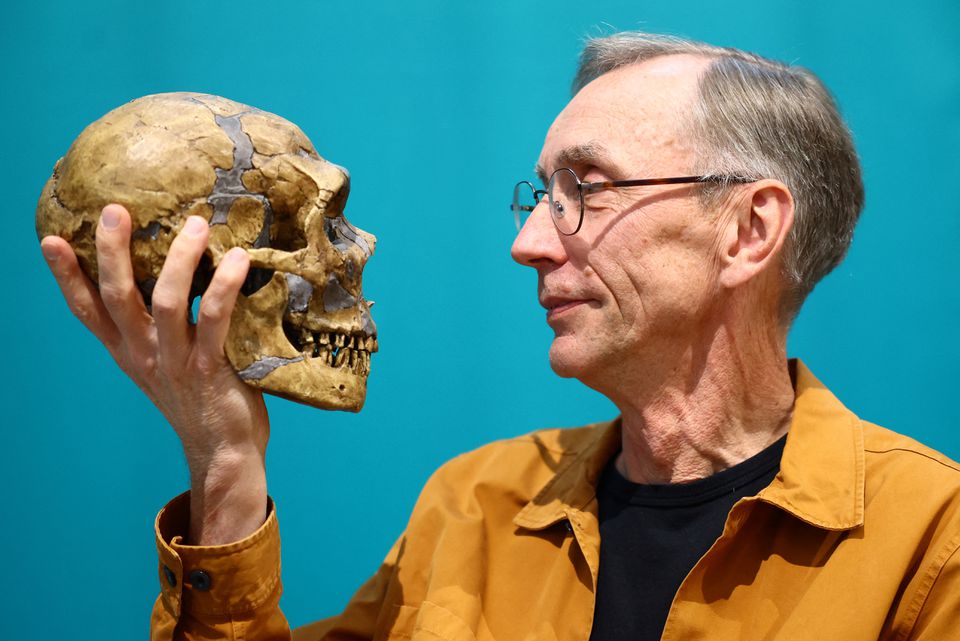
STOCKHOLM/LONDON: Swedish geneticist Svante Paabo won the 2022 Nobel Prize in Physiology or Medicine on Monday for discoveries that underpin our understanding of how modern-day people evolved from extinct ancestors at the dawn of human history.
Paabo’s work demonstrated practical implications during the COVID-19 pandemic when he found that people infected with the virus who carry a gene variant inherited from Neanderthals are more at risk of severe illness than those who do not.
Paabo, director at the Max Planck Institute for Evolutionary Anthropology in Leipzig, Germany, won the prize for “discoveries concerning the genomes of extinct hominins and human evolution,” the Award committee said.

“The thing that’s amazing to me is that you now have some ability to go back in time and actually follow genetic history and genetic changes over time,” Paabo told a news conference at the Max Planck Institute. “It’s a possibility to begin to actually look on evolution in real-time, if you like.”
Paabo, 67, said he thought the call from Sweden was a prank or something to do with his summer house there.
“So I was just gulping down the last cup of tea to go and pick up my daughter at her nanny where she has had an overnight stay,” Paabo said in a recording posted on the Nobel website.
“And then I got this call from Sweden and I of course thought it had something to do with our little summer house … I thought the lawn mower had broken down or something.”
Asked if he thought he would get the award, he said: “No, I have received a couple of prizes before but I somehow did not think that this really would qualify for a Nobel Prize.”
Paabo, son of a Nobel Prize-winning biochemist, has been credited with transforming the study of human origins after developing ways to allow for the examination of DNA sequences from archaeological and paleontological remains.
Not only did he help uncover the existence of a previously unknown human species called the Denisovans, from a 40,000-year-old fragment of a finger bone discovered in Siberia, his crowning achievement is considered to be the methods developed to allow for the sequencing of an entire Neanderthal genome.
‘Genetic differences’
This research, which showed that certain genes of Neanderthal origin are preserved in the genomes of people today, was once considered impossible, given that Neanderthal DNA on bones has shrivelled up over thousands of years into short fragments that have to be assembled like a gigantic puzzle, and are also heavily contaminated with microbial DNA.
“This ancient flow of genes to present-day humans has physiological relevance today, for example affecting how our immune system reacts to infections,” the Nobel Committee said.
The prize, among the most prestigious in the scientific world, is awarded by the Nobel Assembly of Sweden’s Karolinska Institute and is worth 10 million Swedish crowns ($900,357).
It is the first of this year’s batch of prizes.
Born in Stockholm, Paabo studied medicine and biochemistry at Uppsala University before creating a scientific discipline called “paleogenomics”, which helped show genetic differences that distinguish living humans from extinct hominins.
“His discoveries provide the basis for exploring what makes us uniquely human,” the Committee said.
The COVID-19 pandemic has placed medical research centre stage, with many expecting that the development of the vaccines that have allowed the world to regain some sense of normality may eventually be rewarded.
Still, it typically takes many years for any given research to be honoured, with the committees charged with picking the winners looking to determine its full value with some certainty amongst what is always a packed field of contenders.
Pandemic
When asked why the prize did not go to advances in combating COVID, Thomas Perlmann, secretary for the Nobel Committee for Physiology or Medicine, said the committee would only talk about prize winners, not those who had not won, or had not yet won.
However, Paabo’s ancient forensics work did offer insight on why some people are at higher risk of severe COVID.
In 2020, a report from Paabo and colleagues found that a gene variant inherited by modern humans from Neanderthals when they interbred some 60,000 years ago made those that carry the variant more likely to require artificial ventilation if infected by the COVID-causing virus.
“We can make an average gauge of the number of the extra deaths we have had in the pandemic due to the contribution from the Neanderthals. It is quite substantial, it’s more than one million extra individuals who have died due to this Neanderthal variant that they carry,” Paabo said in 2022 lecture.
Paabo’s most cited paper in the Web of Science was published in 1989, with 4,077 citations, said David Pendlebury, from UK-based scientific data analytics provider Clarivate.
“Only some 2,000 papers out of 55 million published since 1970 have been cited this many times,” he said.
“It is, however, not an award for a discovery relevant to clinical medicine, which many anticipated this year after a Nobel Prize focusing on physiology last year.”
Past winners in the field include a string of famous researchers, notably Alexander Fleming, who shared the 1945 prize for the discovery of penicillin, and Robert Koch, who won already in 1905 for his investigations of tuberculosis.
This morning, Svante Pääbo was awarded the #NobelPrize in medicine. The Swedish geneticist has made stunning discoveries about our forebear species by analysing ancient DNA https://t.co/PzXTtGflPQ
— nature (@Nature) October 3, 2022