• Skip to primary navigation
  • Skip to main content
  • Skip to primary sidebar
  • Skip to footer
Trending:
  • Kashmir
  • Elections
Friday, June 5, 2026

Daily Times

Your right to know

  • HOME
  • Latest
  • Iran-Israel war
  • Gilgit Baltistan Election
  • Pakistan
    • Balochistan
    • Gilgit Baltistan
    • Khyber Pakhtunkhwa
    • Punjab
    • Sindh
  • World
  • Editorials & Opinions
    • Editorials
    • Op-Eds
    • Commentary / Insight
    • Perspectives
    • Cartoons
    • Letters to the Editor
    • Featured
    • Blogs
      • Pakistan
      • World
      • Lifestyle
      • Culture
      • Sports
  • Business
  • Sports
  • E-PAPER
    • Lahore
    • Islamabad
    • Karachi

AFP

‘Limnic eruption’: DR Congo’s volcano nightmare

Published on: June 2, 2021 3:26 PM

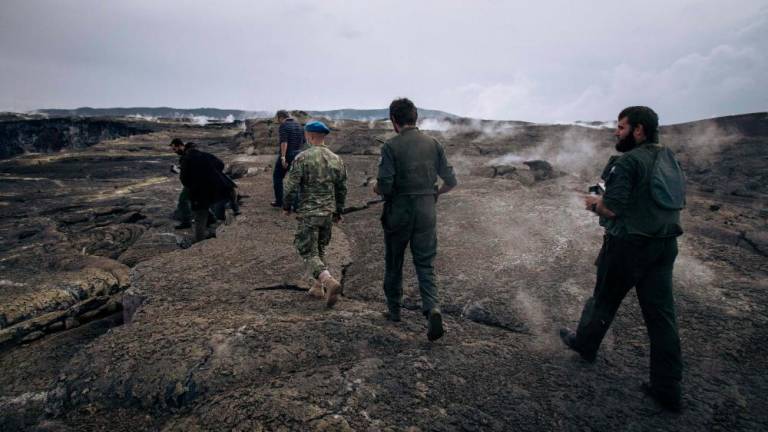
Orders on Thursday to evacuate Goma, a city lying in the shadow of DR Congo’s Mount Nyiragongo volcano, have shed light on a rare but potentially catastrophic risk — a “limnic eruption,” when volcanic activity combined with a deep lake can spew out lethal, suffocating gas.

The phenomenon first came to the world’s attention in August 1984, when 37 people mysteriously died at Lake Monoun in western Cameroon. Scientists found that dissolved carbon dioxide (CO2) gas in the depths of the lake had erupted, creating invisible clouds at the surface that were borne by winds into homes and fields, snuffing out life. Two years later, more than 1,700 people and thousands of cattle died in Lake Nyos, also in Cameroon, strengthening the belief that earthquakes and volcanic activity can trigger these unusual events. More than 600,000 people live in Goma, although the region’s population is around two million, in addition to more than 90,000 people who live across the border in the Rwandan city of Gisenyi. Both cities lie on the northeastern shore of Lake Kivu, which is dominated by Nyiragongo, a strato-volcano nearly 3,500 metres (11,500 feet) high that straddles the East African Rift tectonic divide. The much-feared volcano roared back into life on Saturday, spewing two rivers of lava over the next day that have claimed 32 lives and left around 20,000 homeless. This was followed by hundreds of aftershocks, some of them the equivalent of small earthquakes, that have collapsed or destroyed several buildings, ripped cracks in the ground and terrified the population.


– Disaster scenario –


The evacuation order comes on the heels of a warning by the Goma Volcano Observatory (OVG), which monitors the pulse of Nyiragongo and the Nyamuragira volcano, 13 kilometres (nine miles) away. In a technical note seen by AFP, the OVG said it saw worrying signs of activity by Nyiragongo that pointed to three potential outcomes. In the first two scenarios, Nyiragongo would erupt again, sending renewed lava flows southwards towards Goma and Gisenyi, destroying buildings in their path before reaching Lake Kivu. In both cases, the quantity of lava likely to enter the lake would not be enough to raise its deep-water temperature by at least one degrees Celsius (1.8 degrees Fahrenheit) — a key condition for a limnic eruption. But in the worst-case scenario, lava flows from Nyiragongo would combine with volcanic activity under the floor of the lake. This activity could take the form of a “fissural or phreato-magmatic eruption under the lake and/or a large earthquake of 6.5 or 7 magnitude,” the OVG said. In this scenario, “a limnic eruption would take place and dissolved gas in the lake’s deep water would rise to the surface, especially CO2, asphyxiating all living beings around Lake Kivu on the Congolese and Rwandan side.”

“There would be thousands of deaths,” the OVG said, spelling out the need for resources to carry out an “urgent exploration” of Lake Kivu.


– Volcanic region –


The OVG also cautioned against the use of rainwater for drinking or washing food, given the ashfall from the volcano. Six volcanoes dot the Goma region, dominated by Nyiragongo, which is 3,470 metres (11,400 feet) high, and Nyamuragira, 3,058 metres. Nyiragongo last erupted on January 17, 2002, killing more than 100 people and covering almost all of the eastern part of Goma with lava, including half of the airport’s landing strip. Its deadliest eruption was in 1977, when more than 600 people died. Nyamuragira is also highly active, with its last major eruption a decade ago.

Filed Under: World Tagged With: environment, Headline, Rwanda, volcano

Submit a Comment


Primary Sidebar


Latest News

Oil falls on hopes of broader peace after Lebanon, Israel halt fighting

Meat exports grow by 4.16%

SBP-held foreign reserves rise by $43m to $17.9bn

Gold prices up by Rs 1,523 per tola

Rupee strengthens against dollar

Pakistan

Bilawal seeks heavy public mandate to protect GB’s rights

PM directs pilot launch of automated tax collection system in Islamabad

Federal budget on June 10

PM hails special ties with Washington at event marking US 250th anniversary

FO rubbishes reports of Dar sharing Iran nuclear information with Rubio

More Posts from this Category

Business

Pakistan’s exports to US up by 1.70% to $5.12bn in 10 months

Pakistan, Tajikistan set $200 million trade target, deepen ties at 8th JCM

Services’ exports up by 17.68% to $8.26bn

OGDCL’s new wells deliver record oil, gas output in FY26

Buying returns as PSX gains nearly 1,000 points

More Posts from this Category

World

No sign of progress in US-Iran talks as Hezbollah rejects truce

Vast accelerates race to replace ISS

Gulf crisis drives India-Venezuela oil partnership

More Posts from this Category


Footer

Home
Lead Stories
Latest News
Editor’s Picks

Culture
Life & Style
Featured
Videos

Editorials
OP-EDS
Commentary
Advertise

Cartoons
Letters
Blogs
Privacy Policy

Contact
Company’s Financials
Investor Information
Terms & Conditions

Facebook
Twitter
Instagram
Youtube

© 2026 Daily Times. All rights reserved.

Manage Consent
To provide the best experiences, we use technologies like cookies to store and/or access device information. Consenting to these technologies will allow us to process data such as browsing behavior or unique IDs on this site. Not consenting or withdrawing consent, may adversely affect certain features and functions.
Functional Always active
The technical storage or access is strictly necessary for the legitimate purpose of enabling the use of a specific service explicitly requested by the subscriber or user, or for the sole purpose of carrying out the transmission of a communication over an electronic communications network.
Preferences
The technical storage or access is necessary for the legitimate purpose of storing preferences that are not requested by the subscriber or user.
Statistics
The technical storage or access that is used exclusively for statistical purposes. The technical storage or access that is used exclusively for anonymous statistical purposes. Without a subpoena, voluntary compliance on the part of your Internet Service Provider, or additional records from a third party, information stored or retrieved for this purpose alone cannot usually be used to identify you.
Marketing
The technical storage or access is required to create user profiles to send advertising, or to track the user on a website or across several websites for similar marketing purposes.
  • Manage options
  • Manage services
  • Manage {vendor_count} vendors
  • Read more about these purposes
View preferences
  • {title}
  • {title}
  • {title}
We use cookies to ensure that we give you the best experience on our website. If you continue to use this site we will assume that you are happy with it.