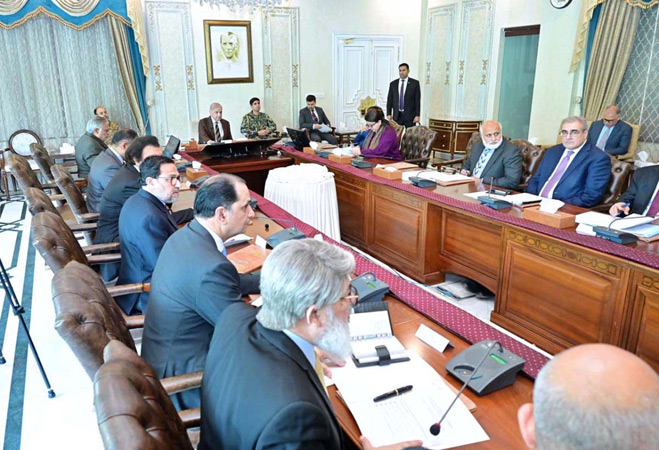
 Prime Minister Shehbaz Sharif on Tuesday approved the restructuring of Pakistan Agricultural Research Council (PARC) under a plan that envisions aligning the national agenda with export targets and food security goals.
The premier’s approval came during a meeting chaired by him and convened to discuss PARC-related matters in Islamabad, a statement issued by the Prime Minister’s Office (PMO) said.
It added that PM Shehbaz directed the Ministry of National Food Security and Research to chalk out a comprehensive roadmap for the implementation of the reorganisation plan, including a timeline.
He directed that the PARC should be developed in line with research being carried out on agriculture by the Chinese Academy of Agricultural Sciences (CAAS), the statement said, further quoting PM Shehbaz as saying that research plays a central role in the development of the country’s agriculture sector and food security.
Under the restructuring plan, a copy of which is seen by Dawn, the National Agricultural Research Centre (NARC) in Islamabad would be converted into centres of excellence in five disciplines of agricultural research.
The reform vision is to align the national agenda strictly with export targets and food security goals, the plan states.
According to the plan, PARC would be “repositioned as a strategic coordinator, shifting away from direct implementation, embedding international partnerships systematically across the research system”.
It envisions the establishment of centres of excellence for genome-based research in field and horticultural crops to develop climate-resilient varieties and high-yield hybrids; genetic improvement and health management of livestock to improve breeds, advanced diagnostics, and vaccine development; climate-smart solutions for land, water and energy with the objective of precision irrigation, soil health restoration and renewable energy; and employing artificial intelligence (AI) technology in the agri and food system to build big data, AI, precision equipment, farm automation and robotics.
The centres of excellence would be headed by CAAS experts, the plan says.
On governance reforms, it states that 50 per cent of the members of the scientific advisory committee’s board would be foreign experts – including CAAS experts – who are specialised in agriculture research and development.
In addition to the centres of excellence, the restructuring plan seeks to establish four ecology-based regional centres to replace the fragmented network.
“The ‘Tropical Agricultural Research Centre’ in Karachi will focus on tropical crops, coastal agriculture and inland fisheries. The ‘Dryland Agricultural Research Centre’ in Quetta will specialise in arid horticulture, rangeland and livestock. The ‘Dryland Agricultural Research Centre’ in Gilgit-Baltistan will be dedicated to mountain horticulture and cold-water fisheries while the ‘Arid Zone Research Institute’ in Dera Ismail Khan will concentrate on arid crops and natural resource management,” it elaborates.
According to the PMO’s statement, the prime minister was given a comprehensive briefing on the transformation of PARC into an active institution with modern needs.
The reform agenda seeks “to make PARC a viable institution to ensure national food needs [are met] and promote agri exports by bringing reforms in the governance structure, acquiring the services of top agricultural scientists and effective coordination with the provincial governments with significant goals to achieve”, the plan states.
It says that the implementation roadmap for restructuring PARC will be completed in four phases, starting in 2026 with an institutional setup, which includes establishing governance bodies, defining targets and creating an evaluation cell.
The second phase will be completed in 2027-28, with the operationalisation of five centres of excellence at NARC, piloting PARC and NARC in Punjab and Sindh. Under the third phase from 2028-30, there will be a national rollout to all provinces, integration of the AI-powered National Agricultural Research Information System, and to achieve 25pc private co-funding.
The final phase will begin in 2030 to ensure continuous global benchmarking, international peer reviews and regional innovation leader status.
“The expected outcomes and key indicators will result in 25pc private sector co-funding. The private sector will contribute through co-investment pathways. There will be 20pc commercialisation income, and license revenues will generate 20pc of the research budget to reduce dependence on government grants,” the plan states.
For sustainable financing, it adds, the endowment fund target has been set at Rs10 billion, whereas the federal grant per annum will be Rs2bn.
The plan further states that the national agriculture research and development budget will be enhanced from 0.5pc of agri GDP investment to one per cent to align with international benchmarks.
“At least 20pc of projects will be dedicated to artificial intelligence, biotechnology and precision agriculture,” it added.
The plan indicates that 70pc of export-oriented research will be aligned with the prime minister’s export initiatives, focusing on high-value commodities. The human capital erosion will also be reversed under the plan, and the average age of researchers has been envisioned as 45 years.