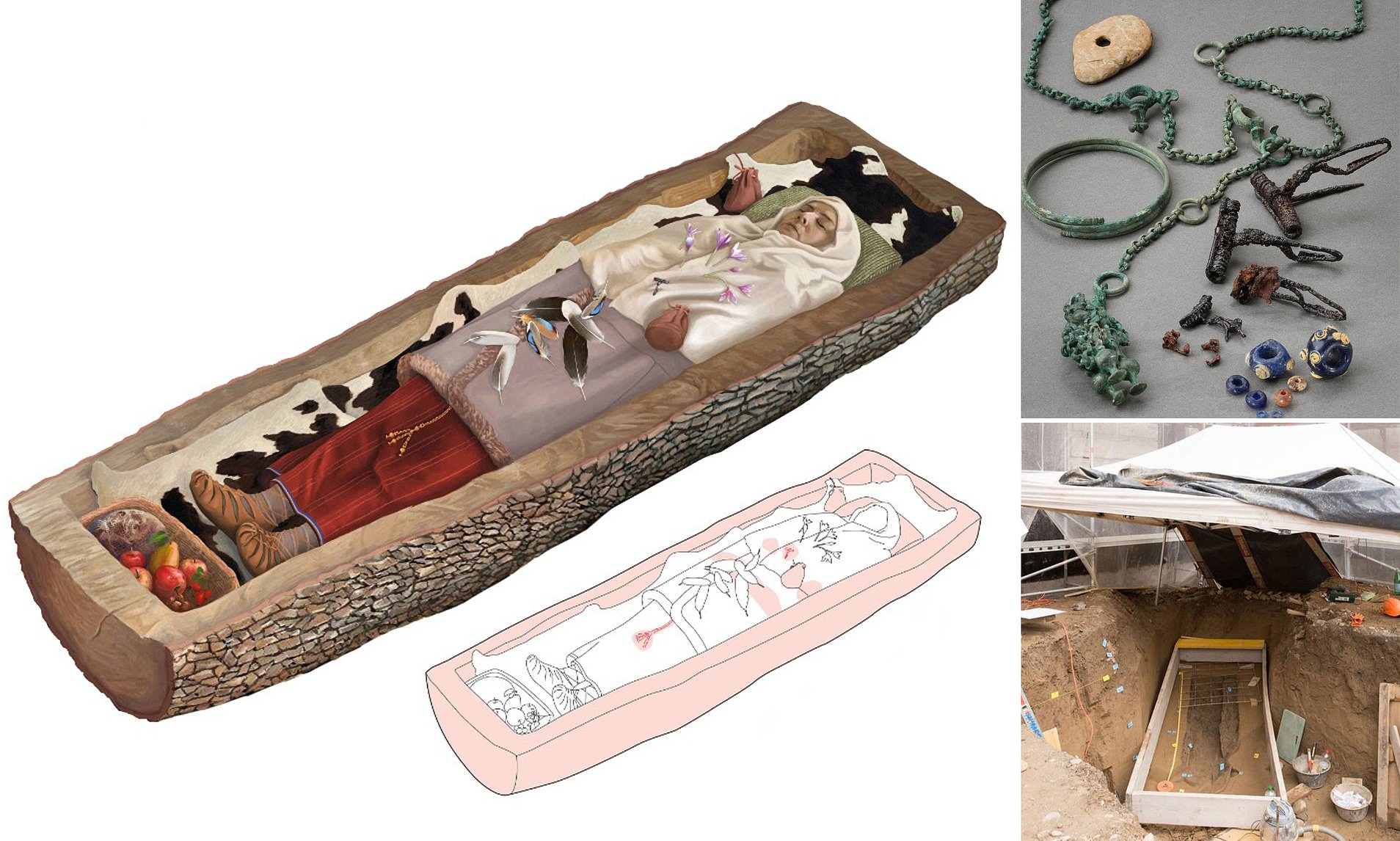
 A noblewoman’s burial from 2,000 years ago has been recreated in stunning detail after her remains were discovered by Archaeologists in Switzerland.
The rare find shows that Celtic communities hand-crafted tombs from hollowed-out trunks and adorned their deceased with high-quality clothes and jewels.
The corpse was laid to rest wearing a woolen dress, a shawl and a sheepskin coat, plus a necklace of amber and glass beads – both of which were preserved.
The remains were originally found as part of an excavation in March 2017 at the Kern school complex in Aussersih, but the details have only been publicly released now.
Until this point, scientists from the Office for Urban Development in Zurich were busy analyzing the woman’s remnants to decipher specific details about her general lifestyle, age, and health.
A statement translated from German says that an isotope analysis of her bones showed that she was a local resident who likely grew up in Limmat Valley – a region in the cantons of Zurich and Aargau, Switzerland.
She was also probably 40-years-old when she died, which historians would argue was a good life expectancy for 200 B.C. when people rarely lived beyond a few decades.
Her extremities were in relatively good condition, they added, which suggests she did little manual labor while alive.
However, dentistry analysis shows that she also had a sweet tooth and consumed a sugar-rich and starchy diet.