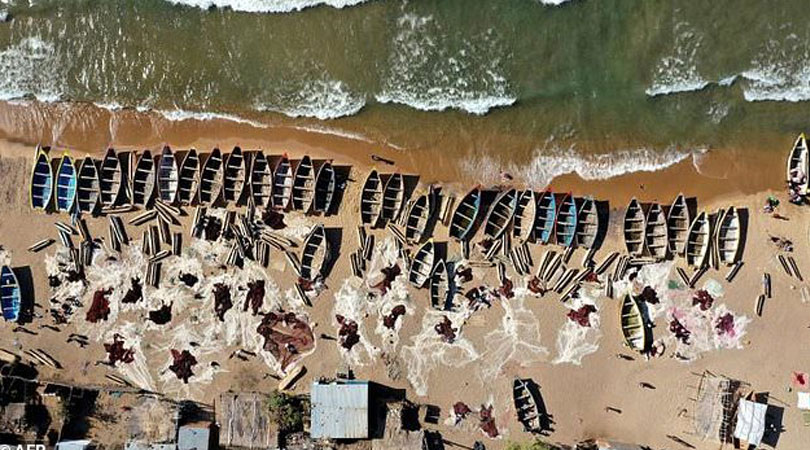
 On the shores of Lake Malawi, a crowd eagerly awaits the arrival of a white and yellow cedarwood boat carrying its haul.
The crew of six deliver a single net of chambo, sardine and tiny usipa fish from the boat, just one of 72 vessels that land their catch every day on the beach at Senga Bay.
But overfishing and climate change have taken their toll.
Hundreds of local traders gather each morning and afternoon at Senga only to find that fish populations are falling in Lake Malawi, Africa’s third largest body of freshwater.
“We were hoping to catch a half-boat full or maybe a quarter-boat… but I’m afraid the fish are dwindling in numbers,” port manager Alfred Banda told AFP staring wearily at the small catch as it was dragged onto the sand.
“Before, we used to catch a full boat but now we are struggling,” he said, adding that a full boat would earn a team of between six and 12 fishermen about $300.
Bordering three countries — Malawi, Tanzania and Mozambique — Lake Malawi stretches across more than 29,000 square kilometres (11,200 square miles) with over 1,000 species of fish.
The 14,000 people living at Senga Bay depend on the lake for food and for their livelihood.
“Seven years ago there was lots more fish than today. In 2019 it is different, there’s no fish in the water,” trader Katrina Male, a 40-year-old mother of six, told AFP as she stalked the nets of newly brought in fish seeking the best deal.
“The fish nowadays are more expensive, because they are becoming scarce,” Male said. “Some children have stopped going to school because their parents can’t find the money.”
‘No alternative to fishing’
For both locals and climate experts, declining fish numbers reflect a combination of environmental change and overfishing that augurs ill for the future.
The World Bank ranks Malawi among the top 10 at-risk countries in Africa to climate change, with cyclones and floods among the major threats.
Senga community leader John White Said says increasing gale force winds and torrential rains have made it harder for fishermen on the lake.
“Our men can’t catch fish because of wind which is much stronger than before,” he said, adding that the rains are increasingly unpredictable on the lake.
“The rain before would not destroy houses and nature but now it comes with full power, destroying everything and that affects the water as well.”
According to USAID, the number of rainfalls incidents in the aid-dependant country is likely to decrease — but each rainfall will be more intense, leading to droughts and floods.
The threat was highlighted in March when Malawi was hit by torrential rains from Cyclone Idai, killing 59 people. The storm also cut a swathe through Mozambique and Zimbabwe, leaving nearly 1,000 dead.
On top of the environmental impact, the number of fishermen in Senga had doubled in the last 10 years due to the lack of other jobs, Said said.
“There is no alternative to fishing.”
One of the few to benefit is 38-year-old boat owner Salim Jackson, who rents out his two vessels.
“I got into fishing 13 years ago because I had no other option, I never went to school. But it has brought me good money,” he said.
‘Unsustainable fishing practices’
By sunset, the balls of fishing net lay stretched out on the beach and both buyers and fishermen negotiate prices.
Traders take their purchases in buckets to makeshift reed tables to be dried, smoked, fried or boiled in preparation for the market.
“Declining fish catches are mainly due to unsustainable fishing practices,” said Sosten Chiotha, a Malawian environmental science professor who works for the Leadership for Environment and Development (LEAD) action group.
“Overfishing is a challenge in Lake Malawi (but) there are efforts on co-management and closed seasons to ensure that the fishery recovers.”
Chiotha added that climate change was hitting Malawi with “increased frequency and intensity of extreme weather events in the major ecosystems including lakes.”
That leaves Malawi´s agriculture-based economy sharply vulnerable to climatic events and entrenched poverty heightens pressure on the environment.
Wearing a black silk thawb robe and white kufi cap, Said stands tall on Senga beach, surveying the scene around him.
“I’m worried,” he said. “In Malawi most people depend on fishing financially and as a cheap food source.
“The men have to cast their nets further and further away from the beach.”