• Skip to primary navigation
  • Skip to main content
  • Skip to primary sidebar
  • Skip to footer
Trending:
  • Kashmir
  • Elections
Friday, June 5, 2026

Daily Times

Your right to know

  • HOME
  • Latest
  • Iran-Israel war
  • Gilgit Baltistan Election
  • Pakistan
    • Balochistan
    • Gilgit Baltistan
    • Khyber Pakhtunkhwa
    • Punjab
    • Sindh
  • World
  • Editorials & Opinions
    • Editorials
    • Op-Eds
    • Commentary / Insight
    • Perspectives
    • Cartoons
    • Letters to the Editor
    • Featured
    • Blogs
      • Pakistan
      • World
      • Lifestyle
      • Culture
      • Sports
  • Business
  • Sports
  • E-PAPER
    • Lahore
    • Islamabad
    • Karachi

Agencies

An earthquake’s impact can be predicted – but only after it hits

Published on: July 7, 2019 3:27 PM


Over the next week, Southern California has only a 27% chance of experiencing a third earthquake greater than magnitude 6, but a 96% chance of going through a tremor of magnitude 5 or higher.

Those precise probabilities were generated by scientists at the United States Geological Survey (USGS), using models based on longstanding principles of seismic behavior and decades of data on aftershocks from earthquakes.

But the same predictive power does not extend to forecasting when and where earthquakes will strike in the first place, experts acknowledge.

“Even if it’s a theoretical possibility, it may be a practical impossibility,” said Andrew Michael, a California-based geophysicist at the USGS.

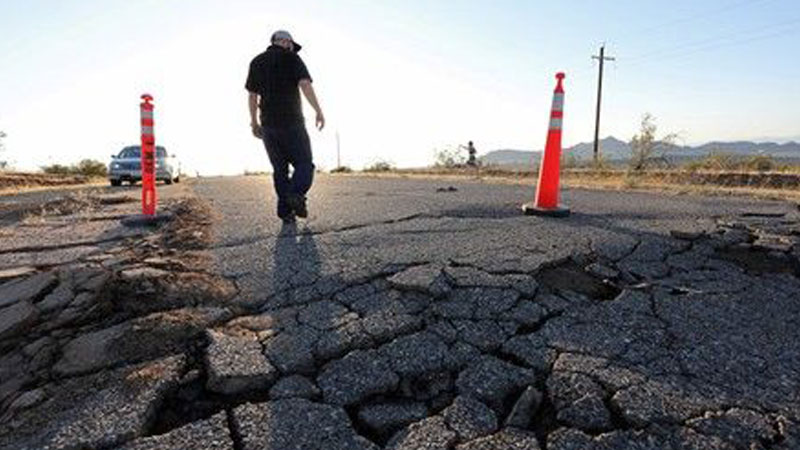
A powerful 7.1 magnitude quake shook the remote town of Ridgecrest in the Mojave Desert on Friday evening, a day and a half after a 6.4 magnitude temblor was recorded in the same region.

On average, a quake is followed by an even stronger tremor only about 5% of the time, though it happens more frequently in areas with significant geothermal activity, like the Mojave, according to Michael.
The USGS first began offering public aftershock forecasts in the 1980s, Michael said.

The models rely on basic laws governing earthquake behavior that have been known for the better part of a century, experts said.

The typical shallow earthquake creates a series of aftershocks that diminish exponentially, with each successive day bringing half as many tremors. In addition, the frequency of earthquakes drops as the magnitude increases – a region will have 10 times as many magnitude 6 quakes as magnitude 7, Thomas Heaton, a seismologist at the California Institute of Technology, said in an email.

“There is now a catalog that stores the locations, sizes and times of millions of past earthquakes,” he said. “It is quite straightforward to characterize the statistical behavior of these events.”

The current model used by USGS predicts the number and size of aftershocks based on the largest earthquake, or mainshock. But seismologists believe aftershocks behave more like the spread of a disease in an epidemic, Michael said. Just as each sick patient can infect others, so too can each aftershock in turn create its own subsequent aftershocks.

Michael said the USGS is perhaps a year away from adopting a newer model that incorporates that theory in making public forecasts. Eventually, he said, the hope is that officials will be able to predict how much shaking a particular town might experience in the aftermath of a quake, so people can be better prepared.

But predicting a big quake in the first place remains out of reach. The best seismologists have been able to do is to use historical data to predict how likely it is that an earthquake of a certain magnitude will hit a particular region over a period of time.

That forecast is crucial for establishing safety standards in building codes, for instance. But it will not help warn a city’s residents that a quake is imminent.

“The problem is the earth is a complex thing,” said Christopher Scholz, a professor emeritus at Columbia University’s Lamont-Doherty Earth Observatory. Scholz noted, for instance, that the 1999 Hector Mine quake in the Mojave Desert was thought to have been triggered by a 1992 quake. That seven-year gap is but a fleeting moment in geological terms.

Federal and state officials hope a new system that alerts residents when shaking is detected might give people a few seconds to seek shelter, say, or stand in a doorway.

“I work on the physics of the rupture process and I have become convinced that the physics is in a class of phenomena that are called ‘chaotic,'” Heaton said. “If this is true, then we will probably never predict earthquakes.”

Filed Under: World Tagged With: earthquakes, impact

Submit a Comment


Primary Sidebar


Latest News

Pakistan secured a convincing 3-0 victory over the Maldives

Oil falls on hopes of broader peace after Lebanon, Israel halt fighting

Meat exports grow by 4.16%

SBP-held foreign reserves rise by $43m to $17.9bn

Gold prices up by Rs 1,523 per tola

Pakistan

Bilawal seeks heavy public mandate to protect GB’s rights

PM directs pilot launch of automated tax collection system in Islamabad

Federal budget on June 10

PM hails special ties with Washington at event marking US 250th anniversary

FO rubbishes reports of Dar sharing Iran nuclear information with Rubio

More Posts from this Category

Business

Rupee strengthens against dollar

Pakistan’s exports to US up by 1.70% to $5.12bn in 10 months

Pakistan, Tajikistan set $200 million trade target, deepen ties at 8th JCM

Services’ exports up by 17.68% to $8.26bn

OGDCL’s new wells deliver record oil, gas output in FY26

More Posts from this Category

World

No sign of progress in US-Iran talks as Hezbollah rejects truce

Vast accelerates race to replace ISS

Gulf crisis drives India-Venezuela oil partnership

More Posts from this Category


Footer

Home
Lead Stories
Latest News
Editor’s Picks

Culture
Life & Style
Featured
Videos

Editorials
OP-EDS
Commentary
Advertise

Cartoons
Letters
Blogs
Privacy Policy

Contact
Company’s Financials
Investor Information
Terms & Conditions

Facebook
Twitter
Instagram
Youtube

© 2026 Daily Times. All rights reserved.

Manage Consent
To provide the best experiences, we use technologies like cookies to store and/or access device information. Consenting to these technologies will allow us to process data such as browsing behavior or unique IDs on this site. Not consenting or withdrawing consent, may adversely affect certain features and functions.
Functional Always active
The technical storage or access is strictly necessary for the legitimate purpose of enabling the use of a specific service explicitly requested by the subscriber or user, or for the sole purpose of carrying out the transmission of a communication over an electronic communications network.
Preferences
The technical storage or access is necessary for the legitimate purpose of storing preferences that are not requested by the subscriber or user.
Statistics
The technical storage or access that is used exclusively for statistical purposes. The technical storage or access that is used exclusively for anonymous statistical purposes. Without a subpoena, voluntary compliance on the part of your Internet Service Provider, or additional records from a third party, information stored or retrieved for this purpose alone cannot usually be used to identify you.
Marketing
The technical storage or access is required to create user profiles to send advertising, or to track the user on a website or across several websites for similar marketing purposes.
  • Manage options
  • Manage services
  • Manage {vendor_count} vendors
  • Read more about these purposes
View preferences
  • {title}
  • {title}
  • {title}
We use cookies to ensure that we give you the best experience on our website. If you continue to use this site we will assume that you are happy with it.