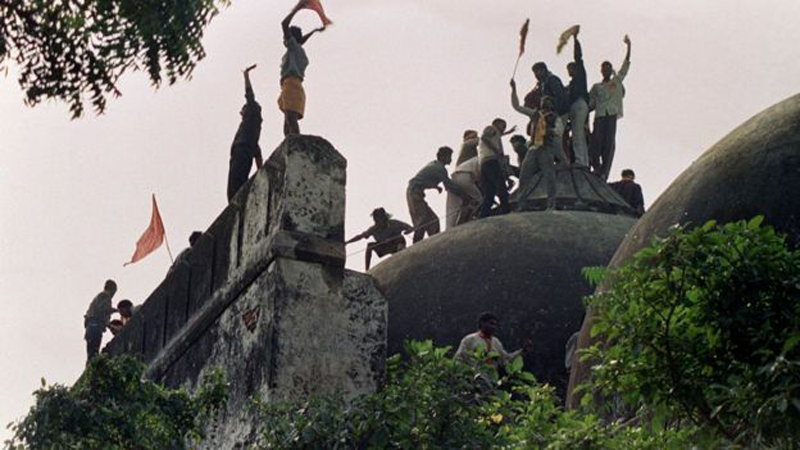
The northern city has been a key point of tension between Hindus and Muslims.
In the past few months, there have been renewed calls to build a temple on the spot, where a 16th Century mosque was demolished by Hindu mobs in 1992.
The BBC explains why the holy site is back in the news:
Why are people gathering in Ayodhya?
Between 100,000 and 200,000 Hindus are expected to gather at Ayodhya on Sunday, demanding that a Hindu temple be built where the 16th Century Babri mosque once stood.
Hindus believe the religious site in the state of Uttar Pradesh is the birthplace of one of their most revered deities, Lord Ram. But Muslims say they have worshipped there for generations.
Tensions between the two communities came to a violent head in 1992 when a Hindu mob destroyed the mosque.
Nearly 2,000 people were killed in subsequent riots across the country.
But now, after various attempts to claim ownership over the land by both religious groups, Prime Minister Narendra Modi’s Hindu nationalist Bharatiya Janata Party (BJP) has been scaling up efforts to build a Hindu temple there.
The crowds who are expected to gather at the site are from various hardline right-wing groups, including the Vishwa Hindu Paris had (VHP) and Shiv Sena.
Local media reports say that walls in districts surrounding the site have been plastered with posters that show Lord Ram going to war. Others contain slogans that are essentially war cries against what they call the inability by previous governments to get the temple constructed.
The situation has prompted a sense of panic and fear among Ayodhya’s Muslim residents, many of whom have plans to leave the area before the crowds descend.
“This is the biggest build-up in favour of a temple since the mosque was destroyed. They are provoking the public. They are stirring up emotions,” Ahmad, a Muslim community leader, told the Reuters news agency.
Why is it back in the spotlight?
The call for the construction of a Hindu temple in Ayodhya has grown particularly loud in the last few months and has mostly come from MPs, ministers and leaders from the BJP.
Uttar Pradesh, India’s most populous state, sends more MPs to parliament than any other state. A big win in the state is essential for any party hoping to form the next government.
Correspondents say the BJP appears to be attempting to galvanise Hindus in Uttar Pradesh along religious lines once again. The party’s strategy paid off in 2014, when it managed to win 71 of the state’s 80 seats.
The BJP’s projection of a united Hindu identity that superseded caste and class divisions and positioned them against those from “other” religions, is largely seen as having been responsible for that performance.
This same momentum helped the party sweep state elections last year. But since that victory, and the instalment of the controversial Hindu hardliner Yogi Adityanath as chief minister, the BJP has lost several key local elections.
One was a parliamentary by-election in Mr Adityanath’s home constituency. Analysts say this could be due to a number of reasons, including farmers who are unhappy with the government after being badly affected by drought and declining productivity.
The BJP may see Ayodhya as offering a way of reversing this trend.
What is the row actually about?
Hindus and Muslims have been at loggerheads over the Babri mosque for more than 100 years.
Hindus say the site is the birthplace of Lord Ram, and insist the Babri mosque was built there only after Muslim invaders destroyed a Hindu temple that stood there first.
Muslims claim they offered prayers at the mosque until December 1949 when some Hindus placed idols of Ram in the mosque and began to worship the idols.
Over the decades since, the two religious groups have gone to court many times over who should control the site.
What are the important legal developments so far?
The Supreme Court, which is hearing a batch of pleas about the disputed site, has deferred its next hearing until January 2019.
But there have been several interesting legal landmarks so far.
In 2010, the Allahabad High Court said that the main site where the mosque stood should be split into three parts, with two-thirds given to Hindus and one-third to Muslims.
The ruling also marked the first time any court had acknowledged the disputed site as the birthplace of Lord Ram.
In 2011 the Supreme Court suspended this ruling after both Hindu and Muslim groups appealed. Since then, some 14 civil petitions have also challenged it.
But another judgement worth noting is one from 1994 when the Supreme Court, which was ruling on a wholly separate case at the time, remarked that the mosque was “not integral to Islam”.
This particular line has bolstered the case made by Hindus who want control of the entire site.
In April 2018, a senior lawyer named Rajeev Dhavan filed a plea before the top court, asking judges to reconsider this observation.
But a few months later the Supreme Court declined to do so.
As recently as last month, the same court rejected an urgent hearing into the civil petitions. “We have other priorities,” chief justice Ranjan Gogoi said, adding that the matter would be taken up early next year.
Have religious tensions eased in India in recent years?
Ever since the Narendra Modi-led Hindu nationalist BJP came to power in 2014, India has seen deepening social and religious divisions.
Rabble-rousing by hardline ministers and Hindu groups has led to what many call greater anxiety in social relations.
Restrictions on the sale and slaughter of cows — considered a holy animal by the majority Hindus — have led to vigilante killings of more than 20 people, most of them Muslims who were transporting cattle.
An uninhibited display of muscular Hindi nationalism has also contributed to religious tension.
The recent revival of the demand by some Hindu groups to construct the temple at Ayodhya through executive fiat — ignoring proceedings in the Supreme Court — is seen by many a renewed attempt to polarise the voters on religious lines ahead of the crucial 2019 elections.
Published in Daily Times, November 26th 2018.