
During the previous week, a report by Conflict Armament Research (CAR) on the Islamic State’s (IS) weapons found in Iraq and Syria has been making rounds on the media. Before the story was picked up by the mainstream media, it was first published on the news website known as Wiredin early December.
Wired has a history of spreading dubious stories and working in close collaboration with the Pentagon and DARPA (Defense Advanced Research Projects Agency)under its erstwhile reporters Noah Shachtman and Spencer Ackerman, both of whom are now the national security correspondents for the Daily Beast, though this particular report has been written by Brian Castner, who is a former US Air Force explosive ordnance disposal officer and a veteran of the Iraq War.
CAR is a relatively unknown company of less than 20 employees. Its Iraq and Syria division is headed by 31-year-old Belgian researcher, Damien Spleeters. Spleeters’ investigation was aimed at discovering IS’ homegrown armaments industry and revealing how the jihadist group’s technicians have adapted the East European munitions to be used in the weapons available to the Islamic State. He has listed 1,832 weapons and 40,984 pieces of ammunition recovered in Iraq and Syria in the CAR’s database.
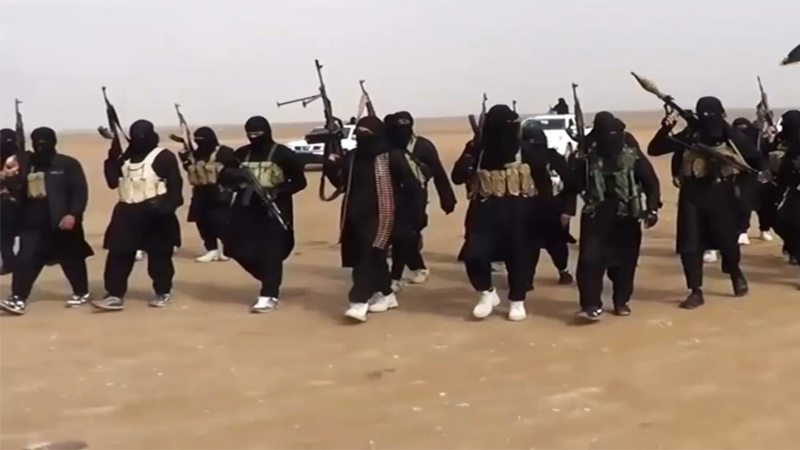 But Spleeters has only tangentially touched upon the subject of the IS’ weapons supply chain, documenting only a single PG-9 rocket found at Tal Afar in Iraq bearing a lot number of 9,252 rocket-propelled grenades which were supplied by Romania to the US military. He only mentioned a single shipment of 12 tons of munitions which was diverted from Saudi Arabia to Jordan in his supposedly ‘comprehensive report’. In fact CAR’s report is so misleading that of thousands of pieces of munitions investigated by Spleeters, less than 10 percent were found to be compatible with NATO’s weapons and more than 90 percent were found to have originated from Russia, China and countries in Eastern Europe, particularly Romania and Bulgaria.
The argument that IS was able to gain large swathes of territory before it acquired modern arms and lost most of said territory after having gained state-of-the-art weapons is paradoxical
In comparison to CAR’s report, a joint investigation by the Balkan Investigative Reporting Network (BIRN) and the Organized Crime and Corruption Reporting Project (OCCRP) has uncovered the Pentagon’s $2.2 billion arms pipeline to Syrian militants. It bears mentioning, however, that $2.2 billion were earmarked only by Washington for training and arming the Syrian rebels, and tens of billions of dollars that Saudi Arabia and the oil-rich Gulf states have pumped into the Syrian civil war have not been documented by anybody so far.
Moreover, Bulgarian investigative reporter Dilyana Gaytandzhieva, authored a report for Bulgaria’s national newspaper, Trud, which found that an Azerbaijan state airline company, Silk Way Airlines, was regularly transporting weapons to Saudi Arabia, United Arab Emirates (UAE), and Turkey under diplomatic cover as part of the CIA covert program to supply militant groups in Syria. Gaytandzhieva documented 350 such ‘diplomatic flights’ and was subsequently fired from her job for uncovering the story. Unsurprisingly, both these well-researched and groundbreaking reports didn’t even merit a passing mention in any mainstream news outlet.
It’s worth noting that the Syrian militant groups are no ordinary bands of ragtag jihadist outfits. They have been trained and armed to the teeth by their patrons in Washington as well as Turkey, Saudi Arabia and Jordan in the training camps located at Syria’s northern and western border regions. Along with Saddam’s and Egypt’s armies, the Syrian Baathist armed forces are one of the most capable fighting forces in the Arab world. But the onslaught of militant groups during the first three years of the civil war was such that had it not been for the Russian intervention in September 2015, the Syrian defenses would have collapsed. And the only feature that distinguishes the Syrian militants from the rest of regional jihadist groups is not their ideology but their weapons arsenals that were bankrolled by the Gulf’s petro-dollars and provided by the CIA in collaboration with regional security agencies of Washington’s client states.
While we are on the subject of IS’ weaponry, lets also touch upon how it managed to take over such large swathes of land. It is generally claimed by the mainstream media that IS came into the possession of state-of-the-art weapons when it overran Mosul in June 2014 and seized huge caches of weapons that were provided to Iraq’s armed forces by Washington. However, the fact IS was able to gain such large swathes of territory before it gained sophisticated, modern arms and lost territory after having gained said weapons makes this claim seem paradoxical. The only conclusion that can be drawn from this fact is that IS had those weapons, or equally deadly weapons, before it overran Mosul and that those weapons were provided to all the militant groups operating in Syria, including IS, by foreign intelligence agencies.
The writer is an Islamabad-based attorney, columnist and geopolitical analyst focused on the politics of Af-Pak and Middle East regions, neocolonialism and petro-imperialism
Published in Daily Times, December 26th 2017.