 Work has not halted to bridge gaps between the United States and Iran, sources from mediator Pakistan said, despite the failure of face-to-face diplomacy after Donald Trump called off a trip by his envoys and told Iran to phone when it wants a deal.
Pakistani officials said negotiations were still taking place remotely, but there were no plans to convene a meeting in person until the sides were close enough to sign a memorandum.
“The draft will be negotiated remotely till they reach some consensus,” said a Pakistani source familiar with the negotiations.
Although a ceasefire has paused the US-Israeli strikes on Iran that began on February 28, no agreement has been reached on terms to end a war that has killed thousands, driven up oil prices, fuelled inflation and darkened the outlook for global growth.
Both sides could be settling in for a test of wills to see who can endure economic pain before making concessions.
Iran has largely blocked all shipping apart from its own from the Gulf through the Strait of Hormuz since the war began. This month, the United States began blockading Iranian ships, which Iran says must be halted as a condition for talks.
Hopes of reviving peace efforts have receded since the US president scrapped a visit on Saturday by his envoys Steve Witkoff and Jared Kushner to Islamabad, the Pakistani capital, where Iranian Foreign Minister Abbas Araqchi shuttled in and out twice over the weekend.
Senior Iranian sources, speaking on condition of anonymity, told Reuters the proposal carried by Araghchi to Islamabad over the weekend envisioned talks in stages.
A first step would require ending the US-Israeli war on Iran and providing guarantees that Washington cannot start it up again. Then negotiators would resolve the US blockade and the fate of the Strait of Hormuz, which Iran aims to reopen under its control.
Only then would talks look at other issues, including a longstanding dispute over Iran’s nuclear program, with Iran still seeking some kind of US acknowledgment of its right to enrich uranium for what it says are peaceful purposes.
In a sign that no face-to-face meetings are planned any time soon, streets reopened in Pakistan’s capital Islamabad, which had been locked down for a week in anticipation of talks that never took place. The luxury hotel that had been cleared out to serve as a venue was again taking reservations from the public.
However, US president Donald Trump in an interview on Sunday said, “If they want to talk, they can come to us, or they can call us. You know, there is a telephone. We have nice, secure lines.”
Responding, Iran’s Foreign Minister Abbas Araqchi said on Monday that Tehran was looking into United States President Donald Trump’s request for negotiations, according to a post on the minister’s Telegram account.
He told reporters in Russia that Trump requested negotiations because the US has not achieved any of its objectives.
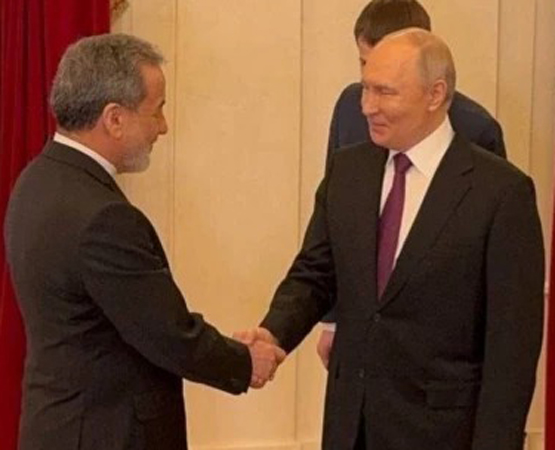
Meanwhile, Russian President Vladimir Putin said that the country would “do what it can” to achieve regional peace as he met Araghchi.
The Iranian top diplomat is currently on a visit to Russia amid a deadline in peace talks with the United States following a temporary ceasefire.
Putin met FM Araghchi in St Petersburg. Iran’s Press TV quoted him as saying that he received a message from Supreme Leader Mojtaba Khamenei.
“Russia will do what it can to support the interests of Iran and other regional countries and help bring peace to West Asia as soon as possible. I hope Iranian people overcome this difficult period and that peace is restored,” the outlet quoted him as saying.
FM Araghchi said his people had bravely resisted US aggression and would continue to do so.
“Iran and Russia have a strategic partnership and will continue to strengthen their cooperation,” he said.
Russian FM Sergei Lavrov, presidential aide Yuri Ushakov, and Admiral Igor Kostyukov, chief of the Main Intelligence Directorate of the General Staff of the Russian Armed Forces, also attended the meeting.
“The visit to Russia provides a chance to discuss with Russian officials the latest developments,” Araghchi said in a statement upon his arrival in St. Petersburg, according to state broadcaster IRIB News.
He also addressed the failure of the latest round of negotiations, pinpointing US demands as the main reason behind the breakdown.
“Americans’ approach led to the previous round of talks to fail to meet its objectives, despite the progress made. This was due to the excessive demands they made and wrong approaches they adopted,” he said after arriving in Russia.
He further stated that consultations were held with Pakistan to assess the situation, stressing the importance of diplomatic support and strengthening ties in the region.
Araghchi also mentioned Oman as a close ally, noting that its stance during the war had been commendable. He stressed the need for closer cooperation, especially with nations in the southern Persian Gulf, to address arising issues.
As both Oman and Iran share borders along the strategic Strait of Hormuz, he concluded by reaffirming the necessity of ongoing talks to align their interests and coordinate efforts for future steps.
Meanwhile, fighting has intensified in Lebanon, where Israeli strikes killed 14 people and wounded 37 in the south on Sunday, according to the health ministry, making it the deadliest day since a US-brokered ceasefire was agreed in mid-April.
Israel and Hezbollah blame each other for violating the truce, which was agreed between Israel and the Lebanese government in Washington and extended last week.
Israeli forces have ordered hundreds of thousands of people out of their villages and have been bulldozing homes where they say Hezbollah fighters operated. The military warned residents on Sunday to leave seven more towns beyond the occupied buffer zone.
Reuters journalists on a vantage point across the border in northern Israel filmed columns of smoke rising into the sky above southern Lebanon and the constant sound of explosions.