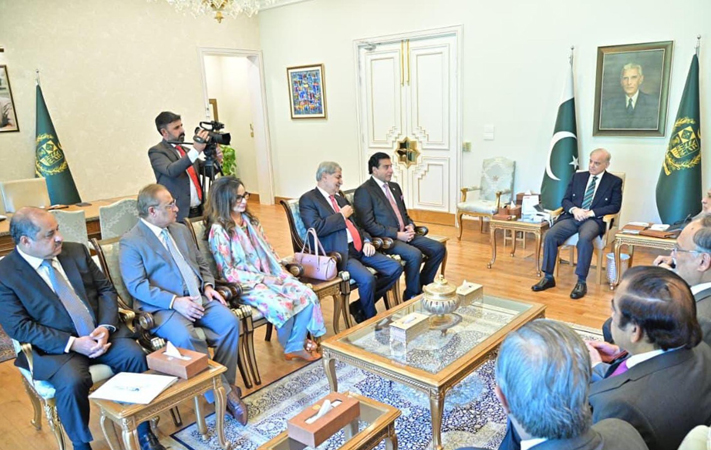
 The government has invited parliamentarians to an in-camera briefing on the regional situation scheduled for Wednesday, according to Law Minister Azan Nazeer Tarar.
Speaking in the National Assembly on Tuesday, the minister said Prime Minister Shehbaz Sharif had invited parliamentary leaders and party heads to “sit down and develop a course of action so we can move forward”.
“There are sensitivities we have to take into account and things that you cannot discuss openly, considering the tension in the region and our relations with brotherly Muslim countries,” the minister said.
“I am requesting both sides of the aisle that this is a sensitive situation and we must sit together for Pakistan and for the security of the wider region,” he said.
He further said that Prime Minister’s Adviser on Political Affairs Rana Sanaullah was giving “person-to-person invitations”. He further said that the briefing would be in-camera and would be scheduled for 11:30am.
Earlier in the day, Foreign Minister Ishaq Dar had also spoken about the in-camera briefing while addressing the Senate.
He said the briefing was expected to “touch upon” the situation in Afghanistan as well.
Meanwhile, Dar on Tuesday expressed concern at the “sudden” US?Israel coordinated attack on Iran, despite “positive direction” observed in talks between Washington and Tehran.
The minister made the remarks while addressing the Senate. In his speech, he recalled that the process of talks between the US and Iran “going successfully”.
Expressing concern at the “sudden” attack in light of the above-mentioned developments, he said, “It was a repeat of what happened in June last year,” referring to the 12-day war between Israel and Iran in June.
FM Dar recalled that last year in June, he, along with Iran’s Foreign Minister Abbas Araghchi, was in Istanbul at the meeting of a multilateral forum.
“Tensions were building up, and I remember Field Marshal Asim Munir sahib was on his way from the US to Pakistan and Araghchi suggested that I should ask the field marshal to come to Istanbul,” he said.
“So on June 12, the field marshal and I had a meeting with Araghchi, where we tried to convince him to resolve things through diplomacy and dialogue,” he said.
The foreign minister also recalled his August 2025 meeting with US Secretary of State Marco Rubio, where Dar said he had taken up the issue of Iran.
“I received a positive response,” he said, adding that Pakistan, on its part, had tried to ensure that the issue was resolved.
He said Pakistan objected to the US demand of no enrichment, arguing that “peaceful use of nuclear energy was a legitimate right”.
He recalled that it was agreed that “there should be surveillance of two to three countries, and Iran was happy with that”.
“It was then decided where the talks should be held, with one party suggesting Oman and Islamabad, while the other suggested Doha and Islamabad.”
“Islamabad was common in both suggestions; they were to be engaged in Islamabad, and we were happy to mediate,” FM Dar recalled.
Talking about Iran’s counter-attack on “so-called US bases,” the minister noted that “there have been attacks on infrastructure and airports as well”.
“Had this not happened, we would have rallied these countries to stand up and have a joint voice against Israeli and US actions,” the minister said.
Dar claimed that Pakistan was the only country which had condemned US-Israeli coordinated attacks, stating that “it took me 15 minutes to decide that we had to condemn”.
Dar also noted Pakistan’s Strategic Mutual Defence Agreement with Saudi Arabia, saying Pakistan told Iran to “please keep that in mind”.
“They (Iran) asked for some assurances,” he said, stating that Tehran asked for reassurances that Saudi “soil should not be used”.
“I got them the assurances,” Dar said, noting the “minimal reaction” on Iran’s part against Saudi Arabia and Oman.