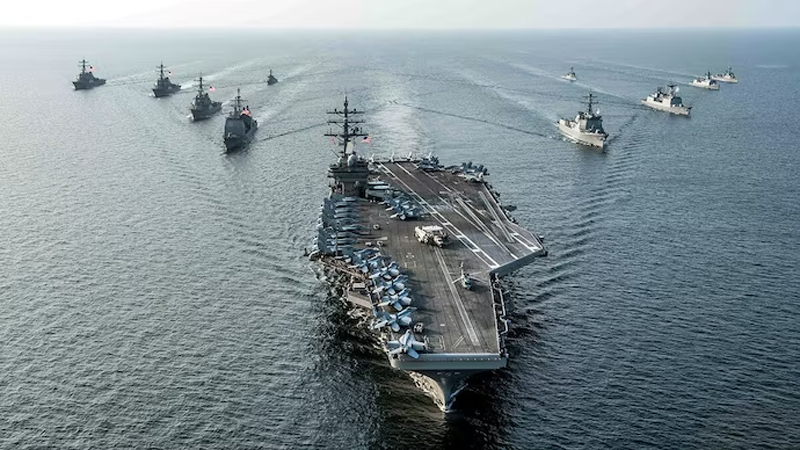
 A US naval strike group led by an aircraft carrier has deployed to Middle Eastern waters, the United States said Monday, as Tehran warned it was ready to hit back at any American attack launched in response to a crackdown on anti-government protests.
A US-based rights group said on Monday that it had confirmed the deaths of nearly 6,000 people in the wave of protests suppressed by Iran’s security forces, but emphasised the actual toll could be several times higher.
The protests started in late December, driven by economic grievances, but turned into a mass movement against the Islamic republic, with huge street demonstrations for several days from January 8.
But rights groups have accused authorities of quelling the movement with unprecedented violence, shooting into crowds of protesters under the cover of an internet shutdown that has now lasted 18 days – the longest Iran has ever imposed.
The clerical leadership who took power after the 1979 Islamic revolution remains in place despite the protests, with many opponents of the system looking to outside intervention as the most likely driver of change.
US President Donald Trump has previously threatened to step in, saying last week that Washington was sending a “massive fleet” to the region “just in case”.
The deployment of the USS Abraham Lincoln carrier strike group dramatically boosts American firepower in the region.
The United States backed and briefly joined Israel’s 12-day war against Iran in June, and while Trump last week appeared to step back from his threats of new military intervention, he has never ruled the option out.
Meanwhile, the United Arab Emirates (UAE) will not allow attacks on Iran to be launched from its territory, the foreign ministry said in a statement on Monday.
The foreign ministry said in a statement it “has reaffirmed the United Arab Emirates’ commitment to not allowing its airspace, territory or waters to be used in any hostile military actions against Iran”.
The UAE also refuses to provide logistical support for attacks, the statement said, adding that “dialogue, de-escalation, adherence to international law, and respect for state sovereignty” were the best way to address “current crises”.
Moreover, Saudi Arabia said it hoped to have “strong, positive” ties with the United Arab Emirates (UAE), the kingdom’s foreign minister said on Monday, but stressed that future relations were contingent on Abu Dhabi’s complete withdrawal from Yemen.
During a press conference in Warsaw, Saudi Arabia’s Foreign Minister Faisal bin Farhan said Riyadh was “always keen” to have a “strong, positive relationship with the UAE”.
“The UAE has now decided to leave Yemen, and I think if that indeed is the case and the UAE has completely left the issue of Yemen, the kingdom of Saudi Arabia will take responsibility,” he added.
“I think that will be the building block for making sure that the relationship with the UAE continues strong and continues to serve the interests not just of both countries but the region,” he said.
Zardari reaches UAE on four-day official visit
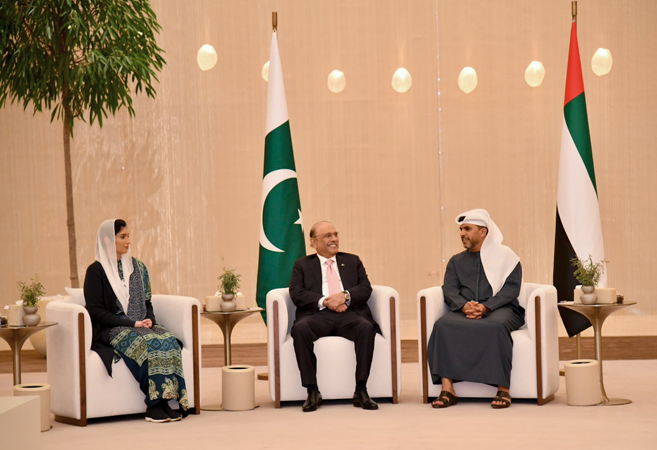
President Asif Ali Zardari on Monday night arrived in the United Arab Emirates (UAE) for a four-day official visit.
According to a handout from the Presidency, the president was received by UAE Justice Minister Abdullah bin Sultan bin Awad Al Nuaimi at Zayed International Airport in Abu Dhabi.
It said that First Lady Aseefa Bhutto-Zardari and Interior Minister Mohsin Naqvi were accompanying the president on the trip, adding that Pakistan’s Ambassador to the UAE Shafqat Ali Khan was also present on the occasion.
A statement released by the Foreign Office earlier in the day said that the president, accompanied by a high-level delegation, will undertake the visit from January 26 to 29.
“During the visit, the president will hold high-level meetings with the UAE’s leadership to review the full spectrum of bilateral ties, especially on the domains of trade and economic people-to-people ties,” the statement said.
The discussion will also focus on regional and international issues of mutual interest, the FO added.
It highlighted that Zardari’s trip, which follows the brief visit of UAE President Sheikh Mohamed bin Zayed Al Nahyan to Pakistan last month, “reflects the deep brotherly ties between the two nations and reaffirms commitment to transforming the strong friendship between Pakistan and the UAE into a mutually rewarding partnership”.