 Punjab Chief Minister Maryam Nawaz Sharif has said that the Kissan Card initiative has brought about a fundamental shift in the direction of agriculture in the province, expressing confidence that a bumper wheat crop would be harvested this year.
According to official figures, loans amounting to Rs100 billion have been disbursed to farmers through the Kissan Card, enabling them to purchase agricultural inputs without financial difficulty. The improved access to credit has resulted in record wheat cultivation across Punjab’s fertile farmlands.
The chief minister was informed that a new record was set in December with the sale of approximately 1.356 million metric tonnes of urea fertiliser, reflecting a 37 per cent increase compared to the corresponding period last year.
So far, Rs100 billion has been released to farmers under the scheme, out of which Rs65 billion has already been utilised. Of the utilised amount, farmers spent Rs47 billion on the purchase of fertiliser alone.
CM Maryam Nawaz said the Kissan Card had not only transformed Punjab’s agricultural landscape but also restored confidence among farmers, adding that the initiative had ensured timely access to capital, technology and financial resources. She emphasized that the progress and prosperity of farmers were vital for the overall development and economic stability of Pakistan.
Separately, Chief Minister Maryam Nawaz Sharif met a delegation of the National Workshop Balochistan comprising male and female students from various educational institutions of Balochistan.
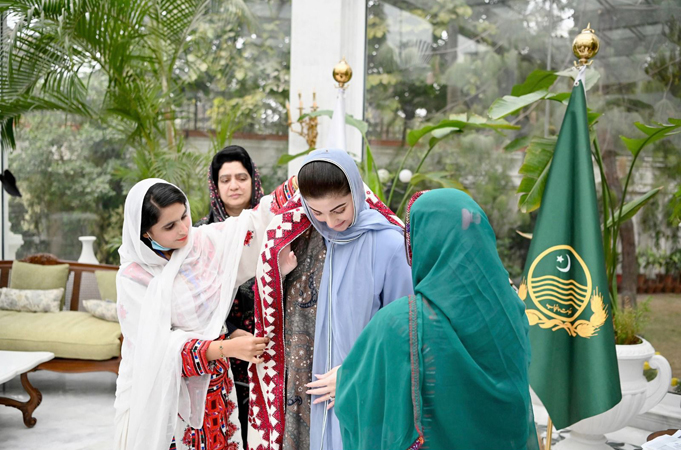
Welcoming the delegation, the chief minister termed their visit a source of happiness and said that Punjab always opened its doors to people from all provinces. On behalf of the people of Punjab, she presented laptops to the visiting students and also announced laptops for all members of the delegation. The students, in turn, honoured the chief minister by draping her with a traditional Balochi shawl.
The delegation described its visit to Lahore and the meeting with the chief minister as a memorable experience and appreciated her public welfare initiatives. Maryam Nawaz Sharif also responded to questions raised by the students during an interactive session.
Addressing the delegation, the chief minister said that a special helpline was being launched for economically deprived segments of society to ensure immediate assistance in cases of illness and medical treatment. She said students were the standard-bearers of Pakistan and that the country’s future rested with the youth, adding that her becoming the first woman Chief Minister Punjab was an honour for all daughters of Pakistan.
She said Punjab’s hospitals, colleges and universities were benefiting people from all provinces, citing the Children Heart Surgery Programme and the Nawaz Sharif Cancer Hospital as national projects serving citizens beyond provincial boundaries. Rejecting the perception of provincial discrimination, she said, “We have never differentiated between Sindhi, Punjabi, Kashmiri or Baloch. We are Pakistanis first,” adding that every province received its due share and that the real difference lay in effective utilisation of public funds.
Highlighting governance and law enforcement reforms, Maryam Nawaz Sharif said the crime rate in Punjab had dropped significantly, with suspects now being arrested within 24 hours. She said Punjab had become safer for women, with drones reaching crime scenes promptly and police responding immediately to panic button alerts, and praised the Inspector General of Punjab Police for his professional performance.
She said Safe City projects, surveillance cameras and modern technology were not only being used to track criminals but also to identify civic issues such as waste management. Under the housing initiative, she said, 25,000 houses had already been constructed, with a target of 500,000 homes over the next five years.
Members of the delegation shared their impressions, praising Lahore’s hospitality and expressing happiness over meeting the chief minister. A student from Turbat described Lahore as “beyond words,” while another remarked that although Maryam Nawaz Sharif appeared graceful, “her heart is even more beautiful.”
Chief Minister Maryam Nawaz reaffirmed Pakistan’s principled stance on the right to self-determination of the people of Jammu and Kashmir, saying that the United Nations resolution of January 5, 1949 guarantees Kashmiris the right to a free and impartial plebiscite.
In a message on the occasion of Right to Self-Determination Day, the chief inister said that the right to self-determination was a fundamental component of human dignity. She added that any deviation from the UN resolution amounted to a denial of human freedom and a violation of the Universal Declaration of Human Rights as well as international human rights treaties.
Maryam Nawaz Sharif said that the people of Kashmir had been waiting for the fulfilment of the promised right to self-determination for the past 77 years.
She expressed serious concern over India’s attempts to alter the demographic structure of occupied Jammu and Kashmir in an effort to undermine the Kashmiri identity.