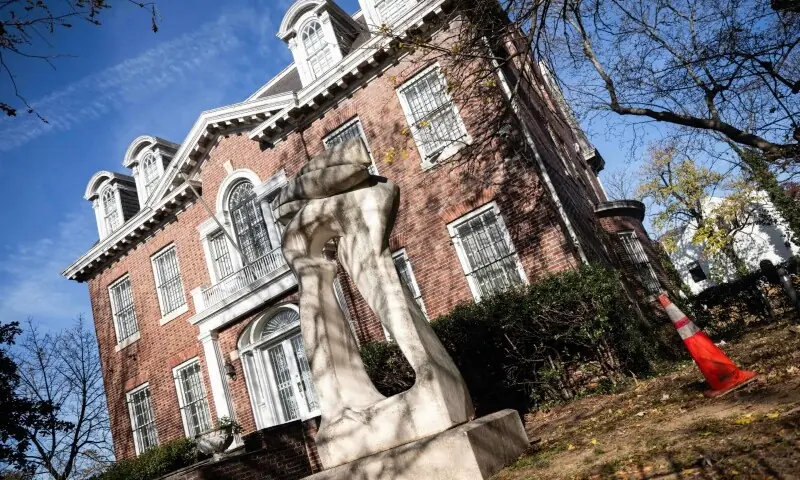
WASHINGTON: The quiet, tree-lined streets of Washington’s Kalorama district have become home to a cluster of abandoned embassies, their empty halls reflecting the turbulence of global politics. The most recent reminder came in September, when the wildly overgrown vegetation outside the shuttered Syrian Embassy was finally cleared and the country’s flag raised again, symbolising a potential reopening after 11 years.
The compound had been closed by the US government in 2014, amid Syria’s civil war. Its revival follows the Trump administration’s announcement on November 10 that diplomatic ties could resume after the rise of Syria’s new president, Ahmed al-Sharaa, an ex-Islamic State militant who ousted Bashar al-Assad in 2024. However, former Syrian diplomat Bassam Barabandi cautioned that the building’s condition is so deteriorated that it may take years before it becomes operational.
Kalorama’s decay is not limited to the Syrian mission. The Afghan Embassy, closed months after the Taliban’s return in 2021, still has yellowing newspapers stuffed into its mailbox. A once-active mansion that housed Russia’s trade delegation sits idle, its closure part of US reprisals over alleged Russian interference in the 2016 presidential election. Weeds have consumed its parking lot.
Local residents have long complained about the neglected properties, including the abandoned Syrian ambassador’s residence, where neighbours occasionally hired gardeners to tame the unsightly hedges. Notices of cut-off utilities still hang on the doors of several former diplomatic buildings.
According to the US State Department, 29 foreign properties currently sit in similar limbo — among them buildings tied to Afghanistan, Venezuela, Iran, China and Russia — many left frozen by wars, collapsed governments or geopolitical feuds. Their deserted presence now stands as a physical reminder of the unpredictable volatility of international diplomacy.