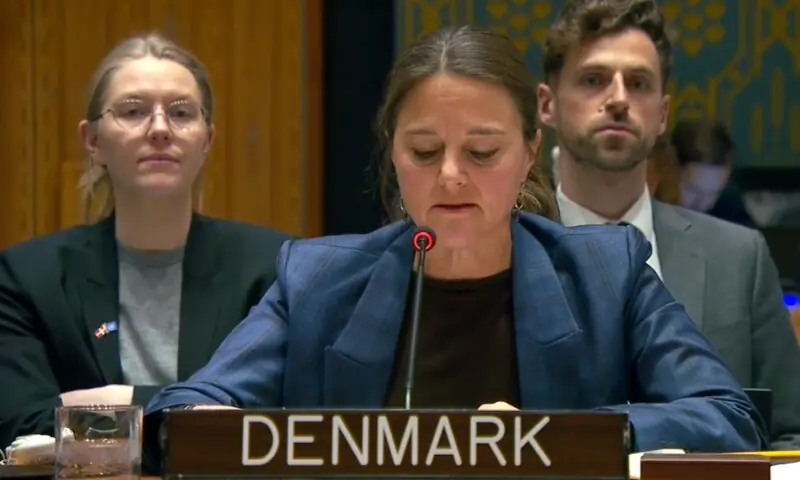
NEW YORK: Denmark highlighted the growing threat posed by the banned Tehreek-i-Taliban Pakistan (TTP) in Central and South Asia during a United Nations Security Council (UNSC) briefing on Wednesday. Speaking as chair of the Security Council ISIL and Al-Qaeda Sanctions Committee, Denmark’s Deputy Permanent Representative Sandra Jensen Landi warned that the TTP, with around 6,000 fighters, continues to receive “logistical and substantial support from the de facto authorities” in Afghanistan.
Read More: UN flags BLA-TTP alliance as major threat to Pakistan
Landi outlined that the TTP has carried out multiple high-profile attacks in Pakistan from Afghan soil, causing mass casualties. She also provided updates on the evolving threats posed by ISIL (Daesh), Al-Qaeda, and their affiliates, noting their increased use of propaganda, social media, and cryptocurrencies to recruit and fund operations. ISIL-Khorasan (ISIL-K) remains a key threat in Central and South Asia, targeting Shia communities, Afghan authorities, and foreign nationals.
Following Denmark’s briefing, Pakistan’s Deputy Permanent Representative to the UN, Usman Jadoon, stressed that unresolved conflicts and external interventions continue to fuel terrorism. Highlighting Pakistan’s sacrifices in combating terrorism, he said over 80,000 Pakistanis have lost their lives and the country has suffered billions in economic losses. He emphasized that entities like ISIL-K, TTP, BLA, and the Majeed Brigade are thriving under support from Afghanistan, which he described as a “principle adversary and net destabiliser in the region.”
Jadoon urged that the UNSC’s 1267 sanctions regime should be updated to reflect ground realities, calling for an impartial approach to listing individuals and entities without political bias. He also advocated for the UN’s counter-terrorism framework to include violent far-right, extremist, ultra-nationalist, xenophobic, and Islamophobic groups globally.
Read More: TTP reunification in Afghanistan poses threat to Pakistan: UN report
The UNSC briefing underscored growing concerns over regional and international terrorism, with both Denmark and Pakistan highlighting the need for close multilateral cooperation and strengthened sanctions to counter the threats.