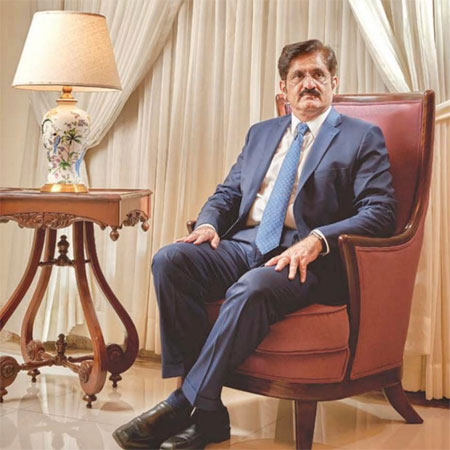
 Sindh Chief Minister Syed Murad Ali Shah, while reviewing the overall development portfolio of the Local government department – including major ongoing and foreign-assisted projects – instructed the department to accelerate the execution of ongoing schemes, focusing on water supply, drainage, and sanitation.
“We are investing in sustainable urban solutions so Karachi and interior Sindh residents can live in cleaner, healthier, and better-managed cities,” the CM said.
Presenting the department’s annual progress, Minister Nasir Shah reported that the development portfolio for 2025-26 includes 756 schemes with a total allocation of Rs 78.087 billion under the Annual Development Programme (ADP) and Rs 45.540 billion via Foreign Project Assistance (FPA). This comprises 713 ongoing, 17 carry-forward, and 43 new schemes, along with 304 Sustainable Development Goal (SDG) block projects and the major PPP-mode Shahrah-e-Bhutto Corridor project.
During FY 2024-25, the department completed 424 schemes of Rs 56.5 billion, greatly enhancing local infrastructure and urban services across the province, the CM was told.
Karachi Mega Projects
The CM was informed that Karachi Division’s major development portfolio includes nine mega projects worth Rs 7.66 billion, in addition to numerous agency-specific schemes such as Karachi Development Authority’s Rs 13.22 billion for 76 schemes, of them 69 are ongoing, one carry-forward, and are six new.
Karachi Metropolitan Corporation (KMC): Rs 18.36 billion for 200 schemes, including 10 new ones focused on roads, drains, and municipal facilities.
Karachi Water & Sewerage Corporation (KW&SC) is utilising Rs 1.80 billion for 47 schemes, including four new water supply and drainage projects. Lyari Development Authority (LDA) is spending Rs 2.30 billion for 35 schemes, including two new urban rehabilitation initiatives.
The CM also reviewed the Hub Canal Project of Rs 12 billion, and the Dumlottee Water Pipeline Project of Rs 10.54 billion, which aims to supply 10 MGD of water from the Dumlottee pumping station to DHA via the Malir Expressway. He directed the department to complete both projects within one year.
Foreign-funded Urban Development Projects
The Chief Minister expressed satisfaction with the progress of several major foreign-funded urban development projects in Karachi. Among these, the Karachi Water & Sewerage Services Improvement Project (KWSSIP) stands out, featuring two significant phases. Phase I, with an investment of Rs 25.47 billion and co-financed by the World Bank, the Asian Infrastructure Investment Bank (AIIB), and the Sindh government, focuses on the initial improvements to the city’s water and sewerage infrastructure. Phase II is a far larger undertaking, with a budget of Rs 167.10 billion (equivalent to $ 600 million), targeted at overhauling Karachi’s ageing water and sewerage systems to provide more reliable services for the city’s residents.
In addition to KWSSIP, the Competitive and Livable City of Karachi (CLICK) Project is advancing with an allocation of Rs 57.63 billion. This initiative seeks to enhance the performance of municipal authorities, introduce digital governance reforms, and upgrade infrastructure within Karachi’s local councils, thereby making the city more efficient and sustainable.
Another critical intervention is the Solid Waste Emergency and Efficiency Program (SWEEP), for which Rs 29.21 billion has been earmarked. SWEEP is designed to modernise Karachi’s solid waste management processes and improve general urban sanitation, addressing one of the city’s most pressing challenges.
Murad Ali Shah said that collectively, these projects underscore the government’s commitment to leveraging foreign assistance for the transformation of Karachi’s urban landscape, improving critical infrastructure and services for millions of its inhabitants.
The CM expressed satisfaction with the progress of major foreign-funded initiatives, including Karachi Water & Sewerage Services Improvement Project (KWSSIP):
After reviewing overall progress, the CM instructed the Local Government Department and its agencies to fast-track ongoing projects, with priority for those concerning water supply, drainage, and sanitation. “Improving water, sanitation, and solid waste systems is not just an infrastructure issue – it directly impacts people’s health, dignity, and quality of life,” the CM said. “We are investing in sustainable urban solutions so Karachi and interior Sindh residents can live in cleaner, healthier, and better-managed cities.”
He also directed improved coordination between the Local Government, P&D, and Finance Departments to ensure timely fund release, strict quality control, and transparent procurement.
The CM emphasised swift completion of foreign-assisted projects, especially those funded by the World Bank and AIIB, noting their vital role in upgrading Karachi’s urban resilience, water supply, and municipal services.
“Our focus is on sustainable, climate-resilient, and people-centred development,” the CM added. “Every ongoing scheme must reflect the government’s commitment to improved municipal governance and grassroots service delivery.”
He tasked Local Government Minister Nasir Shah with personally monitoring all mega projects in Karachi and other districts, and submitting monthly progress reports to the Chief Minister’s Office.