Over the last few years, India has embarked on an extensive and all-encompassing naval modernization program. This has been carried out primarily because of India’s aspiration for becoming a ‘blue water’ navy aimed at dominating the Indian Ocean and beyond. In this regard, India has expanded both its indigenously developed weaponry and most recently signed short and long-term hi-tech defence deals with the US to consolidate its naval buildup. By doing so, India has been able to enhance its strategic relationship with the US while acquiring advanced and sophisticated naval hardware. Since India has been recognized as the ‘major defence partner’ by the US, these deals carry a significant weightage for both its diplomatic and strategic ties with the US. Based on this, India’s offensive naval buildup would lead to significant long-term implications for the regional security and stability of South Asia.
Pakistan, for the time being, seems to be enhancing its indigenously developed anti-ship and anti-submarine capabilities
In modernizing its navy, India’s major focus seems to be enhancing its deterrent capabilities against Pakistan. This has been done with the acquisition of aircraft carriers, nuclear and conventional submarines, sea-launched cruise and ballistic missiles, destroyers, and attack and reconnaissance planes. At present, India possesses and intends to acquire a broad range of advanced weapons in its naval inventory that includes; advanced anti-ship missiles, torpedoes, and anti-surface and anti-submarine aircrafts. Furthermore, during President Trump’s first-ever official visit to India in February 2020, a deal worth $ 3 billion was finalized. The deal along with the provision of six AH-64E Apache attack helicopters for the Indian Army also includes 24 MH-60R Seahawk helicopters for the Indian Navy aimed at enhancing its anti-submarine and anti-surface warfare capabilities. Such acquisitions by India would likely further enhance its future capabilities vis-à-vis Pakistan.
It is worth mentioning here that the capabilities of both the AH-64E and MH-60R would be augmented by the communications, compatibility, and security agreement (COMCASA), which formalized the integration of secure, bilateral communication networks between the US and India back in 2018. These helicopters would be the first post-COMCASA hardware available to the Indian military and especially to its navy. Once acquired, upon delivery, the helicopters could come fully integrated with bilaterally secure networks and communications. This would increase Indian naval capabilities and dramatically enhance US-India military interoperability. In the same vein, this would likely help incorporate India into the larger sphere of cooperation with other western militaries that use similar equipment and software acquired from the US.
 In another significant development, on April 15, 2020, on India’s request, the US government has notified the sale of naval specific weapons worth $ 155 million. According to this, the US would provide 10 AGM-84L Harpoon Block II air-launched missiles and 16 MK 54 lightweight torpedoes to India. The advanced Harpoon missile system would be integrated into the P-8I anti-submarine warfare aircraft aimed at conducting anti-surface warfare missions. Moreover, the MK 54 lightweight torpedo would provide India the capability to conduct anti-submarine warfare missions. India’s acquisition of advanced naval weapons systems such as these would thus likely destabilize the pre-existing deterrence framework in South Asia. It would embolden India to consider countering Pakistan’s existing range of naval capabilities such as its anti-ship missiles, sea-launched cruise missiles, and reconnaissance planes with greater impunity.
Pakistan, due to its economic constraints cannot compete with India on a tit for tat basis. Hence, to address such a threat, Pakistan, for the time being, seems to be enhancing its indigenously developed anti-ship and anti-submarine capabilities. In order to restore stability and address this spectrum of threat, Pakistan has two choices; first, in the long term, to purchase similar, although expensive weapons systems from the international market such as from Russia and/or China. This obviously is a tall prospect, which already seems difficult given the country’s economic difficulties. Second, to counter India’s advanced naval weapons while staying within its existing operational capabilities. It seems that the induction of an increased number of anti-ship and anti-submarine platforms is a more plausible and immediate solution.
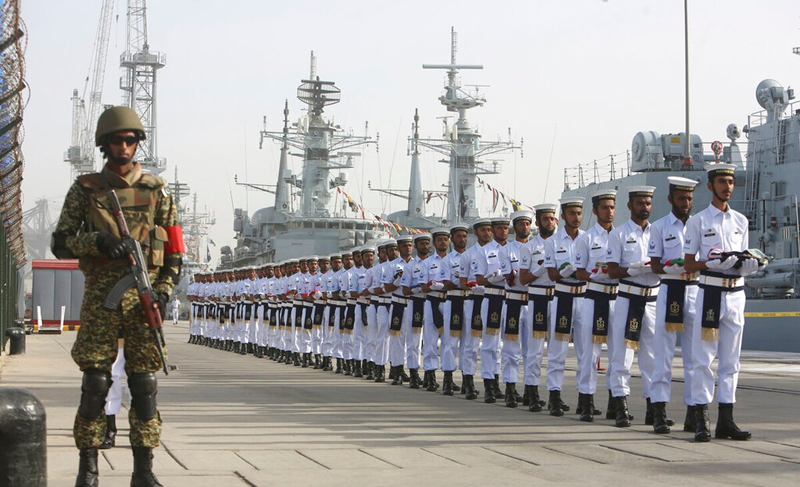
In this regard, on April 25, 2020, Pakistan demonstrated its naval preparedness with a series of anti-ship missiles tests in the North Arabian Sea. The successful firing of the anti-ship missiles would likely boost up Pakistan Navy’s operational capabilities and readiness. Furthermore, it was reported that a fast attack aircraft of the Pakistan Navy fired the missiles from the sea to surface level while few missiles were also fired from an underwater conventional submarine towards the ground. Pakistan’s rationale for exercising this milestone is widely believed to be inclined towards neutralizing a broad range of the expected outcomes of India’s naval modernization drive. This is further evident in the statement of the Naval Chief Admiral Zafar Mahmood Abbasi who acknowledged the navy’s satisfactory operational preparedness. He also asserted that Pakistan is fully capable to give a befitting response to India’s naval aggression, hence further reinforcing deterrence based on Pakistan’s appropriate naval resort.
Hence at present, India intends to project itself as a technologically advanced country that is capable enough to establish ‘strategic deterrence’ in South Asia based on the deployment of advanced naval weapons systems. The acquisition of advanced missiles and torpedoes, along with technical assistance and logistic support from the US is quite alarming at the time when the world is concerned to fight against the COVID-19 pandemic. This would further destabilize the already volatile South Asian region. Pakistan, which still holds a principled stance on instituting lost peace and stability in the region, is being overtly threatened by this Indian offensive naval buildup. In this regard, the induction and perhaps even testing of a medium to short-range anti-ship and anti-submarine missile seems to be the only way out, at least for the time being.
The writer is working as a Research Associate at the Strategic Vision Institute (SVI) Islamabad, Pakistan