The much-hyped Article 370 of the Indian Constitution provided temporary provision for the state of Jammu and Kashmir [J&K], granting it special autonomy. What essentially Article 370 assured was to limit the applicability of laws enacted by the Indian parliament on the J&K and further restricted the applicability of the provisions of the constitution of India on J&K, subject to the conditions of [1] [d] of the aforesaid Article; and ultimately, it bestows upon the president the power to make the Article inoperative by issuance of notification, with the ‘recommendation’ of the constituent assembly of J&K as under article 370[3].
Article 370 [1] [d] and 370[3] of the constitution of India, which are the bedrock of the instant controversy are reproduced in verbatim;
Article 370 [1][d] ”such of the other provisions of this Constitution shall apply in relation to that State subject to such exceptions and modifications as the President may by order1 specify: Provided that no such order which relates to the matters specified in the Instrument of Accession of the State referred to in paragraph (i) of sub-clause (b) shall be issued except in consultation with the Government of the State: Provided further that no such order which relates to matters other than those referred to in the last preceding proviso shall be issued except with the concurrence of that Government”
Article 370 [3] ‘Notwithstanding anything in the foregoing provisions of this article, the President may, by public notification, declare that this article shall cease to be operative or shall be operative only with such exceptions and modifications and from such date as he may specify: Provided that the recommendation of the Constituent Assembly of the State referred to in clause (2) shall be necessary before the President issues such a notification”
In August 2019, the President of India using its powers under Article 370[1] read with Article 370[3] issued Presidential Orders – C.O 272 and C.O 273, which effectuated in application of entire Indian constitution to the J & K, and declaring Article 370 in its present form to be inoperative henceforth. The Presidential Orders also resulted in nullifying the effect of Article 35-A of the Indian Constitution.
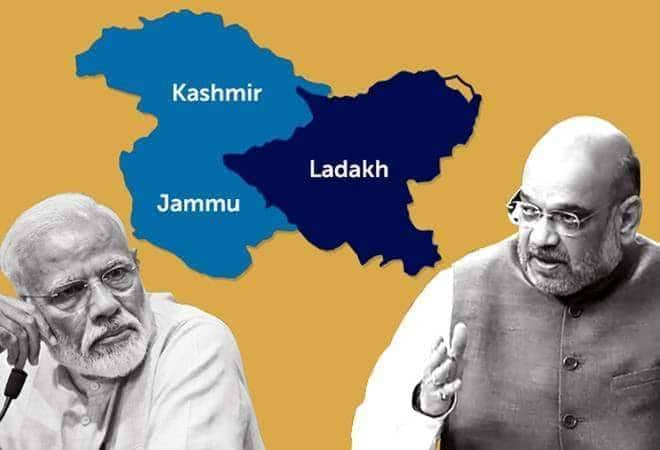
Thereafter, the Jammu and Kashmir [Re-organization] Act and 2019 [Act] was passed, which bifurcated the J&K into two separate union territories of J&K and Ladakh. However, through the cluster of writ petitions filed before the Supreme Court of India, various petitioners have challenged the constitutionality of central government measures which abrogated the special status of the J & K and the Act which bifurcated the state into union territories of J& K and Ladakh [collectively referred to as ‘measures’]. Besides the moral and democratic hiccups, the referred writ petitions raise serious legal questions that require determination by the apex court.
The line of arguments assailing these ‘measures’ are firstly to the effect that the Presidential Order C.O 272 makes use of Article 370[1][d][reproduced above], which was meant to be applicable to other articles of the Indian constitution in relation to the J & K and not to alter very scheme of Article 370 itself, thereby transmuting the fundamental relationship between the state of J&K and the Union.
The second line of contention in these writ petitions is that through the ‘measures’ under challenge, the Presidential Orders substitutes the concurrence of ‘governor’ for that of the ‘government’ against the express spirit of article 370[3] of the constitution. In support of this contention it has been contended that the Presidential Order takes cover of the temporary constitutional situation of presidential rule, and instead of taking concurrence from an elected government [constituent assembly] on an issue that permanently and fundamentally altered the status of J&K, took the approval of the Governor of the J&K, which in constitutional spirit amounts to the concurrence of the central government itself, who in no manner represented the aspiration and will of the people of J&K . Thus the by seeking the concurrence of the governor, the central government took its own consent, instead of an elected representative, and thus going against the scheme of article 370[3].
Thirdly, by making all the provisions of the Indian constitution applicable per se and in perpetuity to the state of J&K, by means of exercising powers under article 370 the presidential order in itself undermines, the fundamental purpose of article 370, which was meant to facilitate the extension of constitutional provisions to the state of J&K in an orderly manner, based upon the requirements and with the consent of the government of J&K. In furtherance to the same, it has been contended that the term ‘government’ used in article 370 cannot be equated with ‘governor of the state’ as far as in matters involving alteration of the fundamental constitutional structure of the state itself. The presidential rule being a temporary and exceptional phenomenon cannot be used as a covert scheme to make permanent and irrevocable changes, like the one in question.
Furthermore, against the bifurcation of state of J&K into union territories of J&K and Ladakh, it has been maintained that the Act is against the very fundamentals of article 1 and 3 of the constitution of India, which although provides for a range of power for alteration of states and creation of new states but do not permit the parliament to retrogressively downgrade the statehood into a less representative form such as union territory; such like through the impugned measures.
Only the time shall tell if the aforementioned objections can sustain before the apex court of India, however, come what may, there certainly lays a protracted legal battle before the dust of Article 370 settles down.
The writer is a Barrister-at-Law and partner at Ibrahim & Ibrahim – Barristers and Corporate Consultants.