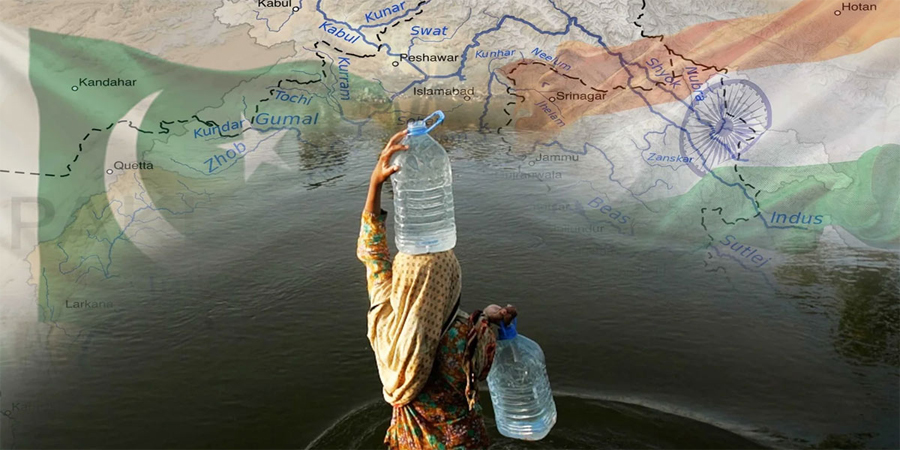
 India has reignited a “water war” during the winter season by abruptly releasing a large volume of water into the Chenab River at Head Marala before sharply reducing the flow to between 870 and 1,000 cusecs for four consecutive days.
In a weekly press briefing, Foreign Office spokesperson Tahir Hussain Andrabi said that abrupt changes in the Chenab’s water flow have been recorded since December 7.
“Pakistan views these variations with extreme concern and seriousness. They suggest unilateral release of water into the Chenab River by India without prior notification or data sharing,” he said.
He added that Pakistan has approached India through the Indus Water Commissioner, seeking details and clarification in accordance with the procedures outlined in the Indus Waters Treaty (IWT).
While highlighting the potential consequences of such unilateral actions, particularly during the critical agricultural season, the FO spokesperson said: “Any manipulation of river flow directly threatens the lives, livelihoods, food security, and economic well-being of our citizens,” he said.
According to officials, the Modi administration abruptly released 58,000 cusecs of water during the midnight hours of December 7 and 8, 2025.
Subsequently, on December 13, India sharply reduced the releases to an alarmingly low level of 870 cusecs, which remained between 870 and 1,000 cusecs until December 17. Historical data shows that average Chenab River flows over the past 10 years during this period ranged from a maximum of 10,000 cusecs to a minimum of 4,000 cusecs.
Pakistani authorities said India violated the Indus Waters Treaty (IWT) of 1960 by first emptying the Baglihar Hydropower Project reservoir and then refilling it, despite the fact that run-of-the-river projects on rivers allocated to Pakistan could not be arbitrarily emptied and refilled.
The Court of Arbitration, in its decision dated August 8, 2025, had already declared that India’s manipulation of water releases – through the emptying and filling of dams on rivers allocated to Pakistan – constitutes water weaponisation.
It is pertinent to note that on April 23, 2024, India unilaterally suspended the treaty. However, the Court of Arbitration later clarified that India could not suspend the treaty unilaterally and that it remained legally binding.