
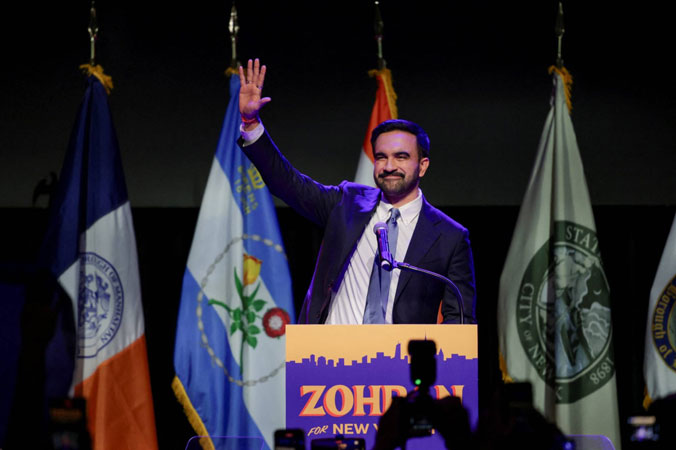
 “A moment comes, which comes but rarely in history, when we step out from the old to the new.”
On a crisp November night in New York, Nehru’s words from 1947 echoed once more; this time from the victory stage of Zohran Mamdani, a 34-year-old Muslim of South Asian descent and the newly elected mayor of America’s largest city. Quoting India’s first prime minister, Mamdani declared, “Tonight, New York steps from the old to the new.”
It was a line heavy with history, marking a political moment that stretched far beyond city limits. Mamdani’s triumph, paired with Ghazala Hashmi’s election as Virginia’s first Muslim and South Asian lieutenant governor and Aftab Pureval’s reelection as Cincinnati’s mayor, signalled the arrival of a new political generation: young, diverse, unapologetically progressive, and deeply rooted in the post-9/11 Muslim-South Asian diaspora.
Born in Uganda to an Indian father and a filmmaker mother, Mamdani built his campaign around economic equity and social justice–rent freezes, free public transport, and workers’ rights. His clear-eyed agenda resonated with disillusioned voters weary of establishment promises. Turnout surged to its highest in half a century.
If Mamdani’s win rewrote New York’s story of representation, Ghazala Hashmi’s in Virginia expanded it. Once a college professor, she defeated her Republican rival despite a barrage of Islamophobic attacks. Her calm response — “We’re not divided on those lines of bigotry” — captured the dignity of a candidate refusing to be defined by prejudice.
Pureval, the son of Indian and Tibetan immigrants, similarly extended that momentum from the Midwest, proving that Muslim-sounding names could now headline ballots. And win.
Collectively, their victories puncture the old narrative of token representation. They are not merely faces of diversity but architects of a broader movement that insists identity and competence are not opposites.
For the Democratic Party, this ascent offers both a gift and a challenge. The gift lies in their ability to energise youth and minority voters. The challenge lies in reconciling their Democratic Socialist leanings with the party’s cautious centrism. Mamdani’s outspoken support for Palestinian rights, for instance, unsettles moderates but galvanises a younger base disillusioned by political timidity.
Progressive groups like Justice Democrats hailed his win as proof that “a campaign built on rent control and dignity can defeat fear.” Yet party elders fret about alienating suburban moderates. Whether Mamdani and his cohort can translate protest energy into pragmatic governance remains an open question.
The symbolism is not lost on the Global South. In India, television networks celebrated the triumph of Indian-origin Muslims while politicians from across the spectrum hailed the diaspora’s “inclusive vision.” In Pakistan, however, the moment seems to have struck a different chord. One of reflection, if one may dare put words to it.
Here was a trio of Muslims from South Asian roots commanding America’s ballot boxes, while Pakistan itself remains mired in exclusionary politics. The contrast is jarring. An immigrant Muslim community in the West triumphs through pluralism, even as a Muslim-majority state back home wrestles with intolerance and disillusionment.
Lawyer and social commentator Yassir Lateef Hamdani took to X to comment, “Zohran Mamdani’s victory shows how flat the US is for its people. A Uganda born South Asian son of a Muslim father and a Hindu mother just became the mayor of the world’s most important city. Can a minority achieve this in Pakistan? No. And that is the tragedy.”
Political analysts in Islamabad privately note that these American elections have delivered a lesson in democratic elasticity, for these are Muslims who ran on issues, not slogans.
There is an irony to this story. For decades, the Muslim diaspora in the West has been caricatured as the “other.” Today, that same diaspora is redefining what inclusion means by earning it through policy, perseverance, and public trust.
Their wins also blur inherited categories of nationhood. Mamdani, Hashmi, and Pureval are all of Indian origin, yet their success resonates across borders, from Karachi to Kuala Lumpur. They are not Indian, Pakistani, or Bangladeshi triumphs alone; they are collective diasporic victories against the narrow politics of fear.
For all those still unwilling to read the writing on the wall, the crowd’s final chant must have been a jolt of lightning, as they danced to the Bollywood anthem Dhoom Macha Le. The symbolism has truly come full circle.