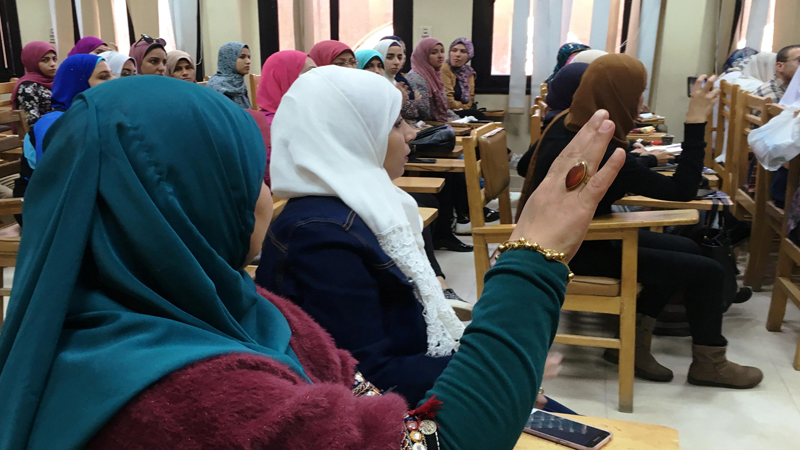
 During a recent class at Cairo University, students laughed as they watched a skit acted out by their peers about a married couple.
The husband came home from work and asked his wife, who was sweeping the floor, why dinner wasn’t ready.
“I pick up the kids and I go to work. Am I neglecting something because the food is still on the stove?” the wife asked, to which the husband responded, “The apartment looks like a rubbish dump.”
The skit was part of a new government project called Mawadda, which offers lessons to university students about how to pick the right partner and how to handle conflicts in marriage. The goal is to prevent divorce after the number of divorces reached more than 198,000 in 2017, a 3.2 percent increase from the year before.
Mawadda, meaning affection, is still in a trial phase, but the goal is to target 800,000 young people yearly starting 2020 and to eventually make it mandatory for university students to take a class before graduating.
After watching the skit, some students and the teacher pointed out that the husband should carry out more household tasks.
“It’s not her obligation to do all that,” said Salah Ahmed, the teacher, adding that Prophet Muhammad (Peace Be Upon Him) helped his wife with all tasks and his example should be followed.
But he also said the wife should have been more understanding and tried to look good for her husband instead of welcoming him while sweeping the floor.
Julia Gosef, a 23-year-old student who attended the class with her fiancé, said she worries that Egypt’s economic hardships could harm her marriage. The couple will not be able to rely on one income so she would be forced to work, which could lead to arguments similar to the one in the skit, she said.
Mawadda, meaning affection, is still in a trial phase, but the goal is to target 800,000 young people yearly starting 2020 and to eventually make it mandatory for university students to take a class before graduating
“I think I won’t be able to take care of our home well enough,” she said.
Mawadda’s lessons will be accompanied by YouTube videos, a radio program and educational plays. The church and Egypt’s top Sunni Muslim authority, Al-Azhar, are partners.
 “If we want to solve the problem from the root we need to target people before they get married,” said Amr Othman, manager of Mawadda at the Social Solidarity Ministry. He added that there’s a correlation in Egypt between divorce and problems such as child homelessness and drug addiction.
At a youth conference in July, President Abdel Fattah al-Sisi said divorce and separation meant that millions of Egyptian children were living without one of their parents.
Islam allows men to end their marriages verbally, only by telling their wives they are divorcing them. Sisi has said he wants to see an end to this practice in Egypt because the divorce rate is too high. The Mawadda project was launched in response to Sisi’s concerns, officials said.
It typifies some of Sisi’s efforts to drive social change.
“He is patriarchal and speaks to Egyptians as if he was their father,” Barak Barfi, research fellow at New America, a think tank based in Washington, said of Sisi. “It reflects his belief that transformation can be instituted from the top rather than from below at the grass roots level.”
Adhab al-Hosseiny, 26, who played the role of the husband in the skit, said he hoped to get married in the near future.
He also worries financial difficulties might lead to arguments between him and his future wife.
“What might cause problems after I marry is external pressure,” he said. “If there are money issues in terms of affording school fees and food, all that affects my mental state.”