
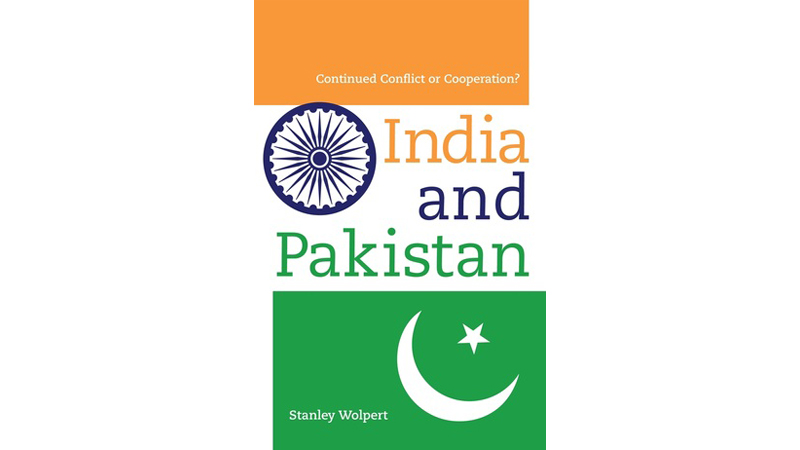
 India and Pakistan have come to a fork in the road. Will the siblings continue the conflict that attended their birth 71 years ago and which has continued ever since, in the form of major wars, minor wars, insurgencies, and a cold war, indefinitely into the future, bringing with it all the hardships and deprivations that flow from unmitigated military spending and the threat of a nuclear holocaust? Or will they see the light, take the high road, and begin a journey toward peace and cooperation?
These questions are at the heart of Wolpert’s fine book. He is not the first person to write on the subject of war and peace in the subcontinent. But what he brings that most others don’t is that he is a historian, not a political scientist, economist, or warrior.
Wolpert is a professor emeritus of history at UCLA and the eminent biographer of Jinnah, Gandhi, Zulfikar Ali Bhutto and Nehru. The book under review is essentially a biography of the troubled relationship between India and Pakistan. Along the way, he also comments in his inimitable style on some of the personalities that have shaped history.
“It might require years, if not decades, of patience and persistent fortitude before India and Pakistan finally attain sanity and prosperity together”
One of these is Bhutto, the youngest cabinet minister in Ayub’s 1958 martial law cabinet. He shows how Bhutto turned on Ayub after the inconclusive war of 1965, and how he went on to become Pakistan’s first civilian chief martial administrator and president and later it’s prime minister.
Wolpert discusses how Bhutto had promised a new Pakistan that would be prosperous and progressive in his opening speech after General Yahya was removed from office. Without citing a source, he says that inspiring speech was suggested to Bhutto by Henry Kissinger.
He describes how Bhutto’s resort to socialism ruined the country and how it came to an end after he had over-reached and rigged the elections of 1977. He says Bhutto could have won the elections without the rigging. In the chaos that followed the rigging, his self-appointed army chief turned on him, an ironic echo of what he had to Ayub. Alas, “Pakistan’s best-educated popular leader… profligately squandered all his advantages” and died on the scaffold.
Wolpert observes ruefully that “a quarter century after it was born, Pakistan … lost more than half its original population, and the respect of most of the world.” In the decades that followed, its polity lurched from unpopular military rule to unstable civil rule. Like most scholars, he is no fan of Musharraf’s rule which began with the Kargil war and ended ignominiously with the declaration of an emergency, suspension of the constitution, and removal of the chief justice.
During Musharraf’s tenure, “a car full of armed Pakistanis” attacked the Indian parliament just months after the 9/11 attacks. Wolpert says that for the next six months, “the two nuclear powers faced each other eyeball to eyeball …posing the greatest potential danger to South Asia as a whole, and to world peace, since the Kargil war.”
He painfully chronicles the litany of terrorist incidents that followed, beginning with the execution of US journalist Daniel Pearl in February 2002, followed on 20 September 2008 by the attack on the Islamabad Marriott in Pakistan’s most protected area. In November 26, 2008, the Taj hotel in Mumbai was attacked by “ten Pakistani terrorists,” and on March 3rd, 2009, the Sri Lankan cricket team was attacked in Lahore, forcing the Pakistani team in the years that followed to play its “home” games in the UAE.
The rest of the book focuses on what Wolpert regards as the core dispute between the two neighbours, Kashmir. He acknowledges there are several UN resolutions calling for a plebiscite to decide the future of the state but “India’s adamant refusal to accept any of the Security Council proposed resolutions … has by now removed them from the realm of realistic options.”
Another option, supposedly favored by a majority of the Kashmiris, is independence. But since that proposal has “never won any official support from either India or Pakistan,” it remains “an implausible option.”
Thus, “the most realistic solution to the Kashmir conflict would appear to be acceptance of the current Line of Control.” Wolpert recognises this is not what Pakistan wants. Unfortunately, he says, Pakistan has lost its ability to influence the fate of Kashmir because of its “failure to sustain a freely elected civil polity capable of protecting its own people for long [which] has reduced virtually to zero the credibility of its repeated demands for self-determination for Kashmir’s Muslim majority.”
Wolpert says that until Pakistan’s leaders are “strong enough to control the Al-Qaeda and Taliban militants who inhabit its entire Afghan frontier, and to end the nurturing on Pakistani soil of suicide bombers bent on killing Indians, Americans, Sri Lankans, or other innocent people the world over, their demands for a democratic resolution of Kashmir’s conflicts will have little credibility and win scant support.”
Wolpert suggests that India and Pakistan sign “a bilateral agreement specifying greater cooperation economically, educationally and culturally between the two countries.” Instead of focusing so much of its budget on the military and so much of its foreign and defense policy on containing India, Wolpert says Pakistan should focus on “bolstering its economy and strengthening its educational institutions…the process of institution-building will be slow, arduous and obviously expensive, though in the long run relatively reasonable compared to the cost of continuing the conflict and the threat of nuclear war.”
“Many angry and frustrated extremists in both nations will, doubtless, try to derail the peace process. It might require years, if not decades, of patience and persistent fortitude before India and Pakistan finally attain sanity and prosperity together. But the younger generations of both nations will surely prevail, should their elders lose heart and seek to fall back upon ancient religious hatreds or narrow national antipathies.”
The book is lucidly written but could have used some footnotes and reference. A bigger failing is that it does not tell us how or why Pakistan and India will seek a negotiated solution on Kashmir after quarreling for seven decades. But even then it’s a must read.
Maybe the future will be different. Pakistan’s new prime minister believes wars solve no problems. But it’s not clear that he calls the shots when it comes to dealing with India.
General elections are scheduled to take place in India next year. A new Indian prime minister may seize the opportunity and extend the olive branch. Only time will tell. The fate of the subcontinent hangs in the balance.
Published in Daily Times, October 27th 2018.