
 General Pervez Musharraf seized power on October 12th, 1999 and ruled the country until August 18th, 2008. After a halting start, the commando swung into gear. The economy began to grow.
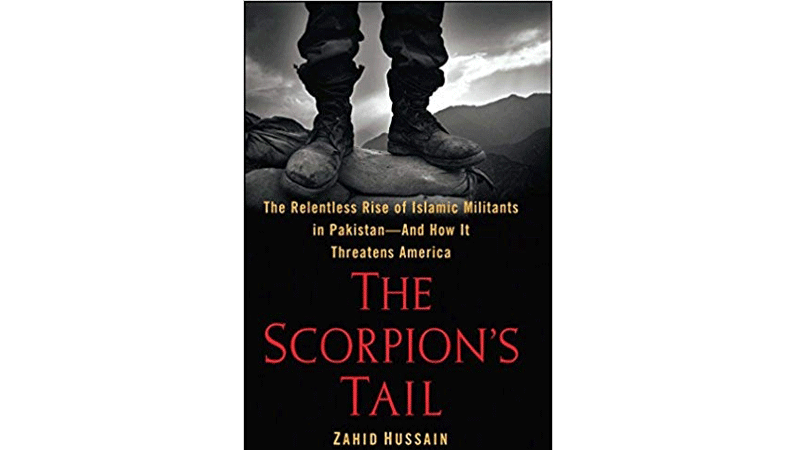
At one point it had looked like Musharraf would pull off the greatest upset in history and make peace with India. But then things began to fall apart. Zahid Hussain’s book carefully and meticulously chronicles why Musharraf fell from grace. Six mistakes are identified.
The metaphor in the title is the Taliban. Even after its wiped out, it comes back, like the tail of the scorpion. In 2005, the Taliban begin killing their opponents in a grisly fashion, often hanging their corpses from light poles. The Pakistani authorities looked the other way.
In March 2006, Taliban armed with machine guns and rocket launchers seized key government buildings in Miranshah. Sharia law was declared. Video shops were shut down. Men had to keep beards. A radio station playing music was blown up. Girl schools were attacked.
Militant violence reached its apogee in the lush green alpine territory when a long-haired firebrand cleric, Mullah Fazlullah, launched his militia. In January 2007 a local businessman with anti-extremist views was kidnapped. Days later his mutilated body was found.
In the next two years, hundreds of activists were hunted down, tortured and killed. A local woman dancer was killed for betraying Islam and her body dumped in the town plaza. A man was shot dead simply for wearing a shalwar that covered his ankle.
The metaphor in the title is the Taliban. Even after its wiped out, it comes back, like the tail of the scorpion. In 2005, the Taliban begin killing their opponents in a grisly fashion, often hanging their corpses from light poles. The Pakistani authorities looked the other way
Musharraf’s first mistake was to sit out the killings. Public anger swelled at his handling of the insurgency, both inside and outside the country, and his grip on power began to falter.
Unsurprisingly, he turned increasingly autocratic. As his position weakened, the Chief Justice of the Supreme Court began taking a harder line on violations of human rights since increasingly large numbers of people were “being disappeared.”
Musharraf’s fired the Chief Justice. That was the second mistake. This led to widespread protests across the country by lawyers. The lawyer’s movement galvanized the major opposition parties, and Musharraf’s hold on power grew tenuous.
Musharraf’s third mistake was the decision to take action against the militant clerics of the Lal Masjid. They had become violent in their calls for action. This triggered the dictator’s downfall.
On July 3, 2007 matters came to a head. Only a stone’s throw from the HQ of the agencies and a few blocks from Parliament and the Presidency, the mosque had become a base for Taliban-style vigilante squads.
On Musharraf’s orders, electricity and gas were shut off to the mosque. Troops, backed with tanks and armored cars, surrounded the complex.
The militants refused to surrender and in the fire fight that broke out, many soldiers were killed as the militants opened fire with automatic weapons. Musharraf toughened his stance and safe passage to the militants that had been promised earlier was refused.
A few days later, the commander of the special operations forces was shot dead by a sniper holed up in a minaret. Troops were ordered into the mosque and mass killings ensued, reminiscent of the attack on the Golden Temple in Amritsar by Indian forces.
Says Hussain, “The violent end of the Lal Masjid rebellion marked a critical watershed in Pakistan’s struggle with Islamic militancy.” Al-Qaeda’s al-Zawahiri, who had refrained thus far on saying anything against the army, declared: “These events have soaked the history of Pakistani army in shame, which can only be washed away by retaliation.”
In July, Fazlullah declared jihad and attacked a military convoy moving toward Swat, killing 13 soldiers. More attacks followed, killing dozens of soldiers.
Public anger at Musharraf swelled as the presidential elections approached on October 6. Musharraf’s fourth mistake was to clamp down on the media, shutting down several TV channels. On July 20 the Supreme Court reinstated the Chief Justice. Musharraf now faced the wrath of the judiciary.
In desperation, he reached out to an old adversary, Benazir Bhutto. The book recalls an earlier meeting between the two, when she was the prime minister and he was the director of military operations. He had proposed the Kargil operation. She had refused, fearing a wider war. Relations between the two had soured.
But times had changed. The two met secretly in Abu Dhabi in January 2007. He offered to step down as army chief and to drop all charges against her husband. As Musharraf’s popularity tanked, she made new demands on him in return for returning to Pakistan. She was confident of becoming the prime minister.
On October 5, a day before the presidential elections, he made his fifth mistake and signed the National Reconciliation Ordinance, granting amnesty to her husband and to Nawaz Sharif, among others.
In late October, in response to demands from the US, he ordered 10,000 troops into the Swat Valley. Hundreds of militants were killed and Fazlullah was captured.
The Supreme Court was expected to annul the presidential election results since he had violated the constitution by wearing the uniform. On November 3 Musharraf made his sixth mistake by declaring an emergency and sacking the Chief Justice for a second time. This reckless action was condemned swiftly by his western allies and met with howls of protest in the country.
On Dec 27, 2007, while addressing a public rally, Benazir Bhutto was killed. While the Taliban were believed to have killed her, Musharraf stood accused of providing insufficient security.
The new army chief, General Kayani, was not keen on propping up his boss any longer. Musharraf said he would not step down under any circumstances. Months later, under pressure from Kayani, he had to eat his words. He announced his resignation in an emotional speech.
The first dictator, Ayub, had also resigned under pressure from the army chief, Yahya, saying in an emotional speech that he could not preside over the destruction of the country.
At least Ayub and Musharraf had a chance to make farewell speeches. The second dictator, Yahya, was buzzed out of the presidency by fighter jets. The third dictator, Zia, died in a plane crash.
The last part of Richard Wagner’s operatic series, The Ring, is called Gotterdammerung, or the twilight of the Gods. Wagner could well have been writing the script for Pakistan’s dictators. They never quit while they are ahead. The end is climatic, swift and hurried, and totally unforgiving.
Published in Daily Times, September 25th 2018.