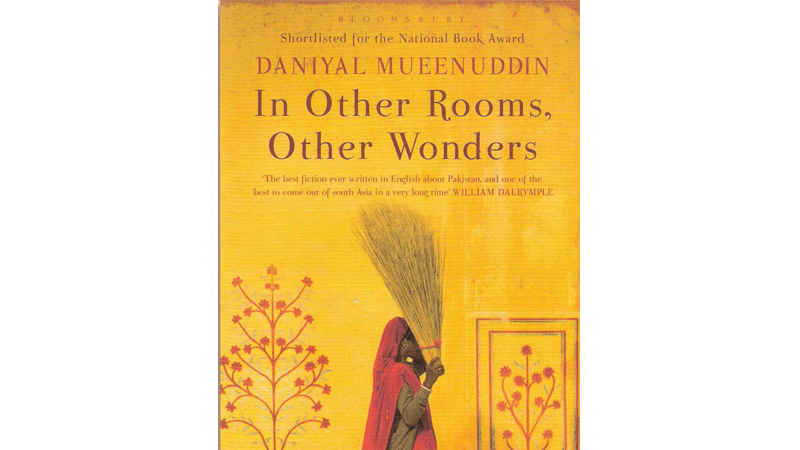
 Having heard of various reviews before starting, In Other Rooms, Other Wonders, I anticipated that Daniyal Mueenuddin will highlight the crude realities of our society and will expose all that is swept under the carpet; leaving us right there: hanging in between: searching for answers. Not only he will scratch the wounds but will leave them right there, bare and unhealed.
“Three things for which we kill: Land, women and gold” (Punjabi Proverb). Set in Pakistan’s district of Punjab, the plot of all eight stories revolve around one main character of KK Harouni, who is a retired civil servant and as he is getting on with years, he still is leading a lavish life. Harouni, a patriarchal landlord, runs the land his family has owned for 100 years in Dunyapur and a mansion in Lahore; both of which are handled and ruled by his workers and servants. And so the lives of his various employees are twisted around his own: of gardener, electrician, cooks, servants, managers etc. As the plot begins we are introduced to a feudal land-based system which is being threatened by the new industrialism of the 70s and 80s. Meanwhile, Harouni is chiefly surrounded by diverse set of servants as his daughters who live in cities—like Karachi, Paris, and New York—are far away from their father’s home with nil emotional affinity. Consequently, the servants rule the farm and mansion as they manage to escape the poverty of their homes and find employment with the Harouni family; praying in their hearts for the wellbeing of Harouni. Not because he is a solicitous master but instead they know that after his death their lives will change forever.
In Other Rooms, Other Wonders, vividly deals with the history and rural culture of Pakistan, specifically portraying the times of 1980s. The aristocratic lifestyle of Harouni and his family, throughout the novel remains all powerful representing the old barons who still dominated the government. The intricate social hierarchy of that historical time is reflected well in the plot of the story: the big mansion of Harouni, the far-stretching farms, parties of whiskey and champagne; parallel goes the tale of servants whose life of splendor is short lived.
It won’t be wrong to say that Mueenuddin succeeds in recreating a world where threads of longing, loss and unfettered love are intertwined with those of corruption, hunger for power and pursuit of economic happiness surpassing moral sensibility of every kind
While reading this book, I had this one constant question in my mind, that how can Mueenuddin observe such intrinsic details of Punjab’s rural life when he actually lives in America? How can he magnify our dark realities when he himself is surrounded by an entirely different culture? However, I got to know that he has been looking after his father’s farm in the district of Punjab for a long time, and that most of his stories are inspired from firsthand experience. These stories can be said to be a reflection of his daily life at the farm as I was taken aback by his fluent Punjabi which I got to hear in his one of the interviews at Karachi Literary Festival. Belonging to a Pakistani father and American mother, Mueenuddin lived his early childhood in Pakistan where he spent his time shifting between the urban and rural homes of his family. As a child he had been shrewd enough to jot down the comprehensive realities of both the rural (lower class) life surrounding him and the land-owning upper class to which his family belonged. Mueenuddin attended high school in the United States and then continued his education there, however, he now works as the manager of his family farm. Mueenuddin, till the end, assures that the Punjabi maxim (introduced at the beginning) stays the core theme of each story, as he explicitly weaves the three – land, women and gold – in the tapestry of his plot and keeps them interwoven. As a result, Mueenuddin’s female characters go through a desperate need to make strategic alliances with men without which they cannot survive in the patriarchal setup. Sometimes these relationships are based on love, sometimes love is based on mercenary purposes. As long as these alliances last, women have security and little power at home. However, as soon as the relationships end – usually as a result of death, manipulation or illness– the women are cut off and marginalized. And so the reader realizes that the only option Pakistani woman has of achieving her goals is by ‘alluring the men’ through her dazzling charms. “Zainab by contrast knew how to please him. She wore no scent but bathed always before he came home and wore attractive clothes.”Dalia Sofer notes in her review of the book in The New York Times that “In Mueenuddin’s Pakistan, happiness is usually short-lived. The women in these stories often use sex to prey on the men, and they do so with abandon at best and rage at worst — in this patriarchal, hierarchical society, it is their sharpest weapon. Women in the lower classes sleep their way up only to be kicked back down, while those in the upper classes use their feminine influence to maneuver their husbands into ever-growing circles of power, until age corrodes their authority.” And so, all the characters revolve around the acts of manipulation, exploitation and selfishness. Mueenuddin successfully describes how economic differences shape the behavior of elite towards the power. Through representing different characters, his stories show how poor people regardless of gender are the most deprived members of the population. Michael Dirda remarks in his review in The Washington Post, “these connected stories show us what life is like for both the rich and the desperately poor in Mueenuddin’s country, and the result is a kind of miniaturised Pakistani “human comedy.” Mueenuddin not only highlights the grim realities of human nature but also magnifies the downtrodden feudal system where ‘might is right’. There are certain scenes that give you goose bumps the moment you read them. I remember, in the last story, during one of the last scenes, just when Rezak’s wife goes missing, we found ourselves sitting in the police cabin where one of the policeman while suspecting Rezak, slaps him and comments: “You listen to me, I can make you fuck your own daughter if I want to, you’ll hump her all night, like a dog fucking a bitch.” It won’t be wrong to say that Mueenuddin succeeds in recreating a world where threads of longing, loss and unfettered love are intertwined with those of corruption, hunger for power and pursuit of economic happiness surpassing moral sensibility of every kind.
Published in Daily Times, September 23rd 2018.