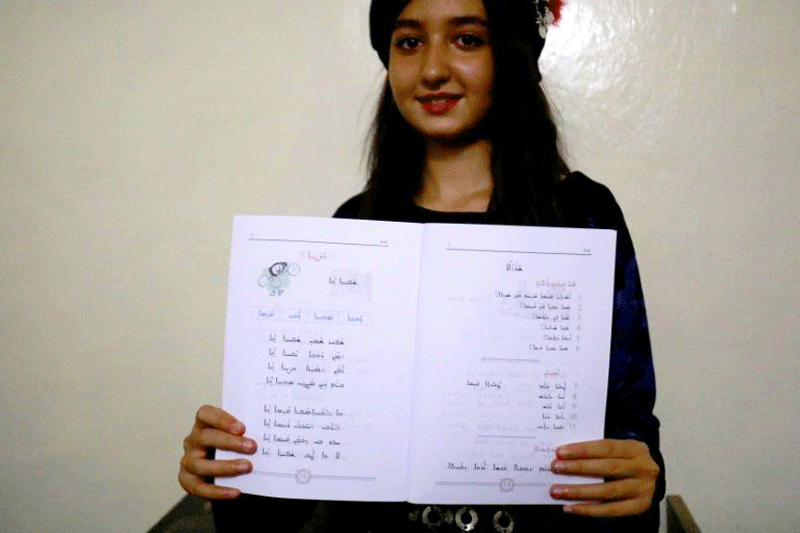
 Kurdish authorities in Syria’s diverse northeast are facing swelling anger from the area’s Syriac Christians after shutting down more than a dozen schools run by the ancient minority.
At the heart of the dispute is a debate over whether to use the new school curriculum championed by the Kurdish-led autonomous administration or stick to the accredited system used by Damascus.
The schism reflects the broader fissures in the northeast between those supporting formal state institutions and those defending parallel bodies developed by the Kurds.
After regime forces withdrew from swathes of Syria’s northeast early on in the seven-year war, Kurds began building up their own institutions in the area, including police forces and schools.
They put an emphasis on minority rights, with Kurdish schools teaching all subjects in their own language and Syriac schools doing the same in their ancient tongue.
But now, some Syriac Christians in Hasakeh province are insisting on using the accredited state curriculum over worries Kurdish diplomas will be considered invalid elsewhere.
“Learning in your mother tongue is something all peoples have a right to in this region,” says Danny Saliba, who teaches science in Syriac in the northeastern city of Qamishli.
“But the problem is the recognition of this language.
“No universities — whether Syrian or foreign — recognise this curriculum or the diploma issued by the autonomous administration’s education commission,” he tells AFP.
The dispute prompted Kurdish authorities last week to shut down 14 schools in the cities of Qamishli, Hasakeh, and Al-Malikiyeh that were supportive of teaching the state curriculum.
Dozens of people took to Qamishli’s streets in protest, waving the two-star Syrian government flag and chanting in support of President Bashar al-Assad.
But their demonstrations were in vain. On Monday, as students headed back to class across Kurdish-held territory, the schools remained shuttered.
Legitimacy of Syrian state
Syria’s Christian community made up about 10 percent of the country’s pre-war population of 22 million people. Tens of thousands hail from the Syriac Orthodox and Syriac Catholic traditions.
Their liturgies are in the ancient Aramaic language, which Jesus is thought to have spoken, and some even use it in their daily lives.
Syrian Christians are broadly seen as having sided with Assad’s regime, although some of the opposition’s most prominent figureheads are Christian too.
Ties are complicated in the northeast, where Syriacs make up the largest Christian community.
Syriac churches have typically stuck by the government, and the pro-regime Syriac Defence Forces — or Sotoro — have fought alongside regime troops.
But other factions back the Kurdish-led autonomous administration, including the Syriac Union and the Syriac Military Council, which helped US-backed forces oust the Islamic State jihadist group from parts of the north.
They have enjoyed the relative autonomy afforded in the Kurdish-governed northeast, but that may not last long.
Damascus has never recognised the autonomous zone, rejecting the federal system championed by the Kurds and repeatedly pledging it would recapture all of Syrian territory. Now, regime officials and Kurdish representatives are in talks to hash out some kind of deal for the northeast.
Negotiations are also ongoing between the Kurdish administration on one side and supporters of the state curriculum, chiefly Syriac Orthodox church leaders, on another.
‘Very exclusive’
In the Church of the Virgin Mary in Qamishli, Father Saliba Abdallah says he is sceptical about the Kurdish education system.
“Who recognises this curriculum internationally? Is there a state that actually recognises the reality of this region?” asks Abdallah.
While Syria’s state diplomas are accredited and recognised elsewhere, Kurdish degrees likely wouldn’t be.
“The legitimacy of our schools comes from the legitimacy of the government of the Syrian Arab Republic,” Abdallah says.
But others say the school dispute, at its core, is about self-determination.
“The Syrian state’s curriculum was very exclusive and distorted history and the Syriac language,” says Elizabeth Koriya, head of the Syriac Cultural Association, which is tied to the autonomous administration.
“Syriac was taught only as a liturgical language… It was limited only to prayer.”
Teaching all subjects in Syriac, however, would push children to take pride in their identity and community, says Koriya.
In the Al-Wusta neighbourhood of Qamishli, young Syriac-speaking men and women gathered in traditional clothing for a course in the ancient language.
“In the past at state schools, we used to take all our classes in Arabic and never learned Syriac, except in religious classes where there were hymns,” says their instructor Samira Hanna, 47.
“But now, we’re taking math in Syriac — history, geography, and social studies too,” she says proudly.
“I’ve very happy because I’ve become a language teacher and can teach Syriac to my kids and people of all ages.”
Published in Daily Times, September 13th 2018.