
 Salima Hashmi, an avant-garde artist and art critic based in Lahore, has curated two exhibitions themed on the Indian Partition in the past two years.
One such iconic exhibition was held in Delhi in January 2016. The Gujral Foundation and the Devi Art Foundation brought both Indian and Pakistani artists together. The house was owned by the Gujral family.
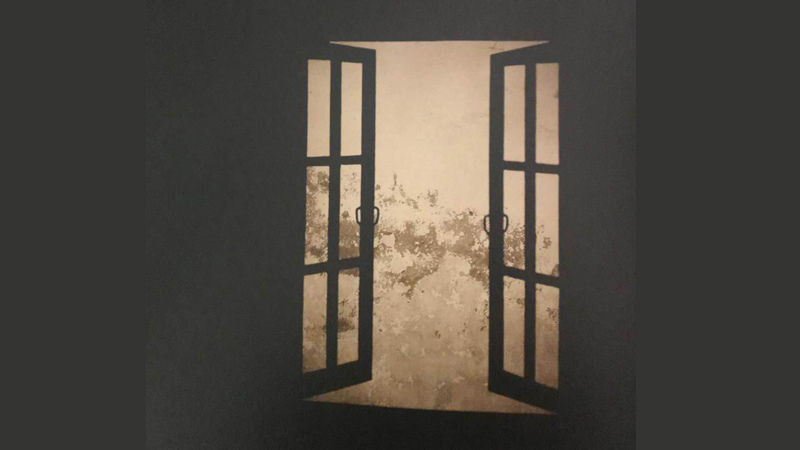
It was an old, classical house in a poor shape. However, it became the perfect venue for the nostalgic exhibits. The Gujral foundation is founded by the family of Satish Gujral, a very famous artist and the younger brother of Inder Gujral.
“The idea came from an invitation from the Gujral Foundation in Delhi,” says Hashmi.
“I understood that we will have to look for artists whose work is already about that subject or it can be interpreted as being about the subject. But the subject itself is a very difficult one.”
The exhibition was themed on Faiz Ahmed Faiz’s poem “Dawn of Freedom” or “Subh-e-Azadi”. The exhibition was titled “This Night Bitten Dawn.” Salima Hashmi says this poem is “the best way to actually look at the effects of 1947.”
“The exhibition was an attempt to reinterpret the ‘Dawn of Freedom’ long after the trauma and grief has gone away. The artists used Faiz’s poem as an inspiration to reinvent their perception and experience of the Indian partition.”
Faiz Ahmed Faiz is an extraordinary poet, and of course, Salima Hashmi’s father. Salima has a sentimental connection with both the partition and Faiz’s verses.
The poem ends on “chale chalo ke manzil abhi nahi aye” (move forward for the destination is still ahead).
“This is a call to people on both sides to go forward because we have not achieved real freedom,” says Salima Hashmi.
The exhibition was an attempt to reinterpret the “Dawn of Freedom” long after the trauma and grief have passed away. The artists used the poem as an inspiration to reinvent their perception and experience of the Indian partition. It dealt with the traditional themes of the Indian partition- homelessness, loss, grief, separation, violence, women and honour. The exhibition showcased the works of 25 artists, both men, and women, from all over India and Pakistan and from different post-partition generations.
Hashmi is pleased that there was “gender balance” and wanted all these different parts and generations of India and Pakistan to have a voice in the exhibition. She was confident that even those who never witnessed the partition had memories and stories of it.
Pakistani artists like Roohi Ahmad, Bani Abidi, Farida Batool, Imran Ahmad and Risham Syed contributed, among others. The Indian side was represented by Somnath Hore, Shilpa Gupta, Anita Dube and Gargi Raina.
Hashmi said that these artists who originated from all across the sub-continent placed the exhibition in a “nice position for dialogue.”
 “There was a wide range of artists in the show, those who did video, sculptor, painting, digital work, and sound work – covered the whole panorama of artistic practices and vocabularies across India and Pakistan. It was not restricted to Punjab which of course is the place people normally talk about when they talk about the partition.”
The artists re-examined and re-interpreted the “freedom” as well as the “partition” of 1947 through different mediums. They utilised traditional, modern and contemporary art to express these ideas.
The exhibition, just like the poem it was based on, served as a way to understand the past and find a path for the future.
Salima Hashmi added that the venue of the exhibition, the house of Gujrals, made the exhibition even more “moving.”
“It was not held in an old antiseptic clinical gallery with white walls but inside a house,” she said. “And we used everything from the broken down old garage to the rooftop. So in a sense, the artworks inhabited human spaces. So many people told me that they were moved to tears.”
Asma Mundrawala, an artist from Karachi, had one of the most intriguing instalments. Her parents had recorded the calls of a street vendor in the Indian Gujrat, and during the exhibition, that sound was being played on the staircase.
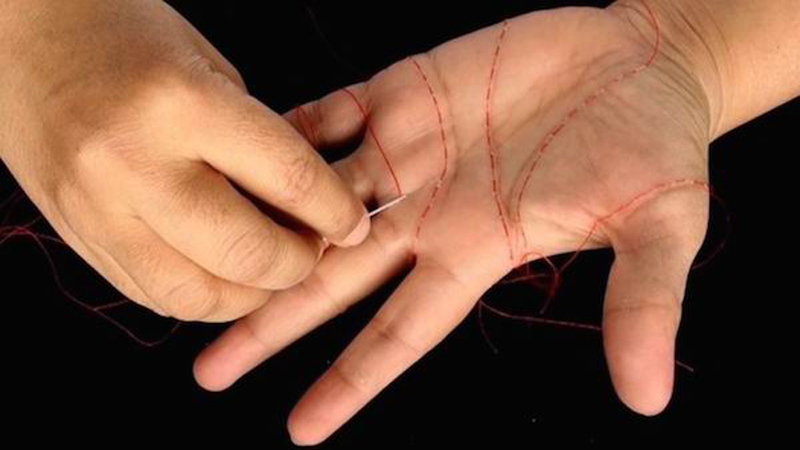
Roohi Ahmed, another artist from Karachi, had produced a disturbing yet compelling image of a woman’s palm while the lines on the palm were being stitched with a needle and thread. This was perhaps a comment on how the fate of millions of women was sealed in 1947. There was also a kurta (shirt) by Risham Syed. The kurta was a part of Syed’s paternal grandmother’s dowry.
Salima Hashmi says her favorite installation was the one by Amar Kanwar.
“Amar Kanwar is one of the most distinguished artists in India,” says Hashmi. “He used the garage. He made a hole in one of the walls. Through it, you could see the light. Then he asked me for my father’s recording of Yeh dhaag dhaag ujala. So when you went into the dark garage you heard Faiz reciting the poem and then you saw the light.”
In June of this year, a similar exhibition was held in the Aicon Gallery of New York. This exhibition was also curated by Salima Hashmi and was concluded in July. It was called the “Pale Sentinels: Metaphors for Dialogues”. Prominent Pakistani artists like Waqas Khan, Ghulam Mohammad, Saba Qazilbash and Faiza Butt presented their work along with their Indian counterparts like Shilpa Gupta and Nilima Sheikh, among others. This exhibition focuses on mementos, personal narratives and other memories from the Indian Partition.
Hashmi’s favorite artwork here was the “Two Chadar” (shawl). The two shawls were from India and Pakistan. Shehnaz Ismail sent a shawl to Priya Ravish Mehra and vice versa. Both the artists then went to refugars (those who mend old cloths) to have the old shawls fixed. These old shawls then became art installations and were placed side by side.
Unfortunately, Priya Ravish Mehra died from cancer in May and this work was exhibited posthumously in June,
 “The fact these two chadars which came from two different sides were repaired by artists from the other side,” says Hashmi. “This becomes symbolic of repairing things that have been damaged or torn or harmed or injured or disfigured. And you give them fresh value and you give them energy. They can be worn again. So this was a very beautiful idea. I carried the shawls on both sides of the border. They were symbolic of the fact that in this exhibition there were artists from both the countries and they were again of different generations,” she added.
This exhibition in New York was yet another attempt at understanding the events of 1947 by artists who have not witnessed it but are nevertheless affected by it. This exhibition also borrows its name from a poem of Faiz: “Zindaan ki aik subh” or “A prison morning”. The poem is an account by Faiz’s from his time in prison. Early one morning, the poet hears the prison guards open the locks. The guards seem just as tired and hungry as the prisoners.
“The exhibition was about borders and constraints,” says Hashmi. “Different kinds of constraints like those caused by language or globalisation.”
Salima Hashmi says that artists today are more comfortable with themes around the partition because the memory and trauma are now distant and subtle. She also adds that such exhibitions can be brought to Pakistan but the infrastructural cost has to be borne by a prominent organisation. Unless government or private funds are available, the artwork cannot be arranged, delegated, transported and installed. Until the financial clot is removed, we in Pakistan will have to just wait.
The writer is based in Lahore and tweets as @ammarawrites. Her work is available on www.ammmaraahmad.com
Published in Daily Times, August 4th 2018.