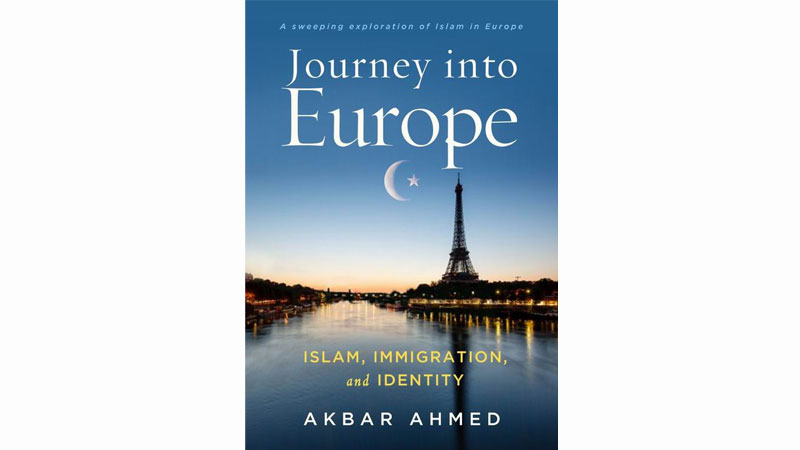
 Following the 9/11 attacks, the West, especially Europe, experienced a sharp rise in Islamaphobia. Over the past years, support for alt-right politics, and their anti-Islam rhetoric, has strengthen, deepening public fear and misunderstanding of Islam so much so that Islam and the West are often believed to be fundamentally opposing forces.
In Journey into Europe, decorated Islamic scholar Akbar Ahmed traces the origins of this belief to primordial tribal identities of European nations and their civilizations. Ahmed argues that European primordial identities center on native blood, land, and physical characteristics such as light skin and eyes, and live deep in the subconscious of modern citizens. According to Ahmed, when faced with an external threat, which Muslims are perceived to be, primordial identities produce a “desire to aggressively defend the ‘purity’ and the identity of the tribe.” Strengthening support in far right politics, which promote distancing from anything seen as “other”, exemplify the European majority’s defense of their primordial identity. By seeking out the psychological origins of Islamaphobia in Europe, Ahmed produces an argument for its sociological occurrence.
In present times, when intolerance threatens peaceful co-existence, Journey into Europe offers a needed perspective of empathy and possibility. Today, the perceived conflicts between Islam and the West seems to escalate uncontrollably
However, while explaining the origins of conflict between the West and Islam, Ahmed deconstructs it. Far from incompatible with western ideals, Ahmed draws on history to uncover a European pluralist identity or “la convivencia”. Ahmed posits Al-Andalus, an 8th to 15th century civilisation in modern day Spain, as a “golden-age” where Jews, Christians and Muslims lived peacefully and with respect. Ahmed reminds us of the integrated societies so often forgotten, intentionally or not, and in so doing masterfully challenges the narrative that Islam and the West cannot co-exist.
Far from coexistence, Ahmed presents Al-Andalus and similar societies in Sicily, where la convivencia allowed diverse citizens to thrive, as models to look towards in the present day. In these historical civilisations, Christians kept trusted Muslim advisers, ornamented churches with Arabic calligraphy of Quranic verses and embraced the ‘other’ which, Ahmad argues, the west is threatened by today. In the harmony of Islamic-influenced European societies of the past, Ahmed establishes not only the possibility but also the beauty of Islam in Europe achievable when the ‘other’ is embraced instead of attacked.
Journey into Europe reads as a fresh and nuanced approach to unraveling the West and Muslim divide. As others have noted, Ahmed’s ‘reversal of the traditional paradigm of the social sciences’ (a Pakistani examining Europe instead of Europeans studying Asia or Africa) divorces the imperialist lens lending insight. To his credit, Ahmed, for the most part, succeeds in avoiding preachy language, especially while presenting a counter-narrative of Islam and instead relies on history and meticulously recorded interviews with Christians, Muslims, Jews and nonbelievers taken over four years of travels across Europe to animate his arguments.
In present times, when intolerance threatens peaceful co-existence, Journey into Europe offers a needed perspective of empathy and possibility. Today, the perceived conflicts between Islam and the West seems to escalate uncontrollably. Through Journey into Europe, Ahmed begins a process of deescalatization by unpacking and debunking the perceived conflict between Islam and the West. Far from an inherent conflict, Ahmed traces a sociological occurrence rising from identity threat and misrememberings of history. In doing so, Ahmed offers the possibility of an alternative state of affairs, like that seen in Al-Andalus, by adopting an empathetic lens.
In my own work on South Asia, I’m often told of opposing forces and diverging interests. These arguments are built on historical evidence of varying degrees of accuracy, similar to those seeing inherent conflict between Islam and the West. In both, history is mobilised in narratives of fear and existential threat. As these narratives spread, fear settles in, breeding the intolerance we’re faced with today.
Through Journey into Europe, I am reminded of the power and danger of historical narratives. At least some of the distrust and conflict between the U.S. and Pakistan, issues I engage with daily, can be traced back to mismemories or even opposing memories of history. Informed through these conflicted lenses, understanding and consensus between the US and Pakistan has become increasingly rare.
Journey into Europe asks us to seek the alternative, established periodically before, of la convivencia. Through unpacking and building consensus around historical narratives, Ahmed offers a mechanism to embrace the difference that drives our fear, an empowering and necessary skill in today’s environment.
The writer is a researcher on South Asian affairs based at the United States Institute of Peace in Washington D.C
Published in Daily Times, June 2nd 2018.