 In Lahore, we find many monuments being neglected or overlooked due to many obvious and unknown reasons. Another 17th century monument, which is either forgotten or unknown, is right here in Lahore at Shiwala Chowk in Singhpura area of Bhogiwal, GT Road. Heritage lovers must be familiar with the Haveli of Nawab Mian Khan inside Walled City of Lahore which is now turned into a school, but have we ever thought about the ignored tomb of the same person. Well, he was a renowned and affluent figure of history and today he lays buried, unnoticed.
Let me tell you a little about this Nawab and then we come to the history of his tomb. Nawab Mian Khan was the son of Nawab Saad Ullah Khan who was the Prime Minister during the reign of Mughal Emperor Shah Jahan. Nawab Saad Ullah Khan, also known as Mian Saad Ullah Khan, was an orphan of Chiniot whose religious conviction and curiosity for learning more brought him to Lahore where he joined a Madrassa near Wazir Khan Mosque. In those days, madrassa were common near Wazir Khan Mosque and students could also get a room inside the Mosque. Till now we see such rooms inside the Wazir Khan Mosque.
A few years later Saad Ullah Khan with his intellect and gained knowledge moved to Delhi. There he became popular for his intelligence and declamatory skills and that led him to the court of the Emperor Shah Jahan who was always in search of intellectual and learned people. Shah Jahan soon got impressed by Saad Ullah’s knowledge and offered him a job in the court.
As PM, Mian Saad Ullah Khan built many important landmarks which we still see in Lahore and Chiniot. These include Shahi Masjid of Chiniot, Haveli Mian Khan in Rang Mehal and Pathran Wali Haveli in Lahore. Mian Saad Ullah Khan became a role model for the courtiers and it is written by the historians that Shah Jahan and Aurangzeb would praise his services before other members of the royal court
Mian Saadullah Khan proved his honesty and worked with ultimate honesty in dealing with the emperor’s finances. This attribute of Saad Ullah made the emperor gave him the title of ‘Allama Fihami Jumlatul Mulk’. Then with a cash prize of Rs. 250,000, the emperor sent him to Lahore as his prime minister. Mian Saad Ullah Khan as PM built many important landmarks which we still see in Lahore and Chiniot. These include Shahi Masjid of Chiniot, Haveli Mian Khan in Rang Mehal and Pathran Wali Haveli in Lahore. Mian Saad Ullah Khan became a role model for the courtiers and it is written by the historians that Shah Jahan and Aurangzeb would praise his services before other members of the royal court.
 Nawab Mian Khan, son of Mian Saad Ullah Khan also followed the footsteps of his father and tried to be as honest and noble as his father. Soon with his qualities he became popular and developed close association with Mughal Emperor Aurangzeb and son of Shah Jahan. Nawab Mian Khan was made the Governor of Lahore during Aurangzeb’s rule. Like his father Nawab Mian Khan also served the Mughal well and happened to be very loyal with them. Nawab Main Khan died in 1671 during the reign of Mughal Emperor Aurangzeb, which was surely a shock for all the royals who loved and respected him.
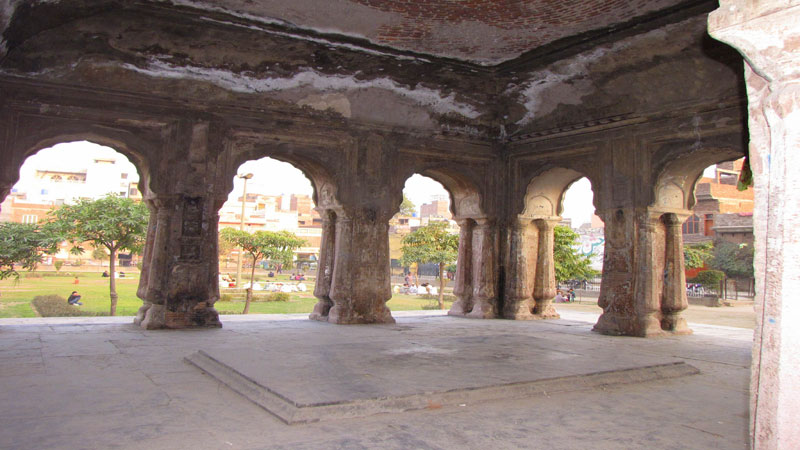
So the tomb I am writing about today is the place where this revered Nawab was buried. It is built in the form of a Baradari (twelve doors) with a tripartite facade. Famous writer and historian Kanhaiya Lal also mentions this tomb in his book Tareekh-e-Lahore which was written in 1884. Unlike other Baradari constructed in that era, this one is reasonably smaller in size. The black stone from Chiniot was used in its construction.
History records that thousands of rupees were spent on the construction of this tomb in order to pay respect to Mian Khan. Delicate floral patterns were made on the borders of the roof, which was an expensive art in those days. If we get into the architectural details of this tomb we see a large high rise podium on the sides of the tomb. The floor of the podium is made of large slabs of black stone and the entire podium including the sides is constructed of the Chiniot’s black stone. In the middle of the main podium, there is another black stone podium on which the building of the Baradari stands. In the middle of the Baradari, there is another podium upon which stood the marble tomb of Mian Khan but it was removed by Raja Suchet Singh – commander of Ranjeet Singh’s crack cavallary brigade the Charyari Sowars and ruler of Ramnagar. Today only the podium remains are seen there. Like many other tombs and Baradari of that era, this was also surrounded by a garden with a fountain. It was a typical design of Mughal era gardens. The south end of the garden had a gate chamber which does not exist now; historians say that it might have been damaged over the passage of time. There were mosques on the eastern and western side having the same dimensions. Only the western mosque was used while the eastern one was made for architectural symmetry which was a known feature of Mughal architecture.
 This place had to meet an ill fate and thus it was plundered during the Sikh rule. The marble along with other precious stones were removed whereas the bricks were stolen by brick sellers. For some time, the tomb structures came under possession of Sheikh Imam-ud-Din who removed a large number of black stone slabs from the Baradari and used them in his haveli. Later when Maharaja Ranjeet Singh took over Punjab, Raja Suchet Singh occupied it, repaired the surrounding walls, and planted a garden in its grounds and gave it a new name ‘Raja Suchet Singh’s Bagh’. That was not an end to the misery of this tomb, during the British Raj; it was put on auction and later was bought by Nawab Ali Raza Khan Qazilbaksh for 2200 rupees. After partition we got this monument and minor repairs were made to it but we could not develop it as a tourist spot. Maybe we were unaware of the importance of this man or we lacked the approach towards tourism in Lahore. Till now, it is an abandoned monument and hardly few of us know about it.
I think it’s high time that this place should be brought out to the tourists and should be developed as per international standards for tourism. If we keep ignoring our monuments, soon we will be left with none.
Published in Daily Times, April 20th 2018.