
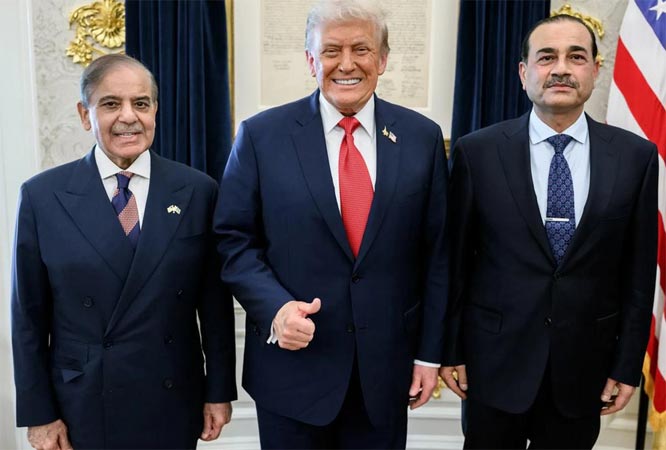
 US President Donald Trump has credited Pakistan’s top civilian and military leadership with helping Washington secure its interim understanding with Iran, publicly praising Prime Minister Shehbaz Sharif and Chief of Defence Forces and Army Chief Field Marshal Asim Munir during an interview with American outlet Axios.
Asked about world leaders he respected, Mr Trump first referred to Chinese President Xi Jinping before turning to Pakistan’s leadership, describing Field Marshal Munir as “great” and saying the army chief and the prime minister worked in close coordination.
“In Pakistan, you have the field marshal, who is great. Munir, he’s great. And you have the prime minister, and they just get along great,” Trump said, according to the interview transcript. “The military guy totally respects the prime minister. It’s a beautiful thing to see.”
He then linked that assessment directly to the US-Iran arrangement. “But they really helped us with this deal,” he said. “They knew the Iranians, they knew the people.”
The remarks are significant because they move Pakistan’s diplomatic role even beyond its official claims, placing the country in the US president’s own account of how the Iran understanding was reached. They also come days after the White House sent the interim agreement, titled the “Islamabad Memorandum of Understanding between the Islamic Republic of Iran and the United States of America” and bearing Pakistan’s signature as witness and mediator, to Congress.
The agreement commits Washington and Tehran to a 60-day negotiation period for a final settlement, while providing for an end to military operations, including on the Lebanon front, the lifting of the US naval blockade on Iranian ports within 30 days, and safe commercial passage through the Strait of Hormuz for 60 days.
In the same interview, Trump was asked what he had learned about the exercise of power and its limits as a result of the conflict.
“There are no limits,” he replied, before adding the US had “defeated (Iran) totally militarily” and said Pakistan had asked him, because of its close ties, “please do not do any more,” while adding: “I like (Pakistan) a lot.”
Pakistan’s role had been visible for weeks before the signing. The army chief travelled to Tehran last month as part of an effort to keep the channel alive. Interior Minister Mohsin Naqvi has so far made four distinct diplomatic trips to Iran in the last few months for the same purpose, including two back-to-back, unannounced strategic trips within a single week. He again landed in Tehran on Saturday as the first high-level official to visit Iran after the signing of the initial peace agreement.
Sharif has, meanwhile, described the development as a historic diplomatic achievement, telling the National Assembly that many nations spend centuries seeking such honour but fail to achieve it, while Pakistan’s name was now being mentioned around the world with respect and dignity.
Trump also repeated his claim (now claiming it more than 80 times) that he had helped prevent escalation between Pakistan and India during last year’s crisis, almost always adding how both nuclear-armed neighbours were close to “a bad nuclear war (where) millions of people could have been killed.”