
On 1 April 1948, 20-year-old Zulfikar Ali Bhutto spoke at University of Southern California of the Islamic Heritage and said, “I see a failure of the Muslim world as a personal failure. In that respect something is binding about the Muslim world despite the fact that it is torn by dissension. I am not a devout Muslim. My interest is soaked in the political, economic and ethnic heritage of Islam. Imperialism has sapped our vitality and drained our blood in every portion of the globe. The young generation of Muslims, who will be the leaders of a new force, of an order founded on justice, wants the end of exploitation. Under the Islamic confederation, the future world may be secure. Destiny demands an Islamic association, political reality justifies it, posterity awaits it, and by God we will experience it. Courage is in our blood, we are the children of rich heritage. We shall surely succeed.”
He frequently spoke about creating a pan Islamic league with his friends. He was always a follower of Quaid-e-Azam Jinnah and would often discuss his ideology with his roommates.
Shortly after Muhammad Ali Jinnah’s death in September 1948, Bhutto wrote to the Pakistani envoy and said, “We have been orphaned at the all-important moment when we needed more than any other force, the torrential magnanimity of our beloved leader. Though the Quaid is no longer with us, yet his pure and virgin spirit will remain forever fertile in our psyche. His entire life was struggle for the improvement and emancipation of his people.” Bhutto spent some time volunteering during summer vacation at Pakistan Embassy. In one of the papers he wrote there, he termed Muhammad Ali Jinnah as his ideal and said that Jinnah was solely responsible for the origination of a state for those he led in the struggle for the emancipation of their lives. His dream of creating a Pakistan has been a outstanding dream, the realisation of his dream has been nothing short of a miracle. He had to lead a people who were thoroughly divided and depressed. He has been a God inspired human being, a man of purity of heart, of an unbelievable audacity and a unique courage and determination.
Less than a year after being enrolled at Lincoln’s Inn in 1953, he was called to the bar at the same location where Muhammad Ali Jinnah had once stayed. Barrister Zulfikar Ali Bhutto apprenticed in the chambers of Ash Lincoln. In 1957, Bhutto became the youngest member of Pakistan’s delegation to the United Nations. He addressed the UN Sixth Committee on Aggression that October and led Pakistan’s delegation to the first UN Conference on the Law of the Sea in 1958. That year, Bhutto also became Pakistan’s youngest federal minister. He entered government as one of President Iskander Mirza’s cabinet members, before being assigned several ministries during President Ayub Khan’s military rule. In 1963, he was appointed as the country’s foreign minister.
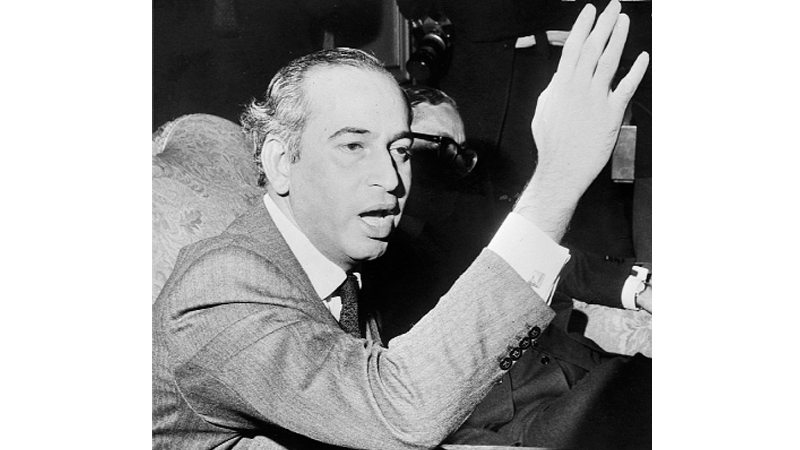
In 1965, Pakistan and India went to war. Later on January 10, 1966, President Ayub and Indian Prime Minister Lal Bahadur Shastri agreed to exchange prisoners of war and withdraw respective forces to pre-war boundaries. This agreement was strongly opposed in Pakistan. Zulfikar Ali Bhutto’s criticism of the final agreement resulted in a major rift between him and President Ayub Khan.
Zulfikar Ali Bhutto, while addressing the National Assembly in March 1966 after prolonged attacks against the regime for its mishandling of the war, said: “Let us look at the history: In 1939, Britain and France declared war against Germany, because in that respect it was a commitment to support the frontiers of Poland. A commitment that needs to be honoured. What really happened in Korea? It’s a war of liberation. Can Kashmir be exclusion, should we not be committed to the 5 million people of Jammu and Kashmir? The statement, that the future of 50 million people of East Pakistan was jeopardised for 5 million people of Jammu and Kashmir is a bankrupt and immoral argument. Then you will say, let Balochistan go, let Sindh go. Propaganda means vilification, propaganda means slander. No respectable and self-respecting country would like to indulge in propaganda. We do not indulge in propaganda. This is not our policy. Only as far as Jammu and Kashmir is concerned, as far as the liberation is concerned, as far as the question of justice is concerned we are not precluded from espousing and propagating these causes.
I tell you we are true. There can be no force, no strength greater than truth. Truth itself is on our side. India will have to abandon its colony in Jammu and Kashmir.” Three days after the speech, Bhutto was ordered to resign as General Secretary of Ayub’s Muslim League.
The fire Bhutto spouted at the UN, and the chants of victory in the National Assembly made young Pakistanis think that at last they had a leader who was committed to bringing a positive change in the country
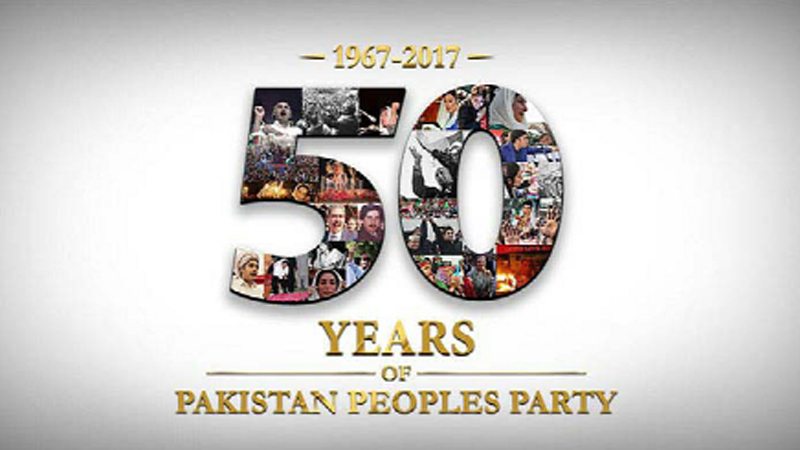
Following his resignation as the foreign minister, large crowds gathered upon his arrival in Lahore in June, 1967. Nearly the whole of Lahore gave him an emotional welcome. He was garlanded and hooked onto the shoulders of supporters including students. Salman Taseer, who was at that time a student himself, was there to chant the slogans of ‘Long live Bhutto’. The fire Bhutto spouted at UN, and the chants of victory in the National Assembly made young Pakistanis think that at last they got a leader who was committing to bringing a positive change in the country. Dr Mubashir Hasan’s Gulberg House in Lahore became the locus of the PPP’s birth on November 30, 1967. “Islam is our faith, democracy is our policy, and socialism is our economy” was the party’s manifesto.
In a bid to create a sense of unity among the Muslim countries, Bhutto invited heads of almost every Muslim state to come to Pakistan for an Islamic summit. His efforts in this regard are acknowledged even by his harshest critics. But he could not serve the nation for long. Bhutto’s arrest and the most brutal period of Pakistan’s history after his hanging in 1979 is still fresh in my memory. I would advise the readers to read more about him to know what made him immortal and why he remains alive in the hearts of the people of Pakistan. From prison, he sent a letter to Zia.
“Politics is not the illegal seizure of the state machinery. Politics is not the conversion of a flowering society into a wasteland. Politics is the soul of life. It is my eternal romance with the masses. Only the people can stop this eternal bond. To me politics and the people are synonymous. You or your coterie has no right to take away my spiritual and perishable links with the beloved people of my country. It is an inseparable component of my heritage. My blood is in the blood of Pakistan. I am a constituent of its dust, a part of its aroma. The tears of the people are my tears. The smile on their beautiful face is a part of my smile. My destiny is in the hands of the people. Only the masses have the right to severe or seal their affinities with me.”
No person in the history of Pakistan achieved greater popular power as Zulfikar Ali Bhutto. He is venerated by his followers in Pakistan as Quaid-e-Awam. Bhutto’s political rise and fall were indeed so meteoric that they ended up making him a champion of democracy in the state over which he presided for little more than half a decade prior to his hanging. A full decade after his death, Bhutto remained popular enough to ensure the election of his daughter Benazir Bhutto to the position he once held. The slogan that always greeted her across the country was ‘Jiye Bhutto’. This is why Bhutto is still alive, this is why jiyalas are celebrating the 50 years of the PPP.
The writer is a traveller and freelance writer based in UK. He can be contacted at [email protected]
Published in Daily Times, November 30th 2017.