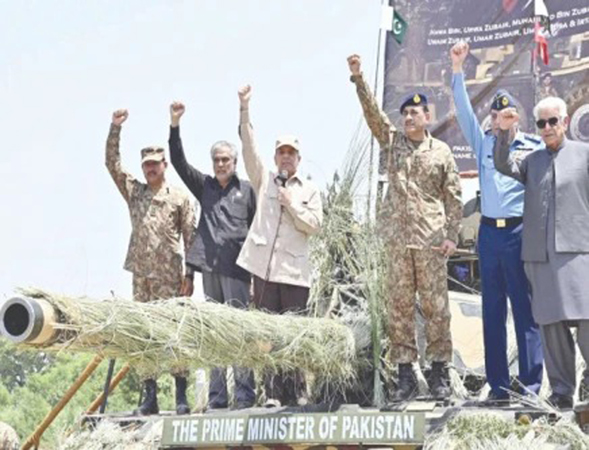
 The first anniversary of Marka-e-Haq is being observed across Pakistan as a reminder of the night the Pakistan Air Force (PAF) stunned the world by neutralizing the Indian Air Force’s (IAF) numerical advantage through precision technology, cyber dominance, and multi-domain integration. The operation Bunyan-um-Marsoos also prompted reflection inside universities, where academics see the campaign as evidence that modern warfare is increasingly shaped long before fighter aircraft enter the skies.
Rawalpindi Women University (RWU), Vice Chancellor Prof. Dr. Bushra Mirza viewed the operation through an academic lens, arguing that Marka-e-Haq was not simply a military success, but the outcome of years of scientific education, research, and intellectual preparation.
Dr Bushra sheds light on the deep connectivity of the academics from classrooms to the cockpits, and said the operation demonstrated how modern defence capability was now deeply connected with the strength of a country’s classrooms, laboratories, and research culture.

“Marka-e-Haq was won in the skies above Pakistan, but it was built in its classrooms,” she remarked. The academics believe the larger story lies behind the systems themselves, in the institutions responsible for producing the engineers, researchers and specialists capable of operating them.
For Dr. Bushra Mirza, the events of that night reflected years of disciplined scientific work carried out quietly inside educational and research institutions.
“What the world witnessed was not just airpower,” she said, “it was the product of engineering rooms, research labs, and years of disciplined scientific work.”
The operation, she argued, highlighted the changing nature of warfare itself. In an era shaped by cyber capability, unmanned systems, and networked command structures, military effectiveness increasingly depends on technological competence and intellectual preparedness rather than numbers alone.
Linking the success of the operation directly to higher education, she stressed that universities now carried responsibilities extending far beyond traditional academics.
“A nation whose defence rests on cyber warfare, unmanned systems, and networked command structures requires universities that produce engineers, systems thinkers, and cyber specialists at scale,” she said.
From an implementation perspective, the precision and systems integration displayed during Marka-e-Haq reflected capabilities developed over years through scientific learning and technical expertise. According to Dr. Bushra Mirza, such operational precision could never emerge without sustained educational investment.
“Precision at that range does not happen by accident. It demands minds as sharp as the systems they operate,” she observed.
She drew a direct connection between the outcome of the operation and the condition of Pakistan’s scientific institutions, saying the country’s demonstrated technological edge was ultimately the return on investments made in universities and research centres over time. “What separated Pakistan that night was not just equipment but expertise,” she said, adding that expertise required years of dedicated education to cultivate. The Vice Chancellor maintained that modern defence capability depended as much on intellectual capacity as on military hardware itself.
“Nations are not defended by weapons alone. They are defended by the quality of the minds that conceive, develop, and operate them,” she said.
The academic dimension of Marka-e-Haq, she noted, also included the growing contribution of women within Pakistan’s scientific and technological sectors. As universities expand opportunities in STEM education and research, women professionals are increasingly contributing to laboratories, communications systems, and technical infrastructures linked to national capability.
“The daughters of this nation were part of this victory, in uniform, in laboratories, and behind every system that performed,” Dr. Bushra Mirza said. Beyond the battlefield, the operation also underscored the importance of information credibility and public awareness during moments of conflict. The Vice Chancellor said educated societies equipped with critical thinking were less vulnerable to disinformation and propaganda.
“When the facts were established, no propaganda could survive them. That is what education does for a nation,” she remarked.
For Pakistan’s universities, she believed the anniversary should carry practical implications rather than symbolic value alone. Strengthening STEM faculties, expanding cybersecurity programmes, and aligning research with emerging technological realities were now national responsibilities for the academic sector.
She said Marka-e-Haq had exposed the importance of technological preparedness in clear terms, making it essential for universities to prepare graduates capable of contributing to evolving national requirements. Dr. Bushra Mirza also highlighted the leadership of Government of Pakistan, the Field Marshal Syed Asim Munir, Air Chief Marshal Baber Ahmed Sidhu and the civilian leadership for the command cohesion demonstrated during the operation, describing their decisiveness under pressure as an example of informed leadership.
“Our obligation as educators,” she said, “is to ensure that the next generation is as ready as the generation that fought Marka-e-Haq.”