Pakistan has cautioned the United Nations (UN) that India’s unilateral decision to suspend the Indus Waters Treaty (IWT) has created a severe and unprecedented challenge for Pakistan’s water security and regional stability.
Read More: Pakistan slams India at UN for ‘weaponising water‘ amid Indus treaty
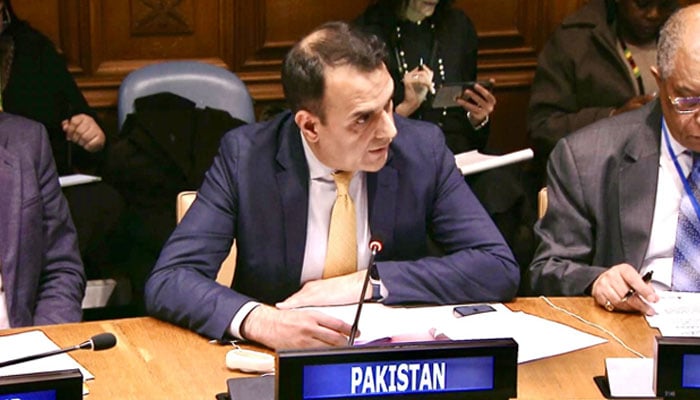
Speaking at the Global Water Bankruptcy Policy Roundtable, Pakistan’s representative to the UN, Ambassador Usman Jadoon, described India’s move as a deliberate “weaponisation of water”. He said New Delhi’s step violated core provisions of the 1960 agreement.
For more than six decades, the Indus Waters Treaty of 1960 has provided a time-tested framework for equitable and predictable management of the waters of the Indus River basin. India’s unilateral decision to hold the Treaty in abeyance last year in April, followed by material… pic.twitter.com/GgaXvgtUvz
— Permanent Mission of Pakistan to the UN (@PakistanUN_NY) January 20, 2026
According to Ambassador Jadoon, India has committed serious breaches since April of last year, including disruptions of downstream flows and withholding of essential hydrological data. He said the treaty did not allow any unilateral suspension, modification, or abeyance.
Ambassador Jadoon underscored that the Indus basin framework had ensured equitable and predictable water-sharing arrangements for more than six decades, enabling the world’s largest contiguous irrigation network. The basin supplies over 80 per cent of Pakistan’s agricultural water needs and underpins livelihoods for more than 240 million people.
India’s Unilateral Suspension of IWT Threatens Water Security & Regional Stability: Pakistan
– Our Press Release today pic.twitter.com/2kgsDjHBgC
— Permanent Mission of Pakistan to the UN (@PakistanUN_NY) January 21, 2026
He said that across the world, water insecurity was emerging as a systemic and compounding risk, affecting food systems, energy production, public health, and human security. For Pakistan, he added, these stresses were already visible due to climate vulnerability, floods, droughts, glacier melt, population pressures, and groundwater depletion.
Pakistan, he said, was attempting to strengthen resilience through integrated water planning, flood protection, irrigation rehabilitation, groundwater recharge, and ecosystem restoration. He cited ‘Living Indus’ and ‘Recharge Pakistan’ as flagship national initiatives.
However, he warned that systemic risks in shared river basins could not be addressed by any country alone. Predictability, transparency, and cooperation, he said, were essential for downstream populations.
Read More: Speakers at UN event warn against weaponisation of water
Ambassador Jadoon urged that water insecurity be recognised as a systemic global risk in the run-up to the 2026 UN Water Conference, and called for placing cooperation and international water law at the centre of shared water governance.