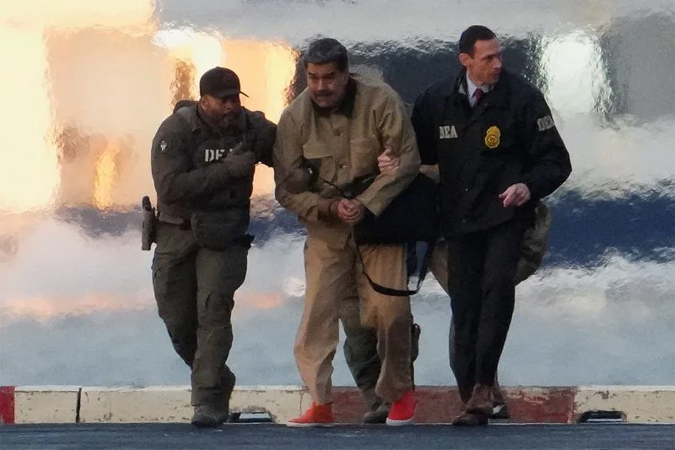
 Deposed Venezuelan president Nicolas Maduro pleaded not guilty to charges of narco-terrorism in a New York court on Monday, two days after being snatched by US forces in a stunning raid on his home in Caracas.
Maduro, 63, told a federal judge in Manhattan that he had been “kidnapped” from Venezuela and said “I’m innocent, I’m not guilty,” US media reported.
“I’m still the president of my country,” he was quoted as saying.
Maduro’s wife Cilia Flores likewise pleaded not guilty.
The pair were snatched by US commandos in the early hours of Saturday in an assault backed by warplanes and a heavy naval deployment.
In a series of shock announcements over the weekend, President Donald Trump declared that the United States is now running Venezuela with an eye to rebuilding and controling its huge but decrepit oil industry.
Amid international alarm, UN Secretary-General Antonio Guterres told an emergency UN Security Council meeting that there should be “respect for the principles of sovereignty, political independence and territorial integrity.”
There was sharp criticism Monday from Mexico, where President Claudia Sheinbaum said the Americas “do not belong” to anyone.
Colombian President Gustavo Petro issued a fiery statement saying that as a former guerrilla fighter he was ready to “take up arms” against Trump.
Maduro became president in 2013, taking over from his equally hardline socialist predecessor Hugo Chavez.
The United States and European Union say he stayed in power by rigging elections and imprisoning opponents, while overseeing rampant corruption.
The end to a quarter century of leftist rule leaves Venezuela’s approximately 30 million people facing uncertainty.
Some 2,000 Maduro supporters, including rifle-wielding men on motorcycles, rallied Sunday in Caracas, waving Venezuelan flags.
On Monday, deputies in the Venezuelan parliament shouted “let’s go Nico!” in support for the ousted leader.
For now, though, the Trump administration is indicating it wants continuity with the remainder of Maduro’s entourage — provided they submit to US demands.
Interim president Delcy Rodriguez, who was Maduro’s vice president, dropped an initially defiant posture on Sunday, saying she was ready for “cooperation.”
Trump has made clear there is no appetite for helping opposition candidates previously seen as the rightful winners of rigged elections to take power.
When asked what he needs from interim leader Rodriguez, Trump said: “We need total access. We need access to the oil and other things in their country that allow us to rebuild their country.”
Pakistan urges restraint and dialogue at UNSC
Pakistan on Monday expressed “profound concern” over the developments in Venezuela, warning that escalating tensions in the country posed risks to regional and international peace and security.
The statement was made at an emergency meeting of the United Nations Security Council (UNSC) summoned to discuss the recent developments in Venezuela. This is also the first meeting for the year of the UNSC, with Somalia in the chair.
Pakistan’s Acting Permanent Representative Ambassador Usman Jadoon said in his address that at a time when the world was already facing multiple crises, instability in the region “does not augur well for regional and international peace and security”.
He reminded Council members that the UN Charter bound states to refrain from the threat or use of force against the territorial integrity or political independence of any state, and to uphold sovereign equality, non-interference in internal affairs and the peaceful settlement of disputes.
Ambassador Jadoon added that unilateral military action contravened these “sacrosanct principles” as well as the doctrine of sovereign immunity, warning that such actions set dangerous precedents and risked eroding the foundations of the global legal framework.
He cautioned that such actions also fuel instability, which, “as history has shown time and again, can lead to unpredictable and uncontrollable outcomes for years to come”.
Calling for de-escalation, the Pakistani envoy said that at this critical juncture, “the path forward must be one of dialogue and diplomacy,” stressing that durable solutions to political differences could only be achieved through peaceful means and with full respect for the will of the Venezuelan people, free from external interference.
He expressed hope that Latin America and the Caribbean, recognised as a ‘Zone of Peace’, would remain free from conflict and confrontation and continue moving towards enhanced regional cooperation and improved prosperity.