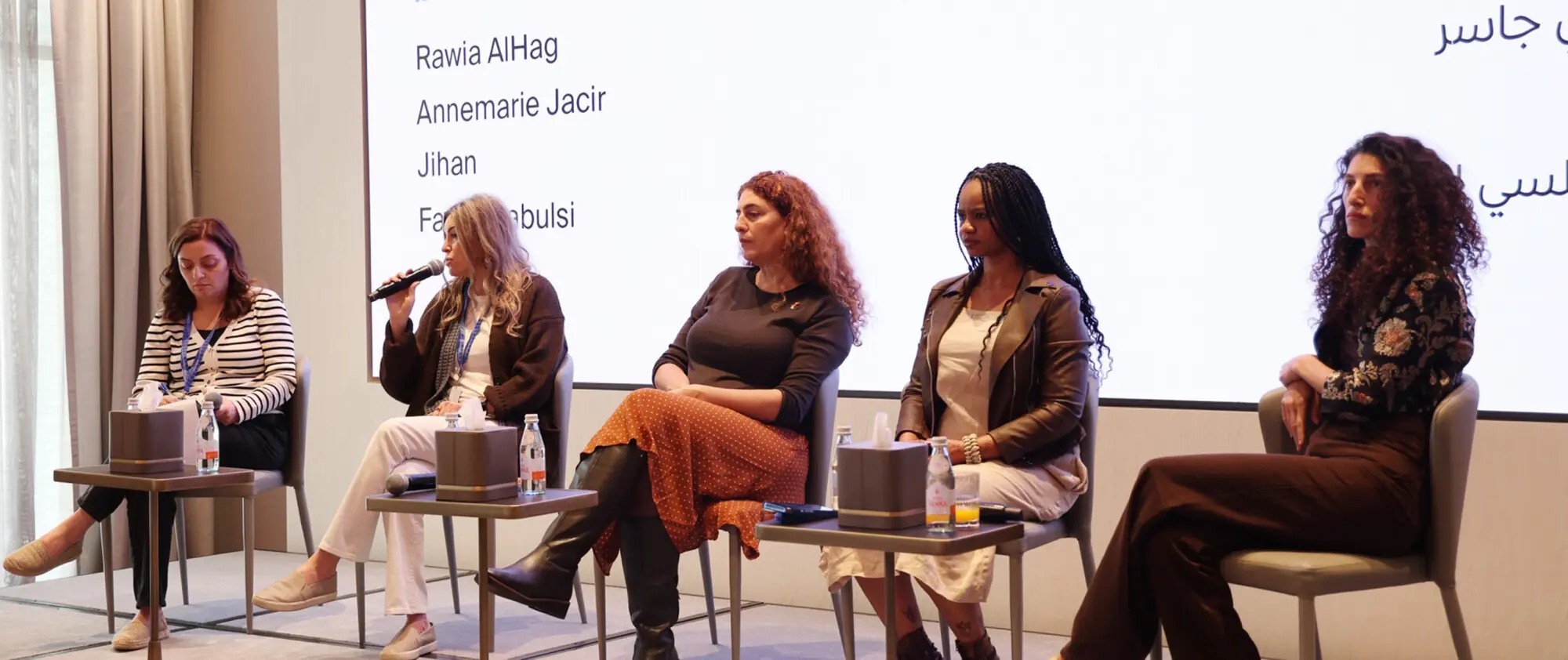
DOHA: Gender and lived experience shape filmmaking in profound ways, panelists said during the Doha Film Festival’s discussion, ‘Reframing Cinema: Diversity in the Female Gaze’. The session explored how women directors challenge stereotypes and bring unique perspectives to the screen.
Read More: Arab women lead ‘new generation’ in documentary filmmaking
The panel featured Palestinian filmmaker Annemarie Jacir, Libyan-Syrian director Jihan K, British-Palestinian filmmaker Farah Nabulsi, and Sudanese director Rawia AlHag. Jacir, whose film Palestine 36 screened at the festival, said her work does not start by confronting stereotypes. “I try to tell the story that is true for me,” she explained, highlighting female characters drawn from real life, including a journalist writing under a male name and a village woman with a history of resistance.
Farah Nabulsi, nominated for an Academy Award for her 2020 short The Present, said her storytelling is informed by her experiences as a mother, sister, and daughter. Even when her films focus on male protagonists, she believes women directors infuse an “intangible essence” that shapes narrative and perspective. “Cinema has a powerful way of overcoming stereotypes,” she added.
From the MENA premiere of the Palme d’or-nominated DFI-granted Japanese film ‘Renoir’ by Chie Hayakawa. From Cannes to #DFF25, the film had a successful run on the festival circuit and tonight, MENA audiences get to experience it for the first time. pic.twitter.com/bOvzmR8eTl
— Doha Film Institute (@DohaFilm) November 23, 2025
Rawia AlHag, director of Khartoum, said her film reflects both love for her city and the political turmoil affecting Sudan. “The film conveys the voices of Sudanese women, children and men in a world where everything is very political,” she said.
Najiba Noori, a former journalist in Afghanistan, shared how her documentary Writing Hawa chronicles three generations of Afghan women, highlighting her mother’s journey from child marriage to empowerment. The film portrays education, entrepreneurship, and defiance of social norms as pathways to progress, underscoring how women’s stories preserve memory and inspire change.
Read More: Sharmeen featured on 18 Best Asian Directors list
Panelists agreed that women directors contribute depth, nuance, and authenticity to cinema, reshaping narratives and challenging traditional gender roles while reflecting lived experiences across cultures and societies.