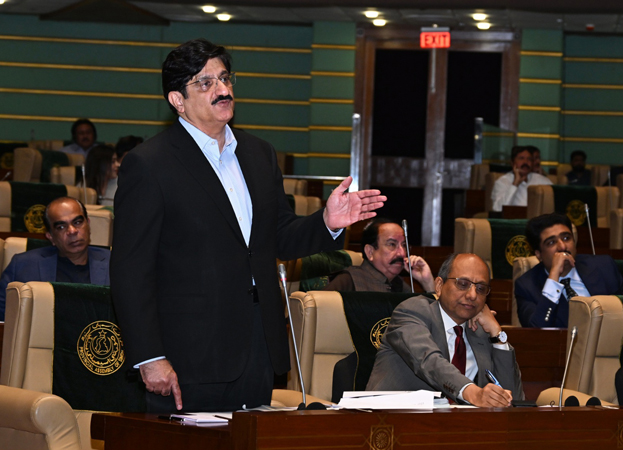
 Sindh Chief Minister Syed Murad Ali Shah reaffirmed his government’s commitment to protecting Karoonjhar Hills, declaring it a cultural and environmental asset of the province.
“Karoonjhar is our treasure; we will not allow any damage to it,” he said while speaking to the media just after addressing a gathering of education leaders, healthcare experts, policymakers, and industry representatives at an event organised by the Sindh Higher Education Commission (Sindh HEC) on the theme “Sustaining Healthcare Gains through Policy Innovation at a local hotel.
Drawing parallels with past criticism of Thar Coal, the chief minister said, “People used to raise similar objections 10 to 15 years ago. Today, Thar has transformed Pakistan and is helping power the nation. We are producing affordable electricity from Thar coal, and the entire country is benefitting.”
Mr Shah said the government respected the ancient and historical significance of Karoonjhar and would not compromise on its preservation. “Anyone creating hurdles in the path of development will be convinced through dialogue,” he added.
27th Constitutional Amendment: Responding to questions about the proposed 27th Constitutional Amendment, Chief Minister Murad Ali Shah stated that constitutional amendments are a normal global practice. “Parliaments across the world amend constitutions and laws as societies evolve. I do not know what the specific objections are this time,” he remarked.
Murad Shah said the newly created Federal Constitutional Courts were not new judges but senior judges from the Supreme Court and High Courts. “These courts will reduce the burden on regular courts and ease difficulties for ordinary litigants. Thousands of cases were pending. I don’t understand why some lawyers oppose this convenience.”
Mr Shah emphasised that he holds the legal fraternity in high regard. “My late father, Abdullah Shah, was also a lawyer. I grew up observing senior lawyers emphasise that arguments, not protests, convince people. Unfortunately, this has changed.”
The CM criticised road closures and street protests by some lawyers, saying, “Coming out on the roads and causing inconvenience to citizens is not acceptable. If lawyers want to talk to the government or Parliament, they are welcome. Or they may take the matter to court. I am always ready for dialogue, whoever wants to come to the CM House can come.”
PPP’s Role in Dialogue: Chief Minister Murad Shah said PPP Chairman Bilawal Bhutto-Zardari had played a key role in creating a conducive environment for discussion on the 26th and now 27th amendments. “There will be no secret amendments. Everything will come openly before the public,” he assured. He added that while discussions had taken place, the draft of the 27th Amendment had not yet reached him formally. “We are under no pressure. We will work with MQM-P to improve the law.”
NFC Award: Regarding the National Finance Commission (NFC), the Chief Minister clarified that the Prime Minister had not yet discussed any NFC-related matters with him. “The first meeting of the NFC is on December 4. All four provinces and the federation work together on the NFC. Provinces present their positions; the PM’s role comes later.”
Murad Shah explained that the NFC Award is finalised by the Commission and then sent to the President of Pakistan. “We take guidance from the Prime Minister, our party leadership, and experts, but the decision is ultimately made by the National Finance Commission.”
Public-Private Partnership: Mr Shah highlighted the Sindh government’s strong performance in public-private partnerships (PPP). “PPP combines private sector expertise with government resources. We want more private investment. With 20 per cent public investment, we can execute five times more projects. This is smart governance.”
Sindh chief reiterated that objections regarding constitutional courts and amendments should be addressed through legal forums. “Those whose job is to give arguments should avoid actions that cause public inconvenience. If anyone wants to challenge something, they should do it constitutionally.”
Sindh Higher Education Commission: Addressing a seminar by Sindh HEC, Chief Minister Murad Ali Shah highlighted the need for evidence-based policies, public-private partnerships, and skilled professionals to further Sindh’s healthcare sector. He appreciated the creation of the Directorate of Strategic Planning at Sindh HEC and its initiative to form thematic think tanks that will develop practical recommendations for policy reforms across healthcare, education, and other sectors.
Mr Shah emphasised that his government is committed to considering such recommendations, underscoring the importance of research and data in decision-making. He praised Sindh HEC for building research linkages and fostering collaboration between universities, industry, and healthcare, noting progress in areas like maternal and child health, advanced care, and medical technology.
He also outlined three priorities for continued progress: evidence-based decision making, human resource development and leadership, and collaboration between education, healthcare, industry, and technology partners. The chief minister expressed confidence that upcoming thematic think tanks would generate informed, practical, and forward-looking policy solutions, aiming to build a resilient and people-centred healthcare ecosystem for Sindh.