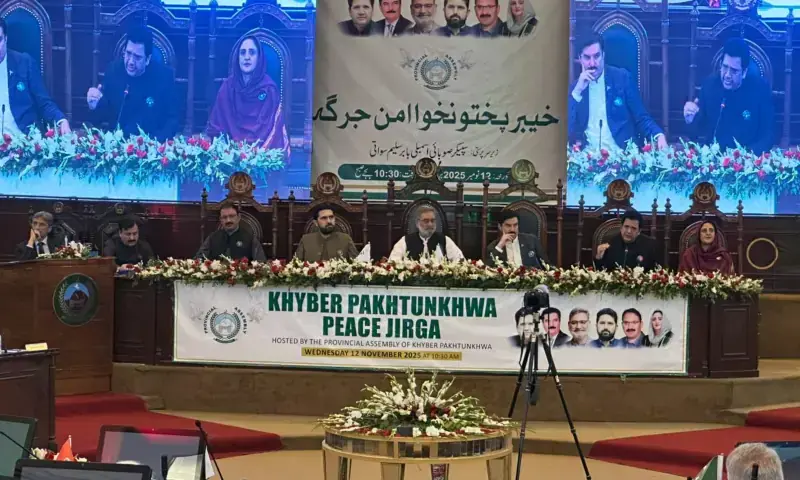
PESHAWAR: Khyber Pakhtunkhwa (KP) has witnessed a series of jirgas over recent months aimed at addressing the province’s deteriorating law and order situation, yet analysts say tangible improvements remain elusive.
Unlike previous gatherings, the KP Peace Jirga convened by the provincial government on Wednesday at the provincial assembly was attended by all political parties, marking a rare display of unity. Earlier events were often marred by political rivalries and boycotts. In December last year, for example, a jirga convened by KP Governor Faisal Karim Kundi was boycotted by the ruling Pakistan Tehreek-i-Insaf (PTI), which accused the Pakistan Peoples Party of working with the federal Pakistan Muslim League-Nawaz government to undermine it.
Read More: KP jirga demands Centre prioritise talks, consult province on Afghan
Over subsequent months, as terrorism and violence worsened, both government and opposition parties announced multi-party conferences and regional jirgas, yet none produced a unified strategy on security. In July, then-CM Ali Amin Khan Gandapur convened a multi-party conference, but major parties, including JUI-F, ANP, and PPP, boycotted it, calling it an “eyewash.” Meanwhile, various parties held their own tribal jirgas in Swat, Bajaur, and Kurram.
After assuming office, CM Mohammad Sohail Afridi held another peace jirga, this time well-attended by all parties. However, experts caution that the gatherings alone are unlikely to change the ground situation.
Veteran nationalist politician Afrasiab Khattak said jirgas have emerged as a response to a malfunctioning government system, providing a platform for pressure-building and public venting but lacking enforcement power. He highlighted that regional and international conflicts could further complicate KP’s security landscape if federal and provincial governments fail to coordinate effectively.
Read More: KP peace jirga calls for power shift: Police to lead, provinces to consult
Dr. Faizullah Jan, a journalism professor at the University of Peshawar, criticized the reliance on jirgas, noting they have no constitutional or legal authority and cannot implement decisions without police or army support. Nonetheless, he acknowledged their value in offering an outlet for alternative perspectives and frustrations.
While the KP Peace Jirga represents a rare show of political unity, analysts say sustainable security improvements require coordinated action by provincial and federal authorities rather than repeated symbolic gatherings.