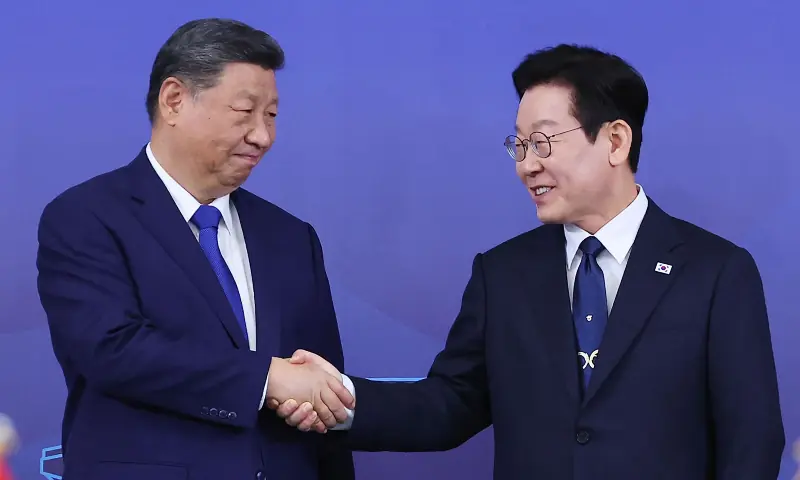
SEOUL — Chinese President Xi Jinping took centre stage at the Asia-Pacific Economic Cooperation (Apec) summit on Saturday, advocating for a global body to govern artificial intelligence and promoting China as an alternative to the United States in trade cooperation.
Xi proposed the creation of a World Artificial Intelligence Cooperation Organisation to establish governance rules and ensure AI serves as a “public good for the international community,” according to China’s official news agency Xinhua. The proposed organisation could be based in Shanghai. The US, which did not attend the leaders’ summit, has rejected efforts to regulate AI through international bodies.
Read More: Xi takes spotlight at APEC summit after trade truce with Trump
The Apec summit, hosted by South Korea, brought together 21 nations representing half of global trade amid rising geopolitical tensions and economic strategies, including US tariffs and China’s export controls. Xi also urged the bloc to promote the “free circulation” of green technologies, an area dominated by China, including batteries and solar panels.
Leaders from 21 APEC member economies have issued the Gyeongju Declaration, concluding the 2025 APEC Economic Leaders’ Meeting chaired by President Lee Jae Myung of the Republic of Korea.
Read declaration here: https://t.co/LP0bHW7FOr pic.twitter.com/RBmt61MPYA
— APEC Secretariat (@APEC) November 1, 2025
During the summit, leaders adopted a joint declaration emphasizing trade resilience and shared benefits. Analysts noted the absence of multilateralism and WTO references in the declaration, signaling a shift in the global trade order. Xi also announced that China will host the 2026 Apec summit in Shenzhen, highlighting the city’s evolution from a fishing village to a manufacturing hub.
Read More: South Korea turns to China for help in engaging North Korea
Separately, South Korean President Lee Jae Myung requested China’s support to resume dialogue with North Korea. The two leaders signed seven agreements, including a bilateral currency swap, emphasizing regional stability and strengthened economic cooperation between the two countries.